
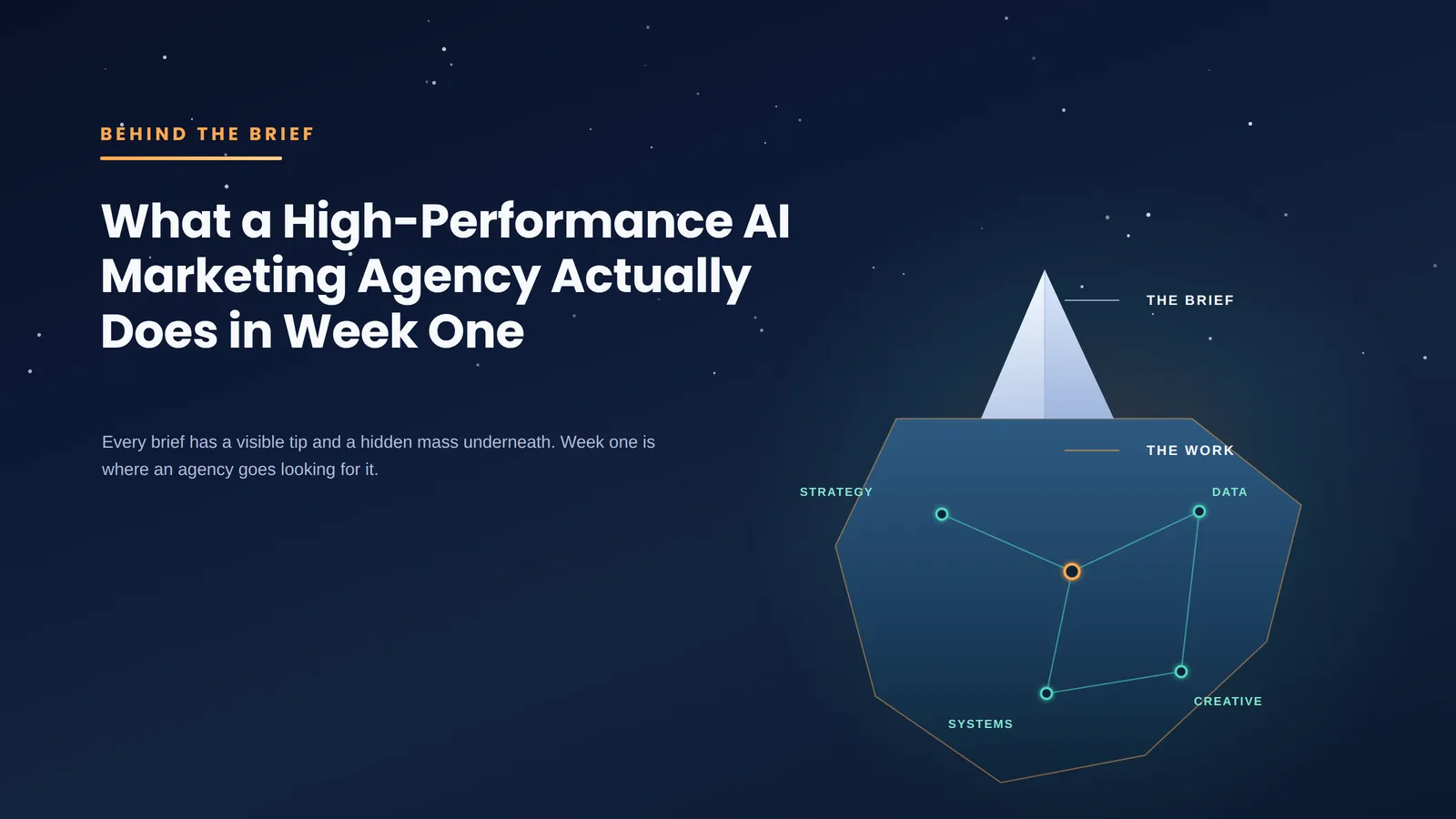
Most agency kickoffs move too slowly because everyone treats the brief as a handover document. A high-performance AI marketing agency treats it as a hypothesis that needs pressure testing before a single campaign goes live. Week one decides whether the engagement becomes a growth system or a queue of disconnected tasks.
Table of Contents
The Brief Is Not Accepted at Face Value
A useful brief tells you what the client believes. It does not always tell you what the market will reward.
That is why the first job is not campaign planning. It is interrogation. The agency has to separate business truth from internal shorthand. “We need more leads” can mean weak traffic, poor offer-market fit, slow sales response, weak qualification, bad CRM hygiene, or a board-level pipeline gap dressed up as a marketing problem.
In week one, the agency should ask uncomfortable questions before it asks for creative assets:
• Which accounts are worth pursuing?
• Which products carry the strongest margin?
• Which segments close quickly but churn early?
• Which sales conversations keep getting stuck?
This is where many average agencies lose the plot. They accept the stated goal, pick familiar channels, and start producing activity. The better team pauses long enough to define what “better” means for the business.
A simple example: a SaaS company may ask for LinkedIn ads to increase demo bookings. The first audit might show that paid traffic is not the main issue. Demo requests already exist, but half of them come from poor-fit companies and the CRM marks them all as equal. In that case, more budget only makes the problem louder.
Week one should expose that before money moves.
Week One Starts With Revenue Logic, Not Channel Planning
Digital marketing becomes wasteful when teams plan from channels backward. “Let’s do SEO, LinkedIn, email, and retargeting” sounds complete, but it skips the commercial sequence.
A stronger agency starts with revenue logic. Who needs to be influenced? What do they already believe? What trigger makes them search, compare, or respond? What signal tells sales that a buyer is ready for outreach?
Only after that does channel planning make sense. For B2B, the path often includes multiple buying roles, delayed intent, and quiet evaluation. The person clicking an ad may not be the person approving spend. The person reading a technical article may be shaping the shortlist months before a vendor call.
That is the kind of operating cadence an high-performance AI marketing agency needs before it recommends channels, budgets, or creative volume.
In week one, the agency should map the buying motion in plain language not as a pretty funnel diagram, but as decisions:
• A founder cares about payback.
• A sales leader cares about lead quality.
• A product marketer cares about differentiation.
• A finance stakeholder cares about waste.
If the campaign speaks to only one of them, performance will look random.
The first week should also force agreement on definitions. A qualified lead should not mean “someone filled out a form.” An engaged account should not mean “someone visited the site.” These definitions shape targeting, reporting, and budget decisions. Loose definitions create confident dashboards with very little business value.
AI Is Used to Find Judgment Gaps, Not Replace Judgment
The weakest version of AI marketing is faster content and automated reporting. Speed helps, but speed without judgment creates polished noise.
In week one, AI should help the agency see patterns faster. It can:
• Cluster search queries
• Summarize sales calls
• Compare landing page messages
• Analyze CRM notes
• Group accounts by firmographic traits
• Spot differences between high-quality and low-quality opportunities
The human work is deciding what those patterns mean.
For example, an agency might feed anonymized sales call notes into an analysis workflow and find repeated objections around integration effort. A junior team may turn that into a blog topic. A stronger team asks why the objection exists. Is the landing page too vague? Are ads attracting the wrong technical profile? Is sales explaining implementation too late?
The answer may change the campaign structure.
AI is also useful for negative discovery. It can show which messages sound similar across the market. If every vendor says “automate workflows” and “increase efficiency,” the agency needs sharper language. Week one is the time to find that weakness, not after three months of creative testing.
Still, AI should not get the final vote. It does not know the politics of a buying committee. It does not know why a founder rejects a channel because of one failed campaign two years ago. It does not know which sales rep updates the CRM carefully and which one treats it as admin work.
The agency has to combine machine speed with field judgment. That combination is the real advantage.
The First Audit Looks for Operating Bottlenecks
Week one should include a hard look at the marketing operating system, a critical step for B2B growth. Campaigns fail for boring reasons more often than strategic ones.
Tracking is broken. Lead stages are unclear. Ad accounts have messy naming conventions. Landing pages ask for too much too soon. Sales receives leads without context. Content attracts students, job seekers, or competitors instead of buyers. Reporting celebrates traffic while revenue teams complain about quality.
None of this sounds exciting. All of it affects performance.
A serious agency will inspect the handoffs:
• What happens after a form fill?
• How quickly does sales respond?
• What information is passed with the lead?
• Which fields are mandatory? Which events are tracked?
• Which campaigns influence pipeline but never get credit?
This is where week one can protect the client from false conclusions.
Imagine a cybersecurity startup running search ads for high-intent keywords. Conversions look weak. The easy answer is to rewrite ads or pause keywords. But the audit shows that the landing page loads slowly on mobile, the demo form asks for too much information, and conversion tracking misses calendar-booked demos.
The campaign may not be failing. The measurement and conversion path may be failing.
That distinction matters. Without it, the agency starts optimizing the wrong layer.
The first audit should end with a short list of constraints not a huge document, but a clear view of what blocks performance now, what can be fixed quickly, and what requires a deeper build.
The Team Builds the First Feedback Loop Before Launching
A high-performance agency does not wait until the monthly report to learn. It sets the learning loop in week one.
That loop should define what will be reviewed, how often, and by whom. It should connect marketing activity with sales feedback, pipeline movement, and account-level behavior. Otherwise, the team only learns what platforms choose to report.
The first feedback loop can be simple:
1. Review ad search terms twice a week.
2. Check lead quality with sales after every batch of demo requests.
3. Compare page engagement by account fit, not just traffic source.
4. Review lost opportunities for messaging patterns.
5. Watch which content topics appear in active deal conversations.
The point is not to create more meetings. The point is to shorten the distance between market response and campaign decisions.
This is especially important for AI-assisted work. AI can generate more variations than a human team can reasonably review. Without a feedback loop, variation becomes clutter. With a feedback loop, the team can decide which messages deserve more budget and which ideas should be killed early.
Week one should also define decision rights. Who approves creative? Who can pause spend? Who decides when a lead source is poor quality? Who owns the offer? Many campaigns slow down because nobody agreed on authority before launch.
A good kickoff makes those decisions visible.
Why Week One Should Feel Slightly Uncomfortable
A pleasant kickoff is not always a productive kickoff. If everyone leaves with the same assumptions they brought in, the agency probably did not dig deep enough.
Week one should create some friction. The agency may challenge the target audience. It may question whether the requested channel matches the sales cycle. It may point out that the website speaks to features while buyers care about risk. It may show that the company’s best customers do not match the audience the team has been chasing.
This friction is useful when it stays tied to evidence.
Bad Friction vs. Good Friction
Bad friction sounds like opinion. Good friction sounds like:
• “Your brief says mid-market companies, but your best closed-won deals share a different pattern.”
• “Your paid campaigns optimize for form fills, but sales accepts only a small share of those leads.”
• “Your content ranks for broad topics, but the pages do not support buying decisions.”
That kind of challenge saves months.
The client also has work to do. They need to share sales context, not just brand guidelines. They need to explain which customers are profitable, which deals drain the team, and which promises the product can actually keep. An agency cannot build a serious growth system from surface-level inputs.
The best week-one work feels less like onboarding and more like diagnosis.
The Real Signal Is the Quality of Questions
A high-performance AI marketing agency does not prove itself in week one by producing the most assets. It proves itself by asking sharper questions, finding hidden constraints, and building a plan that connects campaign activity to revenue reality.
The brief still matters. It gives the work a starting point. But the agency’s job is to look behind it, test the assumptions, and turn scattered inputs into a system that can learn.
If week one feels too easy, the work may not be deep enough yet.

Vandana is a Content Writer and Digital Marketing Executive with 1+ years of experience in SEO content writing, website content, and digital marketing. She specialises in creating engaging, SEO-friendly content, keyword research, and content planning to help brands improve their online presence and audience reach.