Digital Marketing Training

Top 5 Digital Marketing Training Institutes in Haryana (2026 Guide)

Top 5 Digital Marketing Training Institutes in Haryana (2026 Guide)

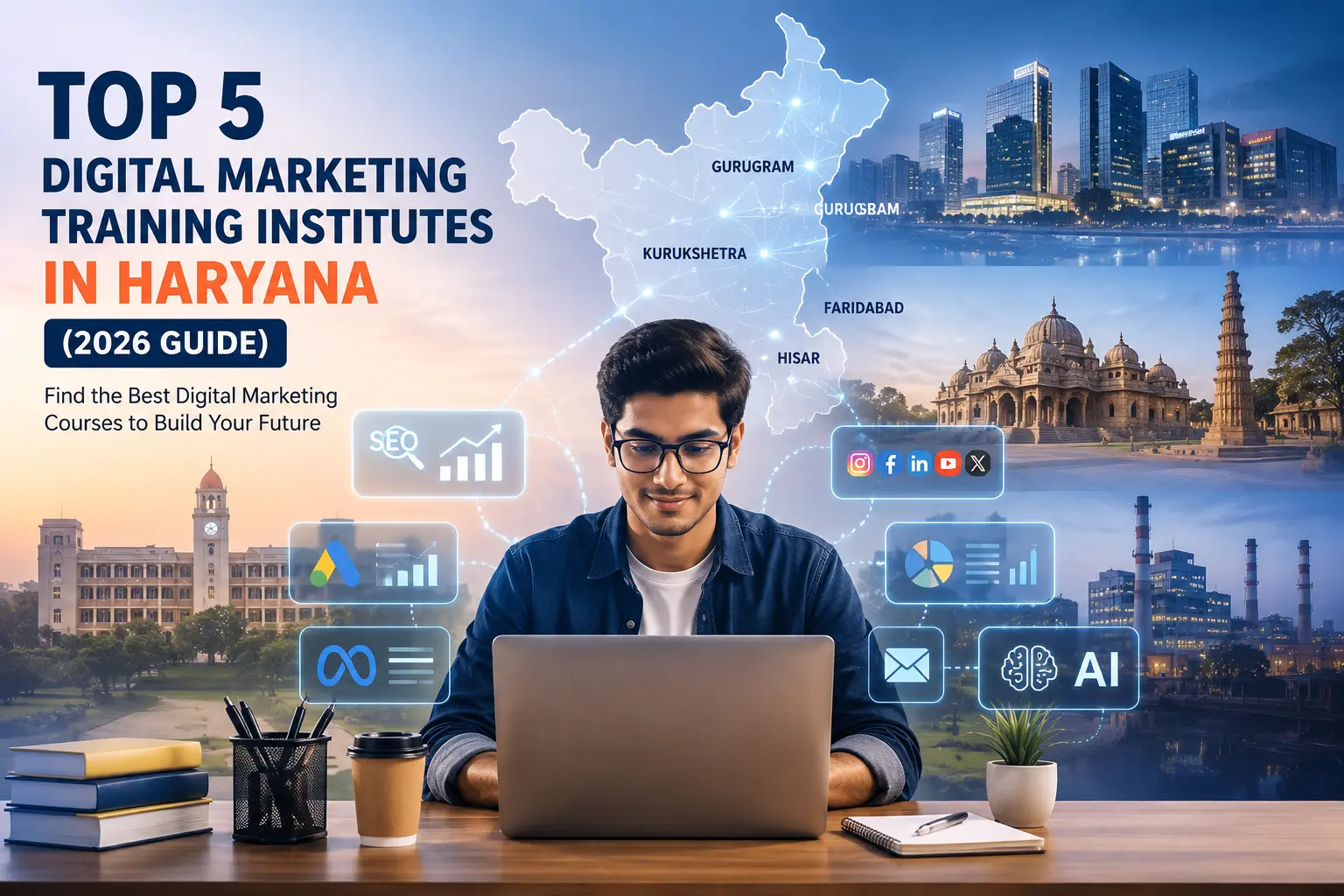
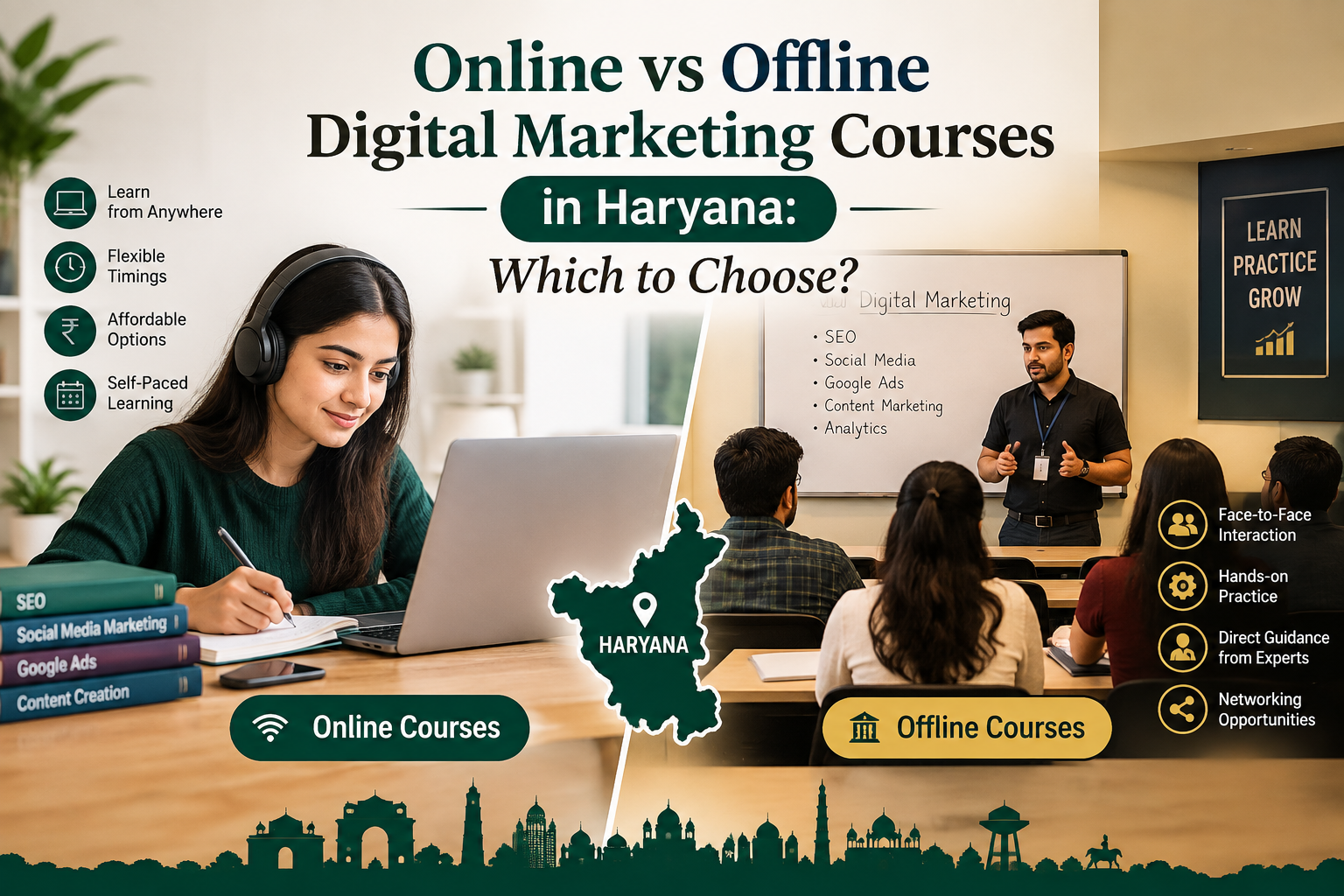
Haryana has quietly become one of the digital marketing centres in North India. Gurugram now serves as a branch office for hundreds of companies and new businesses, while cities like Kurukshetra, Faridabad, and Hisar are also seeing more local companies go online. If this really indicates something, it indicates that real professionals in the field of SEO, social media, advertising, and other aspects of digital marketing have become quite valuable nowadays. In case you used the phrase “digital marketing institute near me” on Google even once, you probably faced this situation. That is really the problem this guide is trying to solve. Here is a list of the top 5 digital marketing training institutes in Haryana, compiled after taking into account course content, city locations, areas of focus, and authentic feedback from students and industry professionals. Maybe you are a graduate, wanting to build a career in digital marketing with a focus on jobs. Maybe you own a business and prefer to run your own campaigns rather than hire someone else to do it. Or maybe you’re a homemaker looking for a flexible, skill-based income-earning opportunity. No matter the reason, this list should help you make a choice. Why Digital Marketing Skills Matter in Haryana Right Now Haryana isn’t one uniform market. You’ve got manufacturing towns like Faridabad and Panipat, agricultural belts around Kurukshetra and Hisar, and then Gurugram’s tech-and-corporate sprawl sitting in the middle of it all. What ties these very different regions together today is simply the internet.  Local shops, real estate agents, coaching centres, clinics, even small manufacturers and artisans — they’re all figuring out that a decent online presence brings in more business than a newspaper ad or a banner ever did. That shift has created two kinds of demand at once. Businesses need a digital marketing agency they can trust to manage their visibility, run ad campaigns, and bring in leads. And on the flip side, there’s a growing number of students and professionals who’d rather learn the skill themselves — either to get hired by those same agencies or to freelance and consult on their own terms.  That’s really why the search for a good digital marketing training institute has picked up so much across the state. Before getting into the actual list, it’s worth pausing on what you should be looking for in the first place. Online Digital Marketing vs Offline Digital Marketing Training One of the first calls you’ll have to make is the format: online or offline. Online digital marketing courses have exploded in popularity for obvious reasons — you can learn from anywhere, fit classes around a job or college timetable, and it’s usually cheaper since the institute doesn’t need to run a physical batch. Live sessions with recordings, screen-shared tool demos, digital assignments — done properly, this can feel just as good as sitting in a classroom. Offline digital marketing training still has plenty of takers, though, especially students who want face-to-face mentorship, hands-on lab time, and the routine of a fixed schedule. There’s also something to be said for the peer network you build in a physical batch, which can turn into referrals and collaborations down the line. Many universities in the state of Haryana, some of which are mentioned in this list, offer both modes at the same time so you do not have to make a choice. To be truthful, neither option is better than the other. What actually counts more is the quality of the programme, the trainer’s experience in the industry, and whether you have the opportunity to practise what you have learnt or only listen to lectures. What Actually Makes a Course “Job-Oriented” Almost every institute claims to offer “placement assistance”. That phrase alone doesn’t mean much. A genuinely job-orientated digital marketing course usually has a few things in place: Live projects – engaging in authentic client projects or realistic simulated campaigns, and not just textbook case studies. Tool certifications – actual hands-on experience with Google Ads, Google Analytics, Meta Business Suite, SEO tools, and email marketing tools. Interview preparation – preparation for mock interviews and portfolio building, along with LinkedIn improvement.  A short internship, even an unpaid one, which still adds real experience to a fresher’s resume. A curriculum that’s been updated recently, since this field moves fast enough that a two-year-old syllabus is already stale. And small batch sizes, so a trainer can actually look at your work and give feedback instead of just moving through slides. Keep that mental checklist handy while reading through the profiles below — it’ll help you judge which institute genuinely fits what you want out of your career, rather than just going with whoever has the flashiest ad. Top 5 Digital Marketing Training Institutes in Haryana Here’s the curated list of the Top 5 Digital Marketing Training Institutes in Haryana, spanning Kurukshetra, Gurugram, Faridabad, and Hisar — so wherever you’re based, there’s likely a credible option close by. 1. Digimaniac Digimaniac has become one of the more recognisable names in Kurukshetra whenever someone searches for a digital marketing agency or a place to actually learn the craft. Started in 2020 by Akshit Rana and Nizu Sachdeva, it runs as both a working agency and a training institute at once — which means students often get to watch, and sometimes even contribute to, real client work instead of only classroom simulations. A few things worth knowing: the courses cover SEO, Google Ads, social media marketing, and content strategy, along with related creative skills like graphic design and video editing. Because it’s agency-plus-institute, students get a closer, more honest look at how campaigns actually get planned, run, and measured – not the sanitised textbook version. The training leans heavily toward practical, job-orientated digital marketing education rather than pure theory. And for anyone in Kurukshetra, it’s a genuinely rare local option — the alternative used to be a long trip to Chandigarh or Delhi NCR. The founders have also discussed pushing further into AI-powered marketing and data

Top 5 Digital Marketing Training Institutes in Haryana (2026 Guide) Read More »

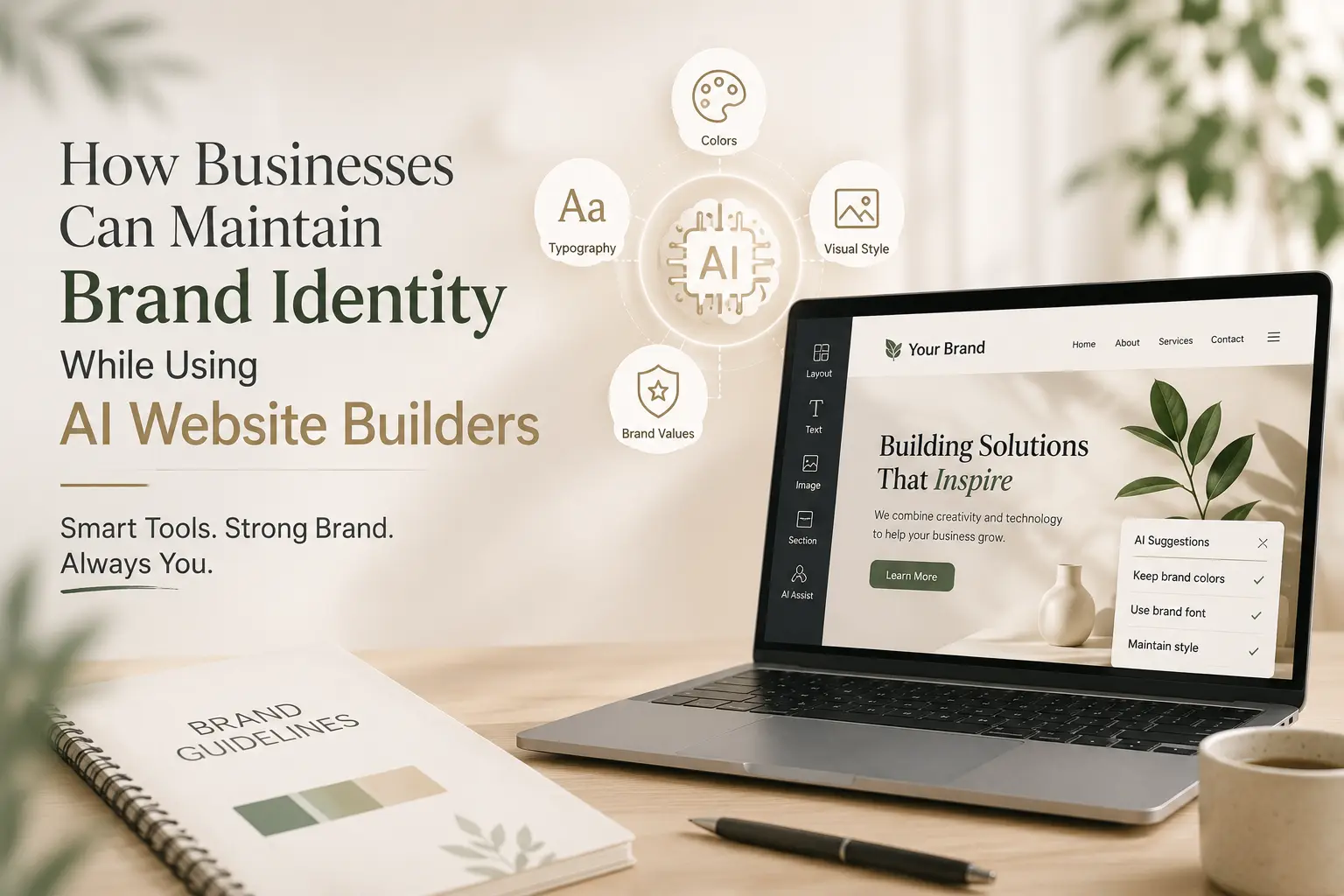
How Businesses Can Maintain Brand Identity While Using AI Website Builders

How Businesses Can Maintain Brand Identity While Using AI Website Builders

Engineers building a business presence operate under strict deployment schedules. Many teams leverage leading no-code builders in web hosting to push infrastructure live without lengthy development cycles. Speed is the goal, but branding often suffers from the generic output of these systems. True technical authority emerges only when you override automated defaults with your design system, precise editorial rules, and custom visual assets that represent your company’s actual standards. The underlying infrastructure defines your website’s operational lifespan and client reliability. When evaluating the best ecommerce website builder in India, ignore marketing claims about ease of use and focus on the depth of the configuration layer. A professional storefront needs to map directly to your backend architecture. Avoid platforms that restrict direct code injection or deep CSS control; these limitations prevent your website from scaling and force you to accept a rigid, templated layout. The Operational Reality of Automated Design Automation handles the routine assembly of your website, but your team must dictate the architectural intent. Treating traditional website builders’ output as a final product guarantees a generic, unmemorable presence. View the generated website as a basic wireframe; your task is to reduce the predictable bloat and inject the specific elements that define your company’s professional signature. Force the interface to adhere to your constraints. If the system suggests a layout that ignores your typography, hex values, or visual rhythm, discard it. Every decision within the builder should be manual and intentional. Professional websites are built through deliberate fine-tuning, not by settling for some pre-packaged templates. Your input provides the only real authority in the final product. Countering Template Uniformity Standard templates rely on common structural patterns that signal low technical effort. Visitors catch on to generic layouts instantly, and they immediately dismiss the website as unrefined. Your goal is to eliminate this modular aesthetic to ensure your brand appears as a custom, high-intent engineering project. Insert proprietary assets everywhere. Replace every instance of stock media with original, operation-focused photography. Audit the underlying CSS padding and margin settings; traditional website builders often include excessive white space that destroys mobile load efficiency. When you customize the structural spacing and asset placement using an AI website builder, you transform a generic template into a bespoke digital asset. Precision Engineering for Website Content Machine-generated text is famously verbose, safe, and lacking in technical nuance. This writing style flags your website as unprofessional to any expert visitor. You must audit every text block for technical integrity. Delete the filler phrases that clutter the UI and replace them with your internal terminology and project-specific context. Professional websites require precise configuration, not reliance on restrictive, pre-built templates. Precision in your communication mirrors the technical precision of your services. If a paragraph does not contribute directly to the user’s understanding of your engineering capabilities, it represents a net loss to your brand identity. Technical Foundations and Uptime A high-fidelity design becomes irrelevant if the backend architecture fails to minimize latency. Slow page loads signal operational neglect to any serious user. You need hosting environments that favor raw throughput and hardened security settings over simple convenience. MilesWeb provides the essential infrastructure and a versatile AI website builder to keep your business operational at all times. A sluggish website drives high bounce rates and immediate lead degradation. Monitoring server latency reveals the true quality of your hosting. Your hosting setup tells visitors exactly how seriously you take your business. Pick a provider that stays up and runs fast, or expect them to look elsewhere. AI Website Builder for Unified Touchpoints Brand inconsistency compromises the user experience. If your website, socials, and emails don’t speak the same language, people lose trust in your work. Align your visuals and tone everywhere so your brand actually looks like it knows what it’s doing. Every digital asset functions as a core node in your network. The transition between an email campaign and your website must feel like a continuous technical experience. Enforce strict, non-negotiable design rules for all your digital outputs. Professionalism is not a broad concept; it is the rigid, disciplined consistency applied to every pixel and paragraph you publish. Iterative Development Protocols Deploy your website as a minimum viable build to verify core logic and user flow. Use raw traffic metrics, not guesses, to dictate your next design adjustments. Do not assume your initial layout serves the user intent effectively; verify that intent through data.  Request your team to evaluate the messaging and communication so you can see what isn’t working. If a design element fails to drive growth, remove it. Base your strategy on actual data, not just whatever “look” is popular this week. Maintaining Technical Ownership True ownership requires control over your domain’s internal architecture. Outsourcing layout decisions to a builder’s algorithm surrenders your brand narrative to a third party. Take ownership of structural decisions.  View the builder as a simple, temporary framework. The final product should demonstrate your specific engineering intent. Protecting your interface from generic, algorithm-driven bloat is the primary responsibility of a website administrator. Ensure your digital footprint remains an accurate, hardened extension of your company’s internal engineering standards. Concluding Insights Combining the efficiency of an AI builder with your manual refinements allows you to maintain a professional standard where your expertise dictates every design choice. By partnering with MilesWeb for your infrastructure, you effectively remove the technical overhead from your daily operations, allowing your team to reclaim time for high-value development. Your reputation doesn’t come from a polished front end alone. It comes from the fact that you own the whole thing—you’re the one in charge of how the servers run, how the data stays secured, and why every pixel on the screen is precisely where it is. Akshit RanaAkshit Rana is the Co-Founder of Digimaniac and a performance marketing professional with around 7 years of experience in digital advertising and growth strategies. He specializes in performance marketing, paid campaigns, and helping businesses improve online visibility and lead generation.

How Businesses Can Maintain Brand Identity While Using AI Website Builders Read More »

Why Consistency Matters in Digital Marketing Campaigns

Why Consistency Matters in Digital Marketing Campaigns

Ever wondered how some businesses rank on top while others disappear in this digital crowd? The answer often comes down to one thing: consistency. Many businesses invest in website development services and digital marketing, create a few social media posts, publish some blog articles, or run ads for a short period. When they do not see instant results, they slow down or stop their efforts altogether. The problem is that digital marketing rarely works that way. Whether it is SEO, content marketing, social media, email campaigns, or paid advertising, results often come from doing the right things regularly over time. The most successful digital marketing campaigns are built through ongoing effort rather than one-time activities.  Let’s look at why consistency plays such an important role in digital marketing campaigns and how it can contribute to long-term business growth. Builds brand recognition and trust People prefer recognisable brands. Using the same voice, images, and messaging across all your digital marketing campaigns will make your business easy to remember. Keep it going consistently. Big brands use this by keeping their logos, colors, and messaging uniform no matter where you see them on social media, websites, ads, or emails. This works for small businesses too. A consistent brand presence makes customers feel good about interacting with the business and strengthens trust over time. Keeps your audience engaged Staying active helps keep your audience interested. Businesses that regularly post content on their social channels and provide valuable, ongoing content are more likely to keep followers engaged. It shows they value communication and are a trustworthy business worth following. On the other hand, if a company does not post content for a lengthy period, it could lead to followers losing interest in the page or even forgetting about the brand. Consistent online marketing efforts keep your business visible and help maintain ongoing relationships with potential customers. Search engines reward ongoing efforts Search engine optimization (SEO) is one of the best examples of why consistency matters. SEO rarely delivers immediate results. Search engines evaluate websites over time based on content quality, relevance, user experience, and authority. Businesses that regularly publish helpful content and maintain their websites often see better long-term performance. Publishing a few articles and then stopping for months usually does not produce the same results as maintaining a steady content schedule. Consistent SEO efforts can include: Creates a better customer experience Customers interact with businesses through multiple channels. They may visit a website, read blog content, check social media pages, and subscribe to emails before making a decision. When the messaging, tone, and branding remain consistent across these channels, the experience feels smooth and professional. Customers have a clear idea of what they are going to get and find it easy to understand what the company provides.  Lack of good communication, on the other hand, can lead to confusion and be bad for the credibility of the brand.  Supports lead generation and conversions Not every visitor is ready to buy instantly just by scrolling once. Some people may spend days or even weeks researching before making a decision. This may include comparing options, gathering information, and deciding whether a company is the right fit for their needs. Businesses that keep providing useful content gain trust. More trustworthy firms have a better chance of turning visitors into customers in the future. Provides valuable performance insights  One benefit that many businesses overlook is how consistency helps them better understand the performance of their marketing campaigns. When you follow a regular posting schedule or stick to a structured marketing plan, it becomes much easier to identify what is working and what needs improvement. You can spot trends, understand which content resonates most with your audience, and make informed decisions based on real data. If marketing efforts are random or irregular, it becomes much harder to measure which activities are actually driving business growth. Over time, consistent tracking helps businesses make smarter decisions, optimise future digital marketing campaigns, and continuously improve their overall marketing strategy. Consistent Marketing  Inconsistent Marketing  Builds trust and brand recognition over time  Makes it harder for customers to remember your brand  Keeps your audience engaged with regular content  Leads to declining engagement and lost interest  Improves search visibility through ongoing SEO efforts  Limits organic growth due to irregular updates  Generates a steady flow of qualified leads  Results in inconsistent lead generation  Provides reliable data to optimise future campaigns  Makes it difficult to measure what is working  Supports sustainable business growth  Often delivers short-lived or unpredictable results  Delivers long-term business growth Many businesses look for quick wins in digital marketing, but growth is rarely that predictable. Partnering with a reliable digital marketing company helps businesses build consistent strategies that deliver sustainable, long-term results instead of short-term gains. More often, results come from showing up consistently and continuing to invest in activities that help the business stay visible online. A single campaign may create a spike in attention, but consistent marketing helps maintain that visibility over time. It keeps the brand in front of potential customers and creates more opportunities for engagement whenever they are ready to take action.  How to maintain consistency in digital marketing Conclusion Digital marketing usually isn’t about just one hit campaign or a post that does well for a few days. Businesses generally see real results when they keep showing up and interacting with their audience over time. Whether it is publishing content, boosting website visibility, or being active on social media, these regular efforts help companies stay visible and relevant. This consistency also makes it easier for future customers to notice and remember a brand when they’re ready to buy. It also makes it easier for potential customers to recognize and remember a brand when they are ready to make a purchase decision. It may take time for consistency to have an impact, but it does help build momentum. In the long run, these repeated smaller marketing activities will pay off with a stronger brand presence, improved engagement with

Why Consistency Matters in Digital Marketing Campaigns Read More »

What a High-Performance AI Marketing Agency Actually Does in Week One

Behind the Brief: What a High-Performance AI Marketing Agency Actually Does in Week One

Most agency kickoffs move too slowly because everyone treats the brief as a handover document. A high-performance AI marketing agency treats it as a hypothesis that needs pressure testing before a single campaign goes live. Week one decides whether the engagement becomes a growth system or a queue of disconnected tasks. The Brief Is Not Accepted at Face Value A useful brief tells you what the client believes. It does not always tell you what the market will reward. That is why the first job is not campaign planning. It is interrogation. The agency has to separate business truth from internal shorthand. “We need more leads” can mean weak traffic, poor offer-market fit, slow sales response, weak qualification, bad CRM hygiene, or a board-level pipeline gap dressed up as a marketing problem. In week one, the agency should ask uncomfortable questions before it asks for creative assets: •       Which accounts are worth pursuing? •       Which products carry the strongest margin? •       Which segments close quickly but churn early? •       Which sales conversations keep getting stuck? This is where many average agencies lose the plot. They accept the stated goal, pick familiar channels, and start producing activity. The better team pauses long enough to define what “better” means for the business. A simple example: a SaaS company may ask for LinkedIn ads to increase demo bookings. The first audit might show that paid traffic is not the main issue. Demo requests already exist, but half of them come from poor-fit companies and the CRM marks them all as equal. In that case, more budget only makes the problem louder. Week one should expose that before money moves. Week One Starts With Revenue Logic, Not Channel Planning Digital marketing becomes wasteful when teams plan from channels backward. “Let’s do SEO, LinkedIn, email, and retargeting” sounds complete, but it skips the commercial sequence. A stronger agency starts with revenue logic. Who needs to be influenced? What do they already believe? What trigger makes them search, compare, or respond? What signal tells sales that a buyer is ready for outreach? Only after that does channel planning make sense. For B2B, the path often includes multiple buying roles, delayed intent, and quiet evaluation. The person clicking an ad may not be the person approving spend. The person reading a technical article may be shaping the shortlist months before a vendor call. That is the kind of operating cadence an high-performance AI marketing agency needs before it recommends channels, budgets, or creative volume. In week one, the agency should map the buying motion in plain language  not as a pretty funnel diagram, but as decisions: •       A founder cares about payback. •       A sales leader cares about lead quality. •       A product marketer cares about differentiation. •       A finance stakeholder cares about waste. If the campaign speaks to only one of them, performance will look random. The first week should also force agreement on definitions. A qualified lead should not mean “someone filled out a form.” An engaged account should not mean “someone visited the site.” These definitions shape targeting, reporting, and budget decisions. Loose definitions create confident dashboards with very little business value. AI Is Used to Find Judgment Gaps, Not Replace Judgment The weakest version of AI marketing is faster content and automated reporting. Speed helps, but speed without judgment creates polished noise. In week one, AI should help the agency see patterns faster. It can: •       Cluster search queries •       Summarize sales calls •       Compare landing page messages •       Analyze CRM notes •       Group accounts by firmographic traits •       Spot differences between high-quality and low-quality opportunities The human work is deciding what those patterns mean. For example, an agency might feed anonymized sales call notes into an analysis workflow and find repeated objections around integration effort. A junior team may turn that into a blog topic. A stronger team asks why the objection exists. Is the landing page too vague? Are ads attracting the wrong technical profile? Is sales explaining implementation too late? The answer may change the campaign structure. AI is also useful for negative discovery. It can show which messages sound similar across the market. If every vendor says “automate workflows” and “increase efficiency,” the agency needs sharper language. Week one is the time to find that weakness, not after three months of creative testing. Still, AI should not get the final vote. It does not know the politics of a buying committee. It does not know why a founder rejects a channel because of one failed campaign two years ago. It does not know which sales rep updates the CRM carefully and which one treats it as admin work. The agency has to combine machine speed with field judgment. That combination is the real advantage. The First Audit Looks for Operating Bottlenecks Week one should include a hard look at the marketing operating system, a critical step for B2B growth. Campaigns fail for boring reasons more often than strategic ones. Tracking is broken. Lead stages are unclear. Ad accounts have messy naming conventions. Landing pages ask for too much too soon. Sales receives leads without context. Content attracts students, job seekers, or competitors instead of buyers. Reporting celebrates traffic while revenue teams complain about quality. None of this sounds exciting. All of it affects performance. A serious agency will inspect the handoffs: •       What happens after a form fill? •       How quickly does sales respond? •       What information is passed with the lead? •       Which fields are mandatory? Which events are tracked? •       Which campaigns influence pipeline but never get credit? This is where week one can protect the client from false

Behind the Brief: What a High-Performance AI Marketing Agency Actually Does in Week One Read More »

SEO vs Paid Ads

SEO vs Paid Ads: Which One Should You Invest In First?

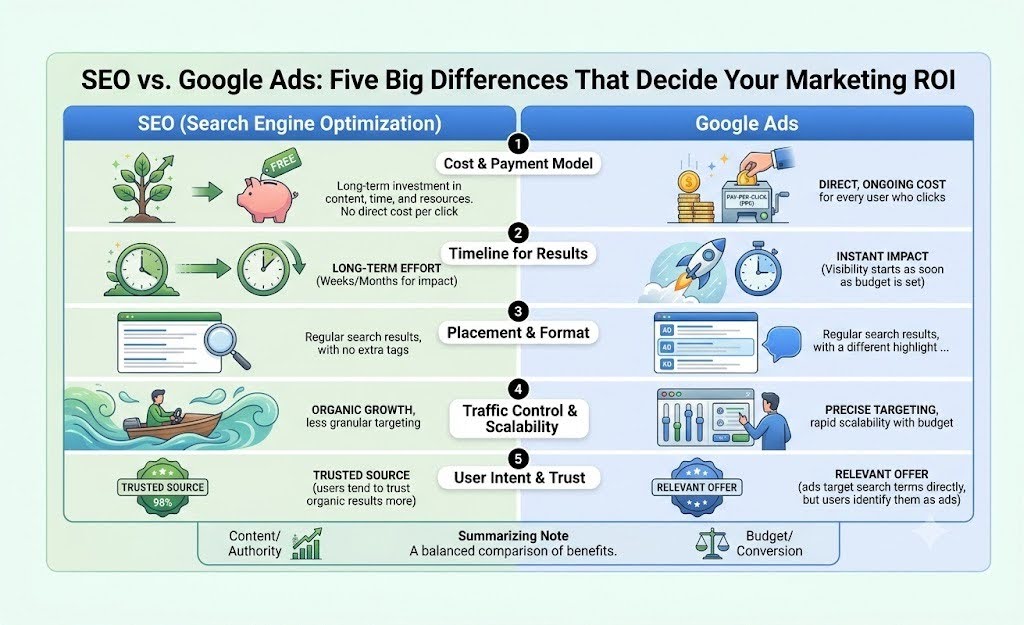
If you’ve ever sat down to plan a marketing budget, you’ve probably hit this exact question — should the money go into SEO or paid ads first? It’s not a small decision either. Get it wrong, and you either burn cash on ads that stop working the day you pause them, or you wait months for SEO to kick in while competitors take the traffic. The honest answer is: it depends on where your business stands right now. SEO builds traffic that compounds over time. Paid ads bring people in immediately, but only for as long as you keep paying. Once you understand how each one actually behaves, the decision gets a lot easier. Why This Decision Actually Matters Here’s what happens when businesses get this wrong. Some pour their entire budget into ads, and the moment spending stops, so does the traffic. Others go all-in on SEO and get frustrated three months in when nothing’s ranking yet. Neither mistake is fatal, but both waste time and money that could’ve gone further with a clearer plan. Most businesses that succeed long-term end up using both — the real question is just which one to lean on first. Key Differences Between SEO and Paid Ads Laying these two side by side makes the decision much less confusing. Factor SEO Paid Ads Cost Over Time Drops as rankings stabilize Stays constant, or rises with competition Time to Results Usually 3–6 months Days, sometimes hours Traffic Longevity Keeps compounding Stops the moment you stop paying Trust Factor Feels more credible to users Recognized as an ad, less trusted Best Fit For Long-term brand building Launches, promotions, quick tests How SEO Builds Long-Term Value SEO is a slow burn, but that’s exactly what makes it valuable. A page that ranks well can keep bringing in visitors for years without any extra spend. It Compounds The traffic doesn’t reset every month like ad traffic does. Once you’re ranking, you’re ranking — until something changes. People Trust It More There’s a reason organic results still get more clicks than ads in most searches. Ranking naturally signals that Google (and by extension, the user) considers you relevant. It Gets Affordable Over Time Yes, SEO needs upfront work — content, technical fixes, sometimes backlinks. But once a page stabilizes in rankings, the effective cost per visitor keeps dropping. If you’re trying to figure out what that upfront investment actually looks like, this breakdown of SEO pricing in Delhi is worth a look before you commit a budget. How Paid Ads Win on Speed Paid ads exist for one reason — speed. You can have a campaign live within the hour, and traffic starts flowing almost immediately. Instant Visibility No waiting for algorithms to catch up. You’re in front of your audience as soon as the campaign goes live. Sharp Targeting You can narrow down by age, location, interests, even past buying behavior — something organic search simply can’t offer with the same precision. Numbers You Can Actually Measure Every rupee spent shows up in the data. Clicks, conversions, cost per lead — it’s all right there, which makes it easy to know what’s working. So, Where Should the Budget Go First? This really comes down to where your business is today. If you’re starting from zero — no traffic, no reviews, no visibility — paid ads buy you time and data while SEO builds quietly in the background. If you’re already established with steady traffic, shifting more budget toward SEO usually pays off, since it reduces your dependence on ad spend over the long run. Competitive industries often need both running at once. A business weighing SEO services in Delhi against a paid ads budget, for instance, will usually get further by using a small ad spend for quick wins while SEO work compounds underneath it. Mistakes That Waste Budget on Both Sides Mistake What’s Actually Happening The Result The Fix Expecting SEO to work like ads Treating SEO as instant Frustration, early quitting Plan for 3–6 months minimum Killing ads with no SEO backup Zero organic presence built Traffic drops to zero overnight Build SEO alongside ad spend Sending ad traffic to weak pages Ignoring the landing page High spend, low conversions Fix the page before scaling ads Running both with no clear goal No defined outcome per channel Budget gets wasted Set a specific goal for each channel Never checking the data Skipping analytics review No idea what’s working Review performance monthly What to Actually Track Metric What It Tells You Why It Matters Organic Traffic Visitors coming from search Shows SEO progress Keyword Rankings Where you sit for target terms Tracks SEO movement over time CTR How many people click your listing/ad Signals relevance CPC Average cost per click Shows ad spend efficiency Conversion Rate People who complete the desired action Measures real effectiveness ROAS Revenue earned per rupee spent Shows if ads are actually profitable Making Both Channels Work Together The businesses that grow fastest rarely pick just one. They typically start with paid ads for quick visibility, then reinvest part of that budget into SEO as it starts gaining traction. Doing It Yourself vs Hiring an Agency Running SEO and paid ads properly — keyword research, technical fixes, campaign management, landing page tweaks, weekly reporting — realistically takes 12 to 22 hours a week. For most small teams, that’s close to a part-time job on top of everything else.The cost math often doesn’t favor going it alone either. A full-time hire strong in both SEO and ads usually costs more than most small businesses budget for marketing. Two freelancers — one for each channel — fix the skill gap but create a coordination gap, since you end up managing two strategies yourself. A team that handles both together tends to earn its cost back through one shared data view and one accountable point of contact. Before committing, ask a few quick questions: Can they show real ranking and ROAS numbers, not just

SEO vs Paid Ads: Which One Should You Invest In First? Read More »

Digital marketing

How Startups & Agencies in Gurugram Are Using AI for Digital Marketing in 2026

Intelligent technologies have a significant role in the fast-changing digital marketing world. By 2026, startups and agencies across Gurugram are expected to be relying on AI Marketing Tools to better understand customer behaviour and get more value out of their marketing campaigns. Gurugram has turned into one of India’s strongest business hubs, and it’s also a place where AI is leaving a real mark on Digital Marketing. Content creation, audience targeting, optimization — AI solutions are reshaping all of it, pushing organizations toward being more efficient and effective. The Growing Role of AI in Modern Digital Marketing AI has changed how businesses think about marketing. Marketers don’t really need to spend hours digging through reports or handling the same repetitive tasks anymore — advanced systems now process huge amounts of data in seconds. There’s a real reason businesses are turning to AI these days — it helps them understand what customers actually want, catch trends before they blow up, sharpen how they run their ad campaigns, and keep their messaging consistent across the board. Bring all of that together, and businesses end up better equipped to make sharp decisions and adapt almost the moment the market moves. Traditional Marketing vs AI-Driven Marketing Aspect Traditional Marketing AI-Driven Marketing Data Analysis Manual process Automated insights Audience Targeting Broad targeting Personalized targeting Campaign Optimization Periodic adjustments Real-time optimization Customer Support Human-based support AI-powered automation Content Planning Manual research AI-assisted recommendations AI was never meant to replace the people doing the marketing — its real job is to sharpen their skills and make the whole process work more efficiently. Why Startups and Agencies in Gurugram Are Investing in AI Gurugram has a very competitive business environment. Every startup or agency is always looking for ways to improve its productivity, lower costs, and create marketing results. This has led to increased adoption of AI in Digital Marketing across multiple industries. Faster Marketing Operations Reporting. Segmenting an audience. Scheduling posts. Tracking how a campaign’s doing. None of these really need a human staring at them for hours, and that’s exactly the work AI has taken over. It tightens up campaigns, automates the routine, and even helps draft content when needed. What teams get back is time — time to actually plan instead of just react, and to use whatever resources they have more wisely. Better Customer Understanding Customers today don’t just want a product — they want it to feel like it was made with them in mind, and AI is what makes that possible at scale. Businesses can look at how people interact, browse, what they’ve bought before, and how they engage over time, and from that build a real picture of what their audience actually cares about. Instead of guessing, startups and agencies can use AI in Digital Marketing to act on real data, which usually translates into a better customer experience and stronger campaign results. The deeper that understanding goes, the more relevant a brand’s campaigns become — better recommendations, stronger relationships, the works. Improved Campaign Performance There’s no need to wait around for a weekly report anymore. AI systems read campaign data as it happens and hand marketers insights in real time. That makes it a lot easier to spot what’s actually working, decide where ad budgets should go, and push engagement higher. Keep refining targeting and optimisation this way, and conversions — along with overall marketing returns tend to follow. Reduced Manual Work Small teams end up doing five jobs at once — that’s just how it works when budgets are tight. AI takes over a fair bit of the repetitive load: reports, lead qualification, email sequences, replying to customers, and watching campaigns run. That’s hours given back, hours that go into growth, into actual relationships with customers, into the kind of planning a machine still can’t do on its own. Top Ways AI Is Transforming Digital Marketing in Gurugram Digital innovation hasn’t slowed down, and AI now touches almost every part of how marketing gets planned and run. Content creation, audience targeting, customer engagement, campaign optimization — businesses are handling all of it more efficiently, with decisions backed by data rather than guesswork. More startups and agencies are adopting AI in Digital Marketing every year, automating the routine stuff, reading customer behavior more sharply, and delivering experiences that actually feel personal. As demand for smarter strategies keeps climbing, more advanced AI Marketing Tools keep showing up too — pushing Digital Marketing in Gurugram toward being more innovative, efficient, and genuinely result-driven. Startups and long-running agencies alike are now using AI for Marketing Agencies to boost productivity, sharpen campaign performance, and stay in the game as the digital landscape keeps shifting under everyone’s feet. AI-Powered Content Creation Content is still right at the center of digital marketing — that hasn’t changed. Keeping up high-quality content on a regular basis isn’t easy, and that’s really the hard part for most teams. AI helps close that gap — generating ideas when a marketer’s stuck, putting together first drafts, and making the whole content planning process feel a lot less chaotic. Common Applications of AI Content Creation  Benefits of AI Content Creation A good chunk of the friction in content production simply disappears once AI tools enter the picture. Production speeds up, messaging stays consistent no matter the channel, and the time that used to disappear into manual planning gets freed up for other things. Publishing schedules also become far less of a hassle to organize — something that really shows over a busy quarter when deadlines start piling up. Smart Audience Targeting If there’s one thing AI has genuinely changed in digital marketing, it’s how precisely businesses can target their audience. Instead of putting a message out there and hoping it reaches the right people, businesses can now lean on AI-driven insights to zero in on exactly who they want to reach — based on interests, online behavior, demographics, and how people have engaged in the past. That’s what lets startups and

How Startups & Agencies in Gurugram Are Using AI for Digital Marketing in 2026 Read More »

Digital Marketing Course in Zirakpur

Best Digital Marketing Course in Zirakpur: Fees, Syllabus & Placement 2026

At the present time, nearly every business is concentrating on online Progress; the need for Internet Marketing has risen drastically. Online Marketing has become a useful skill that can be beneficial for both careers and brands. While selecting the best Internet Marketing course, there are various factors that need to be taken into account, such as course fees, Learning Modules, placement, etc.  Access Our Digital Marketing Course in Zirakpur? The need for digital marketing is expanding quickly in India. The demand for trained professionals is also rising. By observing this problem, we are offering a digital marketing course in Zirakpur. By learning Internet Marketing, they can be prepared to meet new demands and take advantage of new job Career paths in the market. Some reasons to choose this course: Digital Marketing Course Overview Digimaniac Course Details Information Course Name  Digital Marketing Course  Location  Zirakpur  Course Duration  3–6 Months  Learning Mode  Online & Offline  Eligibility  Students, Graduates, Professionals & Business Owners  Training Type  Practical & Live Project-Based  Certifications  Available  Internship Support  Available  Placement Assistance  100 PERCENT PLACEMENT Available  Key Modules  SEO, Google Ads, Social Media Marketing, Content Marketing, Email Marketing, Analytics  Job Opportunities  SEO Executive, PPC Specialist, Social Media Executive, Digital Marketing Executive  Course Fee  Depends on the Season & Course Level  Digital Marketing Course Syllabus 2026 A good Internet Training Program is greatly influenced by its course structure. Clear learning modules help students learn in a structured manner and understand concepts step by step. This helps learners build a stronger understanding of key digital marketing concepts.    Search Engine Optimisation (SEO) In the digital age, people search for information using Online search systems. It is important for any online site to have an online presence for this reason. It is one of the key components. It enhances the visibility of a website and attracts the target audience. SEO can help get more organic visitors to the online platform. and boost its ranking on Internet search tools.   Comparison Between Types of SEO Factor  On-Page SEO  Off-Page SEO  Technical SEO  Local SEO  Focus  Content Optimization  Authority Building  Technical Performance  Local Visibility  Main Goal  Better Rankings  Higher Trust  Improved Website Health  More Local Customers  Traffic Type  Organic Traffic  Referral Traffic  Organic Traffic  Local Traffic  Key Element  Keywords & Content  Backlinks  Site Speed & Indexing  Google Business Profile  Best For  Content-Based Websites  Brand Building  Website Optimization  Local Businesses  Performance Marketing The goal of any business is to meet the needs of more customers with its services and products within a short period. In this context, Google Ads emerges as an effective option. It is useful for organisations to target an audience and to market their products more efficiently. This can help boost online visibility and engagement. Data-driven marketing also helps brands monitor outcomes by measuring conversions and improve marketing strategies for enhanced performance.  Google Ads and Meta Ads both have an important role in Performance Marketing. But there are some differences between the two platforms in audience targeting and ad format. Below is a comparison of the major differences between the two Popular PPC Platforms. Factor  Google Ads  Meta Ads  Platform  Google Search, YouTube, Display Network  Facebook, Instagram, Messenger  Audience Intent  Users actively search for products ya services  Users browse social media while watching ads dekhte hain  Targeting Method  Keywords and search intent-based  Interests, behaviour, and demographics are based  Best For  Lead generation, website traffic, and sales  Brand awareness, engagement, and audience building  Ad Formats  Search Ads, Display Ads, Shopping Ads, Video Ads  Image Ads, Video Ads, Carousel Ads, Story Ads  Customer Journey Stage  Targets high-intent audiences. New audience discover aur engage karne mein help karta hai  Conversion Potential  Generally higher because users are already searching  Strong for awareness and remarketing campaigns  Cost Structure  Mostly Pay-Per-Click (PPC) model  CPC, CPM, and other bidding models  Main Advantage  High-quality leads and purchase intent  Detailed audience targeting and engagement  Ideal Businesses  Service providers, eCommerce, and local businesses  Brands, startups, e-commerce, and content creators  Social Media Marketing In today’s world, online channels have become a main part of people’s daily lives. As a result, companies are also using social media to reach out to their target audience. This allows brands to improve their visibility, build good customer relationships, and increase engagement. This increases awareness of their products and services among more people.  Social Media Marketing Tools  Content Marketing Quality content is a crucial component of This Industry that helps a brand achieve online success. Content planning plays a vital role in this process, as it helps determine what type of content will be useful to the audience. Through blog writing, businesses share their knowledge and build trust with people.  Popular Content Marketing Tools  Email Marketing This is a powerful online marketing strategy that allows businesses to communicate directly with their consumers. Through this method, companies send useful information to their audience. It boosts engagement and builds strong relationships. It improves users’ loyalty, increases conversions, and contributes to overall business Improvement. Google Analytics It is an advanced web analytics tool that helps Companies track website traffic and user behaviour.  This tool allows businesses to detect user origin, create engagement with content, and determine the best pages. Successful utilisation of this data can provide benefits in terms of enhancing marketing strategies and enabling business development. AI Tools and Marketing Automation AI tools have become an integral part of This Industry; consequently, AI-based marketing tools are now being taught in modern courses. They are used to optimise campaigns and manage tasks such as keyword research and data analysis. These Utilities automate repetitive work, save time, and simplify various processes for businesses. Placement Chances After Completing a Digital Marketing Course Completing an Advanced Online Marketing Course opens up numerous career opportunities for students. After finishing the course, they can choose their career option, like SEO, SMM, or Content Marketing, with their acquired Abilities. Plus, they can also apply for positions such as SEO Specialist, Social Media Executive, Content Marketer, and PPC Specialist. SEO Executive Their main focus is on enhancing website ranking

Best Digital Marketing Course in Zirakpur: Fees, Syllabus & Placement 2026 Read More »

7 News Article Removal Agencies

Top 7 News Article Removal Agencies in India

Introduction The online reputation of a brand plays a huge role in how a brand is perceived by its target audience. News articles are one of the digital elements that play a key role in shaping your brand’s online perspective. Outdated, misleading, or taken out of context news articles can linger on search results and damage your brand’s credibility, trust, and reputation.To deal with this situation, many businesses turn towards agencies that offer expert news article removal agencies.  This guide includes the list of the top 7 agencies organizations trust for news article removal services. These agencies have maintained a successful track record for helping their clients protect their digital image, manage their online narrative and maintain a positive presence across search results and media platforms.  Top 7 News Article Removal Agencies You Can Trust News article removal is a part of online reputation management, allowing brands and businesses to protect their reputation, enhance business trust, and reduce visibility of negative content. Let’s take a look at the 7 leading news article removal agencies: RBS Reputation Management It is one of the most reliable news article removal agencies in India, with over 15+ years of experience and a team of 120+ highly professional experts. RBS Reputation uses strategic methods and modern technologies to bring excellent results for its clients. This agency maintains transparency with its clients to earn their trust. It has helped numerous businesses by removing harmful news articles from search engines. RBS Reputation Management helps its clients by shaping their public perception, leveraging its strategic approach and customised removal services. This agency prioritises the privacy of its clients, ensuring every case is handled while maintaining complete confidentiality. The online content removal tactics offered by this agency include the removal of personal data and suppression of negative reviews. The news article removal team at this agency takes down content as quickly as possible to minimize the damage. The services offered by this agency are ROI focused and tailored to match the requirements of each client.  Key Features  Contact Information Repulex It is one of the leading news article removal agencies , dedicated to helping brands build a strong digital footprint in today’s digital landscape. With years of experience and a team of highly professional reputation repair experts this Repulex has helped hundreds of businesses to rebuild their reputation and dominate their industry. The team at this agency focuses on understanding their clients’ goals, analysing market opportunities, and creating an effective strategy to take down news articles.  As a trusted provider of ORM services, this agency follows a structured and effective process to repair, strengthen, and protect its clients’ online image. Each step of their news article removal services ensures your brand stays visible, credible, and well-positioned in the search ranking. Through article assessment, formal legal notice, and platform escalation, this agency ensures the complete removal of the news article.  Key Features  Contact Information Revive It is one of the most trusted news article removal agencies in India. Repvive has been actively taking down news articles for the past 3+ years and has a 95% success rate across all news article removals. This agency ensures that the content is removed within a 30-day timeline.  Repvive begins its news article removal process by auditing the content, identifying the violation, and building a removal strategy according to the data. The removal team at this agency files platform reports, legal notices, and escalates through direct channels.  It ensures that the content is de-indexed and removed from search results. Their job doesn’t end there; they monitor for re-post and take quick action if the content reappears.  Key Features  Contact Information Net Reputation It is one of India’s most trusted news article removal agencies. Net Reputation was established in the year 2014, with the aim of helping businesses maintain a positive online reputation. This agency combines innovation, expertise, and proven strategies to safeguard and strengthen your brand’s online presence. It is a client-centric agency that delivers industry-leading results by leveraging its team of dedicated experts and transparent and ethical process.  The news article removal process of NetReputation is quick, cutting-edge, and has delivered positive results for its clients. The news article removal service of this agency delivers long-term results, allowing its clients to repair their reputation. When removal is not possible, it utilises its customised suppression method to make harmful news articles disappear.   Key Features  Contact Information Guaranteed Removals Guaranteed Removals is one of the most trusted news article removal agencies.Guaranteed removals began its journey in the year 2009, and till now it has removed 10,000+ news articles. This agency exclusively concentrates on taking down content from its source. It has helped many businesses by removing outdated, harmful, and false news articles from the search engines, as well as the original publisher.  Guaranteed Removals evaluates each case and applies the most direct and permanent strategy available for the removal of news articles. This agency has kept the removal process simple and transparent for its clients. If a removed article reappears, then this agency removes that URL for free.  Key Features  Contact Information Negative Link It is one of the leading news article removal agencies known for offering customised services and uplifting their clients’ online presence.  Negative Link is among the top choices for many leading global organizations because it offers 11+ years of experience and a full fledged team of professionals dedicated to protecting your brand’s reputation from misleading and damaging news articles.  Negative Link offers professional legal news article removal and takedown services and protects its client brands from defamatory, unauthorised, and harmful online content that violates laws and platform policies. This agency combines its legal knowledge with harmful news article removal expertise to achieve maximum results. It works alongside trademark attorneys and legal experts for proper documentation of all records.  Key Features  Contact Information Erase It stands tall among hundreds of news article removal agencies. Erase is a full-scale online content removal service provider with 15+ years of industry experience. This agency

Top 7 News Article Removal Agencies in India Read More »

The Rise of AI Search and Its Impact on SEO

The Rise of AI Search and Its Impact on SEO

The online marketing environment is evolving at a rapid pace. One of the major transformations of recent years is the introduction of artificial intelligence in search engines. Nowadays, people do not simply rely on the normal search results any longer. AI-enabled search engines can interpret your queries, produce the relevant answers, and offer you the personalized information immediately. This development has set the stage for a completely different kind of search optimization. Companies, because of this, need to grasp what AI Search is and its impact on SEO if they want to stay competitive on the web. The conventional SEO strategies are still important but now they are accompanied by Answer Engine Optimization (AEO) and Generative Engine Optimization (GEO). With AI leading the change in how people search, those companies that change their working models will be the ones to get the highest spots, earn the greatest trust, and have the highest levels of user interaction. What Is AI Search? AI search is the use of artificial intelligence and machine learning to comprehend the intent of a user and deliver direct, relevant answers. Unlike traditional search engines that only show links, AI-powered search systems examine the information and come up with a summary from several sources. Some of the examples are: Knowing AI Search and SEO Implications will allow companies to be ready for these new search scenarios. How AI Search Changes the Ways Users Act Today users desire instant responses that are correct. Rather than opening multiple websites, searchers usually want search engines to give them instant data. This alteration impacts: That means, enterprises should give priority to AI-supported SEO approaches that bring straightforward advantages to customers. Why AI Search Matters for SEO What is the impact of AI search on the ranking of websites on search engines? Rankings based on traditional factors are still valid But search engines also consider: Companies that comprehend AI Search and Its Impact on SEO will be able to produce content that does well in both traditional and AI-led search results. The link between AI search and AEO Answer Engine Optimization (AEO) is all about making a content that answers what users  Implementing AEO involves Because AI focuses on direct answers, it is AEO that mainly decides the traffic. That is why it has become a must for the companies who want to be found. Companies need to think about their content structure so that AI systems can easily extract the information. GEO and the Future of Search Generative engine optimization (GEO) has the potential to be a mega trend in the oncoming times. GEO is about getting your content ready so that it can be used as source information for AI-generated responses. One of the most important GEO methods are: Modern AI Search and Its Impact on SEO strategies require businesses to think beyond rankings and focus on becoming trusted information sources. Why Quality Content Matters Content has always been the basis of good SEO results. Though, AI based search engines have gotten much better at evaluating content. So organizations should make content that is: Powerful AI-powered SEO tactics focus on delivering user value rather than just overusing keywords.Great content can greatly help your chances of getting featured in AI-generated responses. EEAT and AI Search Google stresses the importance of EEAT: Experience Content should not only be based on knowledge acquired from books and lectures but also from the world around us and personal experiences. Expertise Authors need to prove that they have deep knowledge of the subject. Authority Companies should make themselves known as reliable sources of information. Trust Data should be trustworthy and open to verification. The Role of Structured Data Structured data is a great helper for the search engines as it allows them to understand the content of a website better. Schema markup is an excellent tool to: Structured data supports both AEO and GEO efforts by making content easier for AI systems to interpret. Voice Search and AI Search The use of voice search is becoming more widespread. Users tend to phrase their questions in a natural manner, for example: This move not only supports the AI Search and Its Impact on SEO productivity but also results in better visibility in voice-based search outcomes. How businesses can get adjust Actually, to be successful at AI-powered search, businesses should adhere several points mentioned below: Zero in on User Intent Gain knowledge of what users want to get when they search. Develop Content Based on Answers Give straightforward and meaningful answers. Boost Technical SEO Always have a website that is fast and mobile-friendly. Establish Topical Authority Generate content that is deep and detailed in each single subject areas. Apply Structured Formatting Arrange content using headings, FAQS, and well-organized sections. Common challenges Businesses might encounter some stumbling blocks while adjusting to AI search. Such problems are : However, companies that focus on optimizing search experience will be able to keep attracting qualified visitors and building brand authority. What AI search holds AI search is bound to change in the future. Here are some possible changes in the future: Knowing AI Search and Its Impact on SEO at present is a great way for companies to get ready for the search scene of the future. Conclusion AI search has changed how users search for information. Companies should not depend only on the conventional SEO methods. On the contrary, they should accept AEO GEO structured content, and optimization focusing on the user. Thanks to accurate AI-powered SEO tactics and enhancing search experience optimization, companies can uphold their visibility and competitiveness in an AI-dominated future. Those companies that emphasize on developing superior content, adhering to EEAT standards, and optimizing for the answers will do well in the long run. FAQs 1. What exactly is AI Search and how can it transform SEO? Artificial Intelligence (AI) Search and Its Impact on SEO address that a new AI technology modifies the way search engines comprehend the question, produce answers, and order the results. That’s

The Rise of AI Search and Its Impact on SEO Read More »

How eLearning is Changing Employee Onboarding in Today’s Workplaces

How eLearning is Changing Employee Onboarding in Today’s Workplaces

Onboarding has always mattered, but these days, it’s become so crucial and fast paced. When someone new joins a company, how they’re welcomed and trained can set the tone for everything that follows.  Mainly for the new generation who are also called “gen Z” it became so much complicated that it was, the workplace scenarios of the gen Z are like.Get it right, and they settle in quickly, find their feet, and start making a difference. Get it wrong too much at once, not enough clarity and they struggle before they even begin. It doesn’t help that the way we work is shifting. More people are working remotely, teams are scattered, and those old onboarding routines long presentations, dry paperwork, rushed one-off sessions don’t work as well as they used to. They leave people lost instead of ready. That’s where eLearning starts to shine. Breaking Away from Old Onboarding Habits A lot of companies still lean on the old Traditional Designs: Blackboard sessions, HR presentations, and those big welcome meetings. Sure, they have their place, but they don’t fit every situation anymore. eLearning changes the rules. People can move through online training at their own pace. Instead of trying to absorb everything in one go, they learn short modules, revisit the tricky bits when needed, and don’t feel stuck by information. So instead of forcing new hires to sit through a marathon induction day, companies can break it up, with bite-sized lessons over a week. It’s less overwhelming and far more effective. Why Companies Are Embracing eLearning The big reason? Consistency. Everyone gets the same information, no matter where they are or which team they join. That reduces confusion and prevents things from slipping through the cracks, especially in larger organizations. It also accelerates things. Information is clear, organized, and ready to use when employees need it. They’re not left waiting for a manager to explain the basics or missing out because someone forgot an important detail. Interactive content videos, quick scenarios, and quizzes help too. People actually engage instead of zoning out over endless documents. And for HR, it’s a relief. Measuring progress gets simple. You see who’s done what, where they’re stuck, and what needs fixing. Why Custom eLearning Matters Generic training only goes so far. It covers the basics, but it doesn’t prepare anyone for the real ins and outs of the company. Custom eLearning bridges that gap. When training is built around real company processes and actual job roles, it makes sense in instant. People connect what they’re learning to what they’ll actually do each day. More and more organizations turn to specialists like CHRP-INDIA to craft onboarding that fits their workforce. That way, new hires aren’t just learning they’re getting ready for the job that’s waiting for them. The Future of Onboarding Onboarding’s getting smarter, not just digitally training. Companies now look at how employees learn, what help they need, and tweak paths to fit different roles. In some fields, tools like Virtual Reality even let people practice on the job before they ever step into the real thing. Bodh RajBodh Raj is a Digital Marketing Manager with around 5 years of experience in SEO, content marketing, Meta Ads, Google Ads, and digital growth strategies. He has worked on website optimization, content planning, lead generation, and online marketing campaigns across different industries, helping businesses improve their digital presence and organic visibility.

How eLearning is Changing Employee Onboarding in Today’s Workplaces Read More »