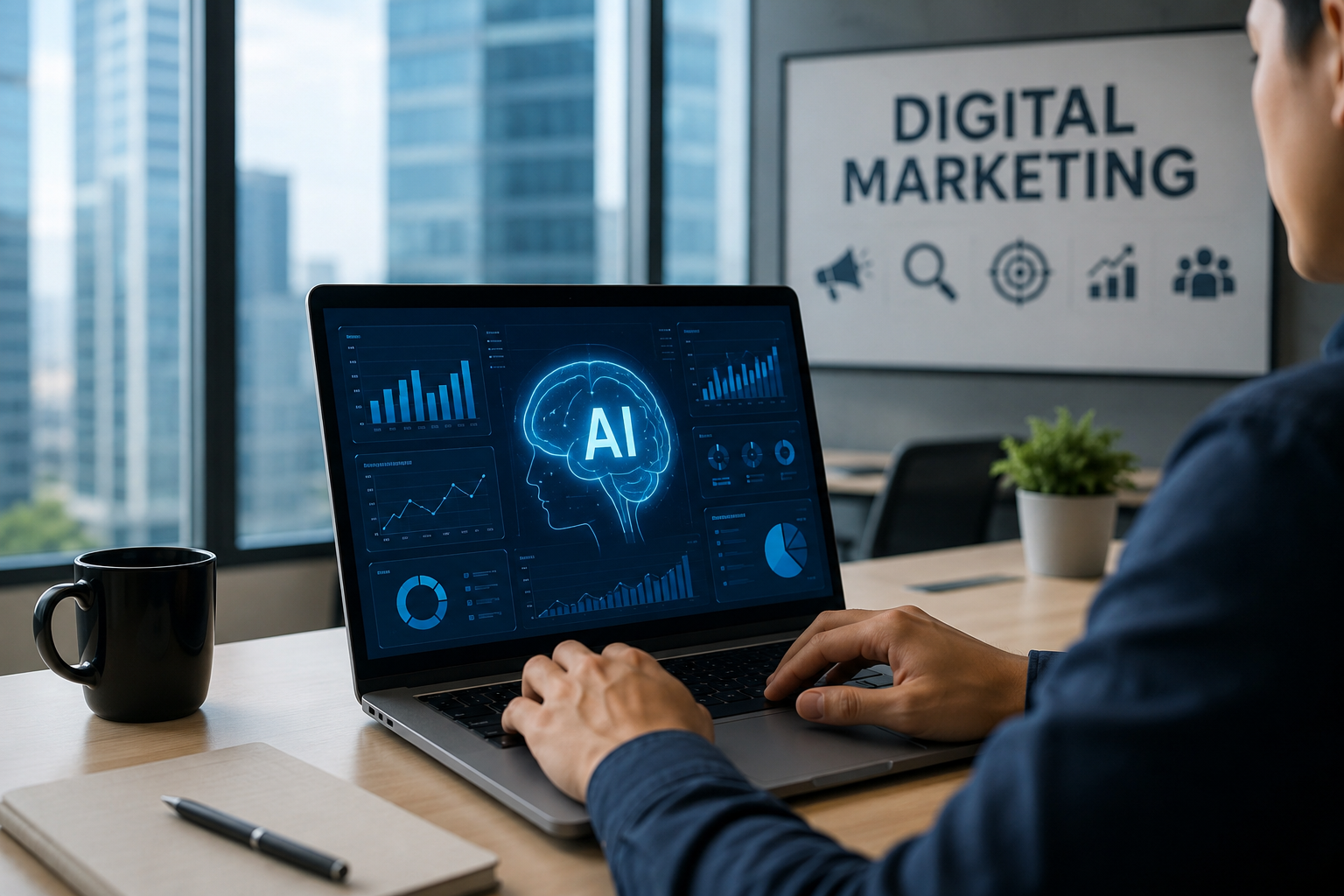
Intelligent technologies have a significant role in the fast-changing digital marketing world. By 2026, startups and agencies across Gurugram are expected to be relying on AI Marketing Tools to better understand customer behaviour and get more value out of their marketing campaigns. Gurugram has turned into one of India’s strongest business hubs, and it’s also a place where AI is leaving a real mark on Digital Marketing. Content creation, audience targeting, optimization — AI solutions are reshaping all of it, pushing organizations toward being more efficient and effective.
Table of Contents
The Growing Role of AI in Modern Digital Marketing
AI has changed how businesses think about marketing. Marketers don’t really need to spend hours digging through reports or handling the same repetitive tasks anymore — advanced systems now process huge amounts of data in seconds. There’s a real reason businesses are turning to AI these days — it helps them understand what customers actually want, catch trends before they blow up, sharpen how they run their ad campaigns, and keep their messaging consistent across the board. Bring all of that together, and businesses end up better equipped to make sharp decisions and adapt almost the moment the market moves.
Traditional Marketing vs AI-Driven Marketing
| Aspect | Traditional Marketing | AI-Driven Marketing |
| Data Analysis | Manual process | Automated insights |
| Audience Targeting | Broad targeting | Personalized targeting |
| Campaign Optimization | Periodic adjustments | Real-time optimization |
| Customer Support | Human-based support | AI-powered automation |
| Content Planning | Manual research | AI-assisted recommendations |
AI was never meant to replace the people doing the marketing — its real job is to sharpen their skills and make the whole process work more efficiently.
Why Startups and Agencies in Gurugram Are Investing in AI
Gurugram has a very competitive business environment. Every startup or agency is always looking for ways to improve its productivity, lower costs, and create marketing results. This has led to increased adoption of AI in Digital Marketing across multiple industries.
Faster Marketing Operations
Reporting. Segmenting an audience. Scheduling posts. Tracking how a campaign’s doing. None of these really need a human staring at them for hours, and that’s exactly the work AI has taken over. It tightens up campaigns, automates the routine, and even helps draft content when needed. What teams get back is time — time to actually plan instead of just react, and to use whatever resources they have more wisely.
- Faster campaign execution
- Reduced manual workload
- Improved operational efficiency
- Better resource allocation
Better Customer Understanding
Customers today don’t just want a product — they want it to feel like it was made with them in mind, and AI is what makes that possible at scale. Businesses can look at how people interact, browse, what they’ve bought before, and how they engage over time, and from that build a real picture of what their audience actually cares about. Instead of guessing, startups and agencies can use AI in Digital Marketing to act on real data, which usually translates into a better customer experience and stronger campaign results. The deeper that understanding goes, the more relevant a brand’s campaigns become — better recommendations, stronger relationships, the works.
Improved Campaign Performance
There’s no need to wait around for a weekly report anymore. AI systems read campaign data as it happens and hand marketers insights in real time. That makes it a lot easier to spot what’s actually working, decide where ad budgets should go, and push engagement higher. Keep refining targeting and optimisation this way, and conversions — along with overall marketing returns tend to follow.
- Identify high-performing audiences
- Optimize ad budgets
- Improve engagement rates
- Increase conversion opportunities
Reduced Manual Work
Small teams end up doing five jobs at once — that’s just how it works when budgets are tight. AI takes over a fair bit of the repetitive load: reports, lead qualification, email sequences, replying to customers, and watching campaigns run. That’s hours given back, hours that go into growth, into actual relationships with customers, into the kind of planning a machine still can’t do on its own.
- Reporting
- Lead qualification
- Email workflows
- Customer responses
- Campaign monitoring
Top Ways AI Is Transforming Digital Marketing in Gurugram
Digital innovation hasn’t slowed down, and AI now touches almost every part of how marketing gets planned and run. Content creation, audience targeting, customer engagement, campaign optimization — businesses are handling all of it more efficiently, with decisions backed by data rather than guesswork. More startups and agencies are adopting AI in Digital Marketing every year, automating the routine stuff, reading customer behavior more sharply, and delivering experiences that actually feel personal. As demand for smarter strategies keeps climbing, more advanced AI Marketing Tools keep showing up too — pushing Digital Marketing in Gurugram toward being more innovative, efficient, and genuinely result-driven. Startups and long-running agencies alike are now using AI for Marketing Agencies to boost productivity, sharpen campaign performance, and stay in the game as the digital landscape keeps shifting under everyone’s feet.
AI-Powered Content Creation
Content is still right at the center of digital marketing — that hasn’t changed. Keeping up high-quality content on a regular basis isn’t easy, and that’s really the hard part for most teams. AI helps close that gap — generating ideas when a marketer’s stuck, putting together first drafts, and making the whole content planning process feel a lot less chaotic.
Common Applications of AI Content Creation
- Blog topic generation
- Social media captions
- Email marketing content
- Ad copy suggestions
- Content optimization
Benefits of AI Content Creation
A good chunk of the friction in content production simply disappears once AI tools enter the picture. Production speeds up, messaging stays consistent no matter the channel, and the time that used to disappear into manual planning gets freed up for other things. Publishing schedules also become far less of a hassle to organize — something that really shows over a busy quarter when deadlines start piling up.
- Faster production
- Better consistency
- Increased productivity
- Improved content planning
Smart Audience Targeting
If there’s one thing AI has genuinely changed in digital marketing, it’s how precisely businesses can target their audience. Instead of putting a message out there and hoping it reaches the right people, businesses can now lean on AI-driven insights to zero in on exactly who they want to reach — based on interests, online behavior, demographics, and how people have engaged in the past. That’s what lets startups and agencies build campaigns that actually land in front of the right audience, at the right time. The payoff usually shows up as better engagement, more chances at conversion, and stronger marketing results overall — simply because the targeting is sharper.
AI Helps With
- Customer segmentation
- Behavioral analysis
- Interest identification
- Personalized recommendations
AI-Powered Advertising
Most advertising platforms already run on machine learning behind the scenes now, adjusting campaigns automatically without much manual input. Businesses running digital campaigns can push this even further with AI Advertising solutions — sharpening targeting, refining bidding strategies, and making smarter calls around budget allocation.
AI Advertising Benefits
| Feature | Benefit |
| Automated Bidding | Better budget management |
| Audience Optimization | Improved targeting accuracy |
| Performance Monitoring | Faster adjustments |
| Predictive Insights | Smarter campaign decisions |
| Budget Allocation | Improved efficiency |
With these AI advertising tools in place, businesses see real improvements — campaigns perform better, ad spend gets used more wisely, and marketing decisions end up grounded in actual data rather than guesswork.
Chatbots and Customer Engagement
A chatbot answering a query the moment it comes in does more for customer experience than people often realize. These tools keep communication fast and consistent, take real pressure off support teams, and more often than not, turn a simple question into something close to a lead. Used well, AI in digital marketing through chatbots strengthens engagement and opens up more chances for conversion.
Advantages of Chatbots
- 24/7 customer support
- Faster response times
- Improved customer experience
- Better lead qualification
- Reduced support workload
Predictive Analytics
Looking at past behavior, AI can make a fairly solid guess at what’s coming — letting marketers move ahead of a trend instead of catching up to it after the fact. That head start makes it easier to spot opportunities early and build retention plans that actually hold up over time.
Applications
- Demand forecasting
- Purchase prediction
- Customer retention planning
- Marketing strategy development
Top AI Marketing Tools Used by Startups & Agencies in Gurugram
These AI Marketing Tools are becoming a normal part of how local startups and agencies run — taking manual effort off the table, sharpening content quality, and pushing customer engagement up without adding to anyone’s workload.
| AI Tool | Main Use | Business Benefit |
| ChatGPT | Content creation | Faster content development |
| Gemini | Research and planning | Better market insights |
| Jasper | Marketing copywriting | Improved ad and email content |
| Canva AI | Design assistance | Faster creative production |
| HubSpot AI | CRM automation | Better customer management |
| Notion AI | Productivity support | Improved workflow efficiency |
These AI Marketing Tools enable businesses to improve productivity while maintaining marketing quality.
Benefits of Using AI in Digital Marketing
AI brings genuine value to the table — better efficiency, stronger customer engagement, and marketing performance that actually improves. Content comes together faster, audience targeting gets sharper, and campaigns keep adjusting themselves in real time instead of sitting around for a manual review. AI in Digital Marketing also helps organizations bring in better leads, take the routine off people’s plates, and cut down on how much operational effort everything takes. Put together, businesses end up saving time, getting more done, and landing better marketing outcomes overall.
Faster Content Production
Keeping content flowing consistently isn’t easy, especially for startups and growing agencies juggling a dozen things at once. AI Content Creation tools help generate ideas, organize calendars, and speed up the actual writing — so teams stay consistent across channels without losing excessive time to planning.
Better Ad Performance
Ad campaigns don’t run themselves — they need constant monitoring and tweaking to actually perform well. AI Advertising solutions help by reading campaign performance in real time, flagging what’s working and what isn’t, so marketers can make smarter calls, reach the right audience, and get more value out of their advertising effort.
Improved Lead Generation
Finding potential customers is, at the end of the day, one of the biggest goals behind any marketing campaign. AI in Digital Marketing helps businesses make sense of audience behavior and pinpoint the users most likely to actually show interest in what they’re offering. That makes lead generation a lot more focused and improves the odds of pulling in genuinely valuable prospects.
Enhanced Customer Experience
Customers expect brands to actually get what they need, not just guess at it. AI-powered insights help businesses deliver content, recommendations, and communication that feel genuinely relevant — and that’s usually what makes customers feel more connected to a brand, building the kind of trust that keeps them around long-term.
Cost and Time Savings
A lot of marketing work eats up serious time and resources when it’s all done by hand. Automate the routine processes, and tasks get finished faster while the unnecessary workload drops off. That frees teams up to actually focus on creative planning, strategy, and the kind of high-value work that drives real growth.
Challenges Businesses Face While Adopting AI
AI opens doors, sure — but putting it to work isn’t always smooth. Plenty of startups and agencies run into friction around data management, getting the whole team on board, and fitting new technology into workflows that already exist. Getting real value out of AI in Digital Marketing means facing these obstacles head-on and building strategies that actually work through them, not around them. A balanced approach — one that brings technology, planning, and human expertise together — is usually what helps organizations get the most out of AI-powered solutions.
Data Privacy Concerns
The more customer information a business collects and analyzes, the more it has to think about protecting that data properly. Companies using AI Marketing Tools need to make sure customer details stay secure and are handled with care — building trust through safe data practices is really what keeps customer relationships strong over time.
Over-Reliance on Automation
AI makes a lot of marketing tasks easier, but handing every decision over to it doesn’t always lead to the best outcome. Building strategy, reading customer emotions, adjusting when the market shifts — these still need a human in the loop. More often than not, a balanced mix of both beats going all-in on automation.
Need for Human Creativity
Technology is great for research, content suggestions, and crunching data, but creativity is still something only people bring to the table. Original ideas, storytelling, the personality behind a brand — automation alone can’t really replicate any of that. That’s exactly why a lot of businesses pair AI for Marketing Agencies with real human creativity, building campaigns that end up being both effective and genuinely engaging.
Training and Implementation Costs
Bringing in new technology rarely comes free — it costs both time and money. Teams need training, workflows often need rebuilding, and AI solutions have to be worked into how the business already runs. That early stretch can feel slow for a lot of startups and agencies, but with proper training and a gradual rollout, the value of AI Marketing Tools tends to show up soon enough. Get the approach right, and these investments pay back in better productivity and growth that actually lasts.
Common Challenges
| Challenge | Impact |
| Data Privacy | Customer trust concerns |
| Automation Dependency | Reduced human oversight |
| AI Errors | Inaccurate outputs |
| Skill Gaps | Additional training needs |
Once a business genuinely understands these challenges, putting AI solutions into practice becomes a lot smoother — and the results actually last.
Best Practices for Using AI Effectively in Marketing
AI can absolutely push marketing performance forward, but it’s not something you just switch on and expect magic — real results need a real strategy behind them. The businesses that get this right treat AI as something that supports their decisions, not something that takes over for human judgment entirely. Pair the technology with actual creativity, keep checking on performance regularly, and stay focused on what customers need. That combination is what lets organizations get the most out of AI in Digital Marketing without losing the quality and authenticity that makes marketing actually work.
Recommended Practices
- Combine AI with human creativity
- Verify AI-generated content
- Monitor performance regularly
- Use customer data responsibly
- Continuously test campaigns
- Focus on customer experience
- Make data-driven decisions
Key Metrics to Measure AI Marketing Success
Putting AI tools in place is only half the job — figuring out whether they’re actually delivering matters just as much. Businesses need to keep an eye on the right performance metrics to know if their AI-driven strategies are paying off. Engagement, conversions, lead quality, return on investment — these are the numbers that tell the real story about how a campaign’s doing. Track these regularly, and startups and agencies can fine-tune their AI in Digital Marketing efforts, make sharper decisions, and land better results over the long run.
| Metric | What It Measures | Importance |
| Engagement Rate | Audience interaction | Content effectiveness |
| CTR | Ad engagement | Campaign performance |
| Conversion Rate | Customer actions | Lead quality |
| Cost Per Lead | Acquisition cost | Budget efficiency |
| ROAS | Return on ad spend | Profitability |
Future of AI in Digital Marketing in Gurugram
AI is still very much a work in progress, and as it keeps growing more advanced, its footprint in marketing is only set to expand further. Businesses putting effort into AI Marketing Tools and intelligent automation now are setting themselves up to handle whatever the market throws at them down the line. As Digital Marketing in Gurugram keeps growing, adoption of AI-powered solutions is expected to pick up pace too — helping startups and agencies run more efficiently, deliver better customer experiences, and stay ahead of the competition.
Hyper-Personalized Marketing
Generic marketing messages are fading out. Going forward, businesses are going to lean toward giving customers experiences that genuinely feel personal. AI in digital marketing will make that possible — reading customer behavior, preferences, purchase history, and engagement patterns to deliver content and recommendations that actually fit the person on the other end. That’s what helps brands build stronger connections with their audience and keep customer satisfaction climbing.
Advanced Marketing Automation
Marketing is heading toward being a lot more automated and a lot smarter about it. Modern AI marketing tools are already taking care of things like content scheduling, lead nurturing, reporting, audience segmentation, and campaign management — and handling them efficiently at that. As more of that repetitive work gets taken off their plate, startups and agencies get more room to actually focus on strategic initiatives that drive real business growth.
AI-Powered Customer Journeys
How businesses keep tabs on a customer’s journey has changed a lot, and most of that credit goes to AI. From the very first time someone notices a brand to the day they finally hit buy, AI-powered systems are watching closely enough — their actions, what they’re drawn to — to keep every step feeling like it was meant for them. Gurugram businesses are seeing this play out as better engagement and people sticking around longer, simply because the communication feels personal and the recommendations show up exactly when they should.
Smarter Advertising Campaigns
Ad platforms don’t sit still for long, and AI advertising tools are right there with them, tightening up campaigns in ways nobody could pull off manually a few years back. The algorithms take care of audience targeting, bidding, and budget allocation, all without someone hovering over a dashboard adjusting settings all day. The payoff for businesses is pretty simple: campaigns that actually perform, ad money that stretches further, and a genuinely better shot at seeing real returns.
Conclusion
Come 2026, AI won’t just be an experiment startups and agencies are dabbling in anymore — it’ll be woven into the very core of how they do marketing, day in and day out. Content creation, audience targeting, ad management, predictive analytics — none of these will operate in silos anymore; they’ll come together, helping businesses trim the fat from their operations and pull more value out of every single campaign. And the more deeply AI becomes part of that daily rhythm, the more precise campaigns get, engagement continues to grow, and choices start coming from real numbers instead of hunches. For businesses based in Gurugram, that’s a change worth taking seriously — ignoring it isn’t really an option.

Nizu Sachdeva is a Digital Marketing Specialist with around 6 years of experience in SEO, content marketing, social media strategy, graphic design, and video editing. She specializes in creating digital strategies and content-driven campaigns that help businesses strengthen their online presence.