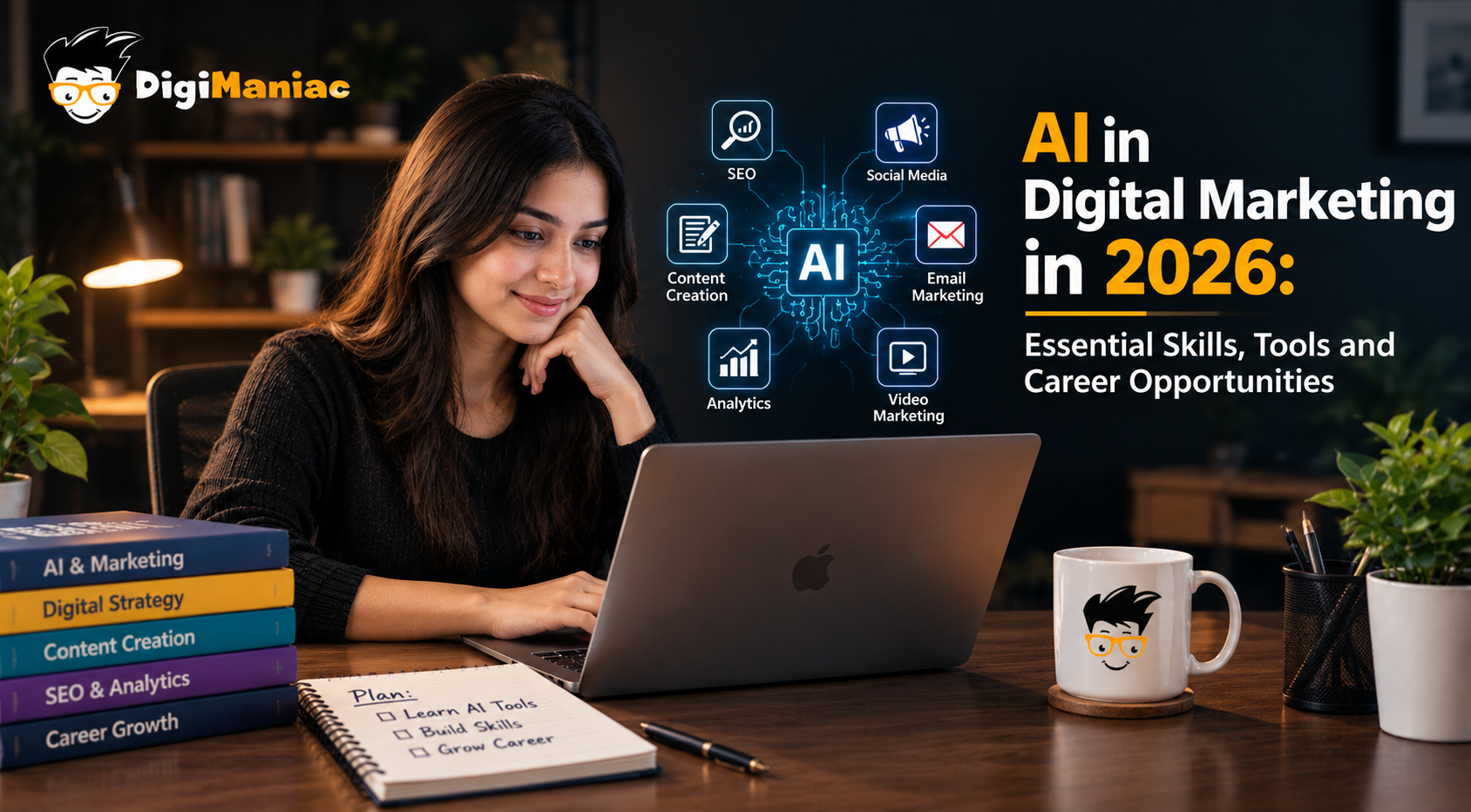
Artificial Intelligence (AI) has been integrated into various digital marketing functions, ranging from research and content creation to advertising and customer analytics. Businesses are also leveraging AI to better understand their audience and improve the overall customer experience.
For students and professionals, learning how to use AI can open up a variety of digital marketing career opportunities. There is no need to pursue an advanced degree or learn coding – a basic understanding of digital marketing principles, including SEO, content marketing, social media, ads, and analytics, will enable one to use AI effectively in the field.
However, AI is not a magical solution that can instantly boost a marketing campaign’s performance. While it can provide recommendations, insights, and automation, human expertise is needed to execute marketing strategies and ensure accuracy and precision.
This article covers everything about using AI in digital marketing, including its tools, skills, and jobs.
Table of Contents
What Is AI in Digital Marketing?
AI in digital marketing refers to the use of artificial intelligence tools, algorithms, and technologies to support and enhance marketing initiatives and decision-making. In other words, it is a combination of computer programs that can carry out marketing tasks and activities more efficiently and effectively.
From generating blog post outlines to optimizing Google Ads and analyzing customer behavior, AI can support nearly all digital marketing activities.
Some common applications of AI in digital marketing in 2026 include:
• Content creation and research
• Search Engine Optimization (SEO)
• Advertising management
• Email marketing
• Chatbots
• Customer segmentation and analytics
• Marketing automation
• Website traffic and conversion rate optimization
AI uses different computer technologies, including deep learning, machine learning, natural language programming, and generative AI models.
Marketers and business owners should understand that AI cannot replace the human element in digital marketing. While it can carry out specific tasks, it is essential to remember that AI-generated information and recommendations should always be cross-checked and verified for accuracy, relevance, and authenticity.
Why Is AI Important in Digital Marketing in 2026?
Digital marketing is a broad term that covers a wide range of marketing activities and platforms. It typically involves carrying out extensive market research, engaging with diverse audiences through multiple channels, and managing various advertising and marketing initiatives.
AI makes it possible to carry out these activities with minimal effort and time. For instance, Google Ads and Google Analytics are using AI to help marketers gain valuable insights and optimize their campaigns.
Below are some reasons why AI is crucial in digital marketing in 2026.
1. Faster Research and Planning
Marketers often need to carry out extensive research and planning before launching a new marketing campaign, writing a blog post, or creating new ad sets. AI can assist in speeding up this process by suggesting relevant ideas, compiling research reports, and developing a realistic action plan. For instance, a content marketer may want to write a blog post targeting the keywords “digital marketing courses in Panipat.” An AI tool can help suggest relevant questions to address in the post, such as “What are the best digital marketing courses in Panipat for beginners?” and “How much do digital marketing courses in Panipat cost?”
2. Better Customer Insights
With the help of AI analytics tools, marketers can gather and organize customer insights to inform their marketing and advertising campaigns. For instance, they can identify which web pages attract the most traffic, which marketing channels drive high-quality leads, and where website visitors tend to leave before purchasing.
3. Enhanced Customer Experience
Most customers are more likely to purchase from a business that understands their preferences and purchasing tendencies. AI can help marketers segment their target audience based on their interests, gender, age, and other factors. They can then develop marketing and advertising campaigns that appeal directly to them, such as sending targeted emails and recommending relevant products.
4. Reduced Manual Efforts
Many digital marketing activities are repetitive, tedious, and time-consuming. Marketers can use AI tools to automate such tasks, including scheduling social media posts, sorting customer inquiries, and generating reports. This way, they can focus on more important aspects of their campaigns, such as creating engaging content and optimizing their ads.
5. Faster Insights and Analysis
Rather than manually analyzing campaign data, marketers can use AI to identify irregularities and patterns within seconds. They can then use this information to optimize their campaigns and improve their performance.
How Does AI Work in Digital Marketing?
AI works differently in various digital marketing activities and use cases. In general, however, it carries out the following steps:
1. Data Gathering
Marketing and advertising platforms generate vast amounts of data, including customer insights, preferences, behaviors, and search history, subject to privacy and consent policies.
2. Pattern Recognition
AI algorithms analyze this information to identify patterns and irregularities. For instance, an advertising platform can recognize what signals and audiences tend to lead to conversions.
3. Recommendations or Automation
Depending on the use case, AI can suggest recommendations or make adjustments automatically. For instance, it can recommend relevant blog post headlines, optimize ad bids, or implement adjustments to improve the performance of a particular social media post.
4. Evaluation
Marketers can analyze the results of a particular marketing activity or initiative and use it to optimize future campaigns. For instance, they may want to tweak a website’s landing page to encourage more visitors to purchase a product or service.
5. Refinement
Refinement refers to the process of fine-tuning a particular campaign, strategy, or initiative based on the evaluation results. For instance, when optimizing a landing page, the marketer may want to A/B test it to determine which version performs better.
It is important to note that AI automation is not always involved in these steps. Some digital marketing tools only provide recommendations before a marketer implements the suggested changes.
How Is AI Used in Various Digital Marketing Activities?
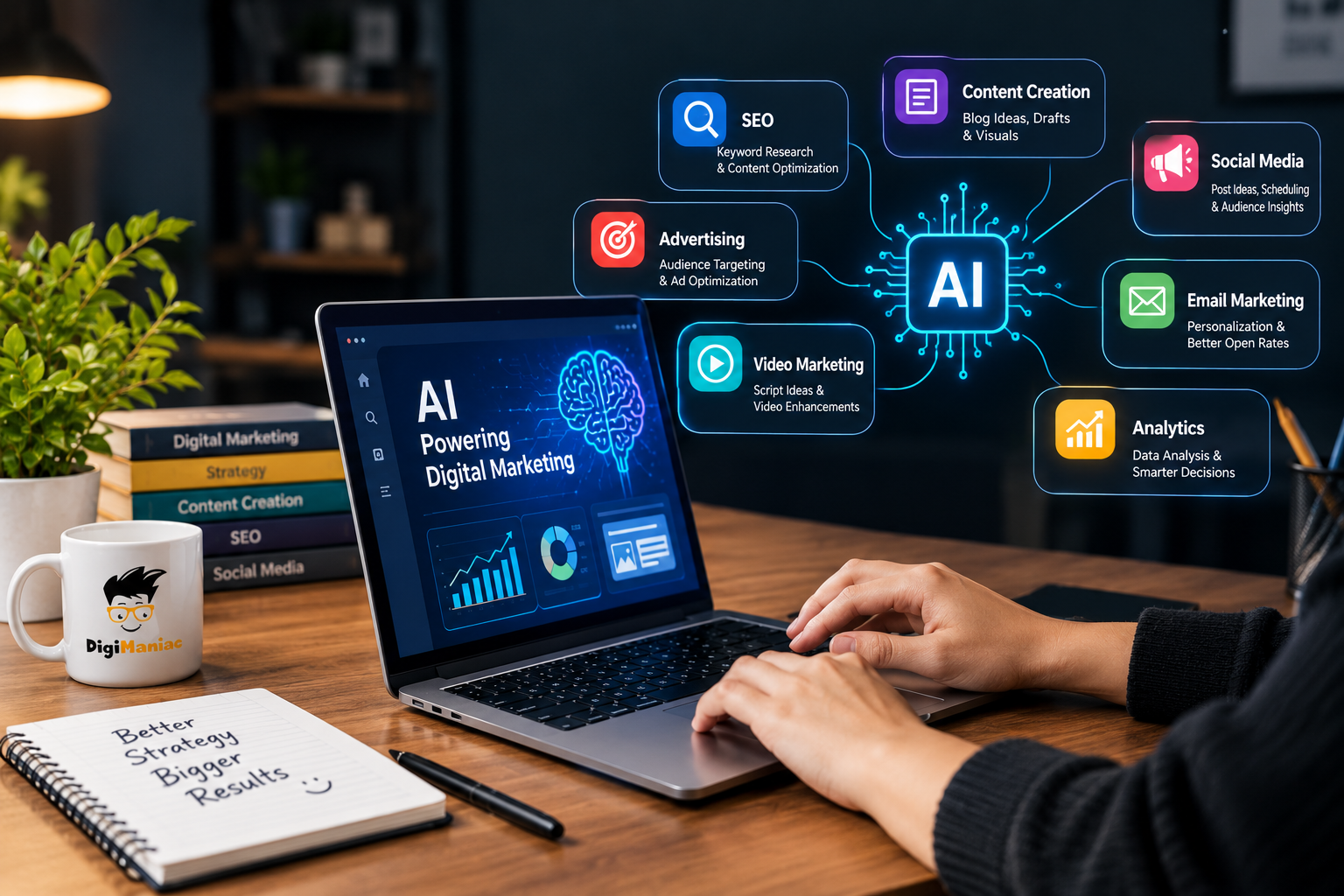
I can be used in nearly all digital marketing activities and channels. It is crucial to combine it with one’s marketing expertise and understand how it can complement one’s efforts to achieve specific campaign goals. Below are some common AI in digital marketing in 2026 activities commonly used.
1. SEO
The main objective of SEO is to help a website rank higher in the search engine’s organic (or natural) search results. AI can support various aspects of SEO, from conducting keyword research to analyzing competitor data, optimizing content, checking technical aspects, and generating reports. Marketers and business owners can use AI to:
• Carry out keyword research and sort keywords according to search intent
• Identify relevant sub-topics under a primary keyword
• Create blog post outlines or suggestions
• Write blog post FAQs
• Summarize search console or website performance data
• Recommend internal linking opportunities
• Optimize meta tags and descriptions
• Carry out technical SEO audits
For instance, if a marketing professional wants to write a blog post around the keyword “digital marketing course in Panipat,” the AI tool can suggest relevant questions or topics to address in the post. However, the marketer should go ahead and conduct keyword research, analyze the competition, and determine the audience’s intent to confirm that the suggested ideas are relevant and profitable.
Google is also using AI to provide more meaningful and relevant search results. As such, SEO professionals must ensure their website offers a positive user experience, original and high-quality information, and accurate answers to frequently asked questions.
2. Content Marketing
Content marketing involves publishing and distributing content that serves to educate and inform a target audience. AI can help with various stages of this process, including research, outlining, writing, and publishing. Marketers and content creators should always double-check the accuracy of the information provided by AI tools. They should also ensure that the content matches the brand voice and adequately addresses the audience’s interests, questions, and concerns. In general, AI can be used for:
• Carrying out content research
• Generating blog post outlines and first drafts
• Writing social media captions
• Creating email subject lines
• Repurposing content
• Coming up with a content calendar
• Enhancing readability and grammar
For instance, when developing a blog post about email marketing, an AI tool can help generate the post’s outline. The writer can then add more information on the topic and elaborate on the sub-topics. Writing with AI can save time and effort, but it is important to ensure that the information is not generic or copied from another website. Google specifically advises against generating articles with AI if they do not provide additional value to the user. How Google views AI-generated content
3. Advertising
Many modern online advertising platforms utilize artificial intelligence to help marketers manage their campaigns more efficiently and effectively. Marketers can use AI to carry out extensive keyword research, optimize their campaigns, analyze performance data, and identify opportunities for improvement. With that said, there is no doubt that human expertise is required to get the best results.
AI can be used in advertising to:
• Come up with compelling ad headlines and descriptions
• Analyze statistics and trends
• Determine which signals contribute to conversions
• Generate various creative options to test
• Optimize eligible automated bidding strategies
• Recommend adjustments to a campaign’s landing pages and audiences
For instance, while running a Google Ads campaign for a digital marketing institute, one can use AI to try out different ad variations for finding the best combination of headlines and descriptions. One may also want to analyze the landing pages, audiences, and keywords to gain valuable insights and optimize the campaign.
4. Social Media Marketing
Social media marketing (SMM) managers are responsible for managing a brand’s social media accounts, including developing and implementing marketing strategies, engaging with the audience, analyzing insights, and monitoring the performance of the social media campaigns. Like in other areas of digital marketing, AI can help SMM managers to enhance their performance in 2026. Some common use cases include:
• Generating content calendar ideas
• Creating social media captions
• Developing creative concepts
• Summarizing insights and reports
• Sorting customer feedback
• Testing different captions, ad variations, and other elements
For instance, when looking to create a content calendar for a jewelry business, one can use an AI tool to come up with ideas for captions and content themes. The tool can also help sort customer reviews and testimonials. Marketers should ensure that their social media posts adhere to their brand guidelines and do not use unverified images or videos.
5. Email Marketing
Email marketing is an affordable and effective method for maintaining a relationship with the target audience, reminding them about the brand, and encouraging them to make a purchase. In 2026, AI can be used to help with sorting customers, suggesting subject lines, analyzing insights, automating repetitive tasks, and optimizing email campaigns. For instance, a business can use segmented email sequences to engage with new and existing customers, as well as those who have abandoned a product in their cart.
When creating marketing emails, marketers can use AI to suggest compelling subject lines that entice the recipient to open the message. Businesses should also consider the value they provide to the customer and avoid sending the same promotional message to everyone in their mailing list.
6. Chatbots
Many digital marketing and business owners are using AI chatbots to support their marketing and customer service efforts. Marketers can use chatbots to help customers find the information they are looking for, address their concerns, collect their personal details and preferences, and promote their products and services. For instance, a digital marketing institute can use a chatbot to help potential students find more information about the courses on offer. On the other hand, the chatbot can forward complex queries to a human representative.
7. Analytics and Reporting
Marketing analytics is all about interpreting data to determine the strengths and weaknesses of a marketing campaign. In essence, it informs marketers and businesses about what is working and what is not, and what they can change to achieve a better result. AI can be used to carry out various data analysis tasks, including sorting reports, identifying patterns, and highlighting weak areas in a marketing campaign.
For instance, marketers can use AI to sort and summarize monthly reports and website data, such as the number of clicks, impressions, traffic sources, landing page performance, and leads. They can also use it to analyze advertising data, such as cost per click (CPC), cost per lead (CPL), revenue, return on ad spend (ROAS), and others, depending on the campaign’s specifics and whether the company is measuring revenue accurately.
Essential AI Skills for Digital Marketers in 2026
While learning how to use various AI tools is important, businesses and clients are looking for individuals who can apply their knowledge of these tools to actual projects. Below are some of the essential skills that one should develop to succeed as a digital marketer in 2026.
1. Prompt Engineering
Prompt engineering is a skill that involves getting the most out of a particular AI tool by providing it with the best prompts. In other words, it refers to the process of coming up with the best questions, statements, instructions, and context for the AI tool to follow to get the best results. A good prompt should specify the task, target audience, objective, tone, limitations, and expected results.
2. AI Assisted SEO
Marketers and business owners should know how to use AI tools to carry out SEO-related tasks, including keyword clustering, content briefs, analyzing competitor data, suggesting internal linking opportunities, and generating reports.
3. Content Editing and Fact-Checking
Many AI tools can generate content faster and easier, but it is important to ensure that it is relevant, fact-checked, properly cited, and does not contain any grammatical errors or inconsistencies.
4. Data Analysis
Every marketer should have strong analytical skills so that they can interpret the data correctly and understand the context. Some of the key metrics that are used AI in digital marketing and should be understood include click-through rate (CTR), conversion rate (CVR), cost per acquisition (CPA), organic traffic, and return on ad spend (ROAS).
5. Marketing Automation
Marketing automation plays a critical role in digital marketing in 2026. It enables businesses to scale their marketing efforts and operations without significantly increasing the workload. With that said, it is important to understand how marketing automation works and how to implement it correctly to achieve the desired results. Some common marketing automation tasks include sending out welcome emails, lead nurturing, and follow-up marketing emails.
6. Creative Strategy
AI can suggest compelling ideas, but it is the marketer’s responsibility to ensure that it is relevant to the target audience and brand image. As such, it is important to keep the brand voice consistent across all marketing materials, including blog posts, website content, social media posts, and advertisements.
Best AI Tools for Digital Marketing
There are many AI tools, and each has its unique purpose and benefits. Marketers should identify their needs and choose a reliable tool that fits their budget. It is also a good idea to start with the free or low-end versions to evaluate the tool’s usefulness before upgrading to a higher plan. Below are some of the best AI tools for digital marketing.
| Tool | Main use | Practical application |
| ChatGPT | Research and content assistance | Blog outlines, content ideas, campaign planning |
| Google Gemini | Research and productivity assistance | Brainstorming, summarising, organising ideas |
| Canva AI | Design and creative assistance | Social posts, presentations, visual concepts |
| Semrush | SEO research and analysis | Keyword research, competitor analysis, SEO audits |
| Surfer | Content optimisation | Content briefs and on-page recommendations |
| Google Ads | Advertising management | Campaign optimisation and performance analysis |
| Google Analytics 4 | Website analytics | Traffic, events, and conversion reporting |
| HubSpot | CRM and marketing automation | Lead management and customer workflows |
| Mailchimp | Email marketing | Campaign creation, segmentation, and automation |
| ManyChat | Messaging automation | Automated social messaging and lead collection |
It is important to note that the plans, features, and availability of these AI tools can change over time. As such, it is a good idea to conduct independent research and confirm the availability of specific features before selecting a tool.
One does not need to learn all the tools and their features at once. Instead, one can start by learning the primary tools used in one’s marketing activities and gradually move to other tools as one gains more experience.
How to Start Learning AI in Digital Marketing
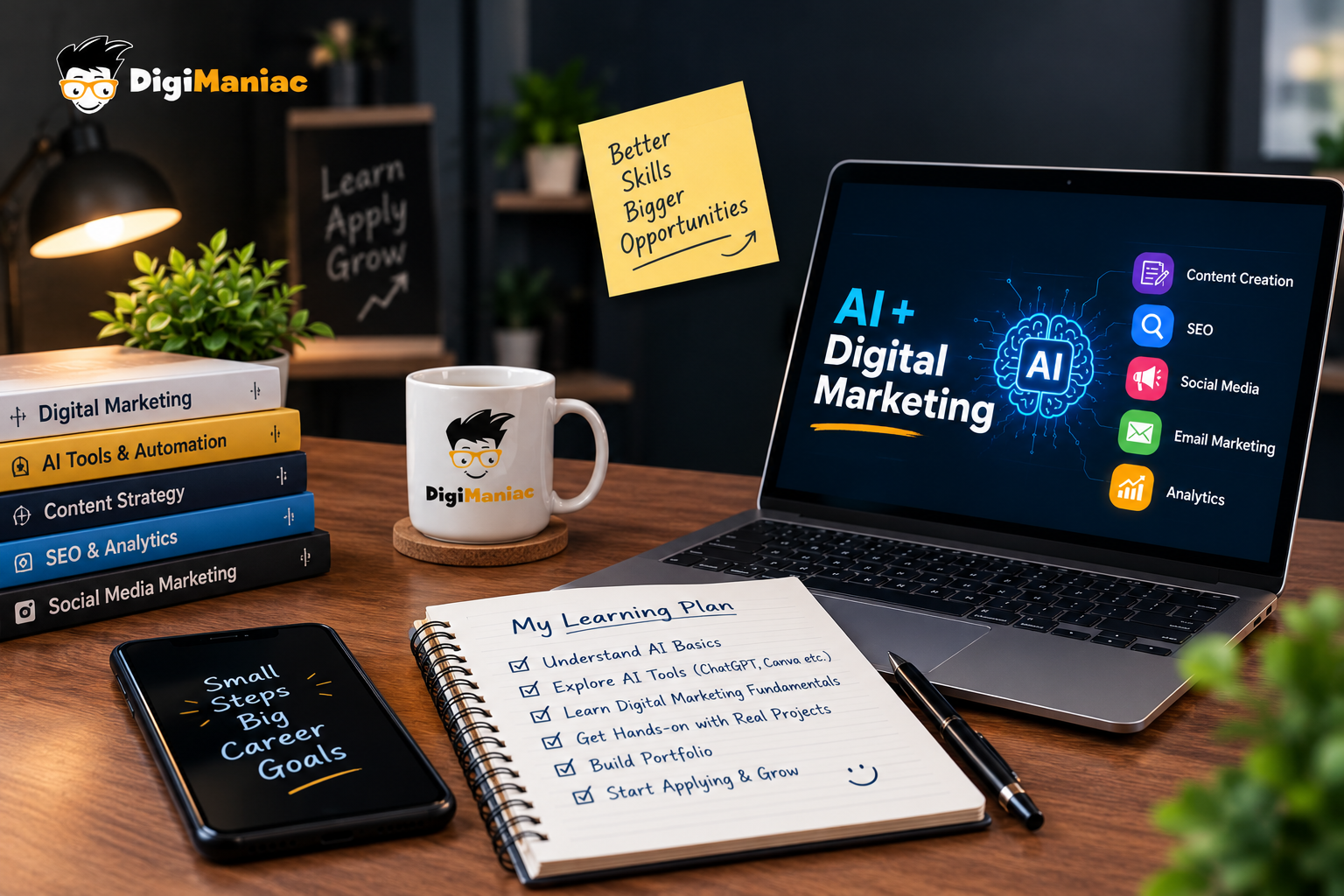
For beginners, the best way to start learning AI in digital marketing in 2026 is to start with the basics and then incorporate it into one’s activities. Below are some tips for learning AI and applying it in practical digital marketing activities.
1. Learn Digital Marketing Basics
Before learning how to use AI tools, it is important to master the basics of digital marketing. This will enable one to understand the purpose of each activity and ensure that the AI-generated recommendations are relevant and profitable.
2. Pick One Marketing Area to Learn
Digital marketing is a broad term that covers many areas. As a beginner, it is best to focus on one area and then move to others as one develops more skills and confidence.
3. Practice Using AI Tools
Once one has mastered the basics of a particular area of digital marketing, they can start practicing using AI tools. For instance, one can use an AI tool to research and write a blog outline or summarize a report. It is important to cross-verify the results and ensure that they are accurate and relevant.
4. Work on a Project
After mastering the basics and getting familiar with the AI tools, one should work on a practical project to consolidate their knowledge and skills. The project should be a realistic example of a marketing activity, such as designing an SEO content plan.
5. Measure Results and Learn
After completing a project, it is important to carry out a detailed review to determine what worked well and what could be improved. In the case of a live project, one should also measure the campaign’s effectiveness using the relevant metrics and see if the changes had any impact.
6. Add Your Work to a Portfolio
A personal portfolio is an excellent way to demonstrate one’s practical skills when applying for a job or working with clients. This is why it is important to keep all projects and even AI-generated drafts and ideas to add to the portfolio.
Career Opportunities in AI-Driven Digital Marketing
AI is transforming the digital marketing landscape, and it has created new career opportunities for professionals. While some roles are similar to traditional digital marketing jobs, there are also new specializations that one should consider.
AI-Assisted Content Strategist – This role is responsible for developing and executing content strategies that utilize AI tools.
SEO Specialist – This role focuses on improving a website’s organic search traffic using AI-powered SEO tools.
Performance Marketing Specialist – This role is responsible for managing and optimizing advertising campaigns using AI.
Marketing Automation Specialist – This role involves using AI tools to implement marketing automation and customer engagement tactics.
Digital Marketing Analyst – This role is responsible for analyzing digital marketing data using AI tools to inform business decisions.
AI Marketing Consultant – This role provides consultancy services to businesses that want to improve their digital marketing activities using AI.
Freelance Digital Marketer – This role involves working as a freelancer and using AI tools to provide digital marketing services, such as SEO, content marketing, email marketing, and advertising.
What Will Be the Future Scope of AI in Digital Marketing?
The future scope of AI in digital marketing is very promising. Over the next few years, we will see more automation, increased personalization, and better analytics. Below are the main trends that will shape the future of AI in digital marketing in 2026.
1. AI Agents and Workflow Automation
AI agents refer to programs that can carry out multiple tasks and perform higher-level functions, such as analyzing data and making recommendations. These agents can support a wide range of digital marketing tasks, from generating reports to optimizing online advertising campaigns. Such tools will greatly enhance efficiency and productivity. However, it is important to ensure that any recommendations that involve high-level functions, such as adjusting the budget, are manually reviewed.
2. Search Experiences
Various search engines are adopting AI to offer better and more personalized search experiences. Businesses need to ensure that their websites are optimized and offer the best user experience. As such, it is important to avoid using AI tools that only target search engines and compromise the user experience. Google recommends creating technically accessible websites, helpful answers, and credible information. How Google views AI search
3. More Personalized Experiences
AI can be used to offer a highly personalized experience to website visitors and social media followers. As such, businesses can use it to recommend products, offer special promotions, and tailor email campaigns. Marketers need to be wary of using such data to target vulnerable populations.
4. More Predictive Analytics
Predictive analytics uses historical data, existing data, and other factors to predict future occurrences. Businesses and marketers can use predictive analytics to identify the best opportunities and allocate resources more efficiently. For instance, marketing analysts can use such tools to determine which leads are more likely to convert. It is important to remember that such predictions are only estimates and should not be regarded as a guarantee.
5. Increased Demand for AI Literacy
Marketers will benefit from understanding how AI is incorporated into everyday marketing platforms.
Marketers who have AI literacy and are familiar with SEO and the ability to incorporate their creativity, analytical skills, and practical knowledge into their practice will be well positioned to respond to the evolving demand.
Common Mistakes to Avoid When Using AI for Marketing
AI tools can help to save time, but they may impact the quality, performance, and credibility of one’s content and campaigns.
- Avoid the following mistakes when using AI for marketing:
- Publishing AI content without verifying accuracy or originality.
- Generating numerous similar AI content without a specific purpose.
- Implementing AI SEO suggestions without understanding search intent.
- Making campaign-related decisions based on inadequate or inaccurate data.
- Automating all customer-related activities without an option to speak with a real person.
- When sharing or storing sensitive or confidential information regarding one’s business or clients, always check the security and privacy of the AI software.
- Assuming that any AI content or campaign is guaranteed to achieve the desired result.
The best approach when using AI is to see one’s AI assistant as a facilitator, and one can utilise one’s knowledge and work with the AI suggestions before finalising one’s campaigns.
How DigiManiac Can Help You Build Practical Digital Marketing Skills
Understanding the application of AI in digital marketing is more likely to help a learner achieve practical skills if they understand the context of using AI tools in various aspects of marketing activity.
Students need to learn how to research, strategize, plan, and execute successful marketing activities and assess their outcomes. They might look at the DigiManiac website, a digital marketing and professional training institute based in Kurukshetra, Haryana, and consider the course structure and check if the course offers what they expect to learn.
Before investing in the course, enquirers should consider the following:
- SEO and content marketing essentials,
- AI-assisted content research and optimisation,
- Practical assignments and demonstration of tools,
- Google Ads, and social media ads,
- Analytics and conversion tracking,
- Portfolio development and career advice.
Learners can use practical assignments to understand how various assignments fit into real-life marketing practice. In addition to practical assignments, students need to develop independent research and practice skills, utilise the latest tools, and prepare examples of their work samples.
Students can visit DigiManiac’s website and review the training opportunities and check if their intended learning outcomes are in the course outline.
Conclusion
AI is transforming how digital marketing teams conduct their analyses, research activities, and campaign optimisation, execution, and creation of content. From AI-driven SEO and content creation to automated ad campaigns and analytics, such technology can help marketers to be more productive and successful in their practice.
However, it is important to note that a marketer has to understand their clients’ needs, create compelling and relevant content, set realistic expectations, and measure their outcomes. Marketers should utilize AI technology and tools as facilitators to enhance their practice and productivity.
Anyone considering a career in digital marketing needs to start by learning the essentials of marketing, utilise accessible AI tools to support their practice, complete practical assignments, and build a portfolio that demonstrates their competence in marketing practice.
The aim is not to master every new tool that emerges but to understand how various AI tools can help to achieve one’s marketing goals.
Frequently Asked Questions
1. What is AI in digital marketing?
AI in digital marketing refers to using artificial intelligence (AI) tools to facilitate various marketing functions, including SEO, content creation, ad campaigns, analysing buyer behaviour, email marketing, and report generation.
2. How is AI used in digital marketing in 2026?
AI is used in digital marketing to conduct keyword research, create and optimise content, and run and analyse ad campaigns, emails, and customer service automation. Various tools offer different features and rely on the volume and nature of one’s data.
3. Which AI tools are best for digital marketing?
Some AI tools are suitable for marketing functions, including ChatGPT and Google Gemini for research and content creation, Canva AI for graphic design, Semrush for keyword research, Google Analytics 4 for data analysis, Google Ads and social media ads for marketing campaigns, and HubSpot or Mailchimp for marketing automation.
4. Can I learn AI in digital marketing without coding?
While most coding is unnecessary for most AI marketing tools, one needs to understand marketing essentials, utilise AI tools effectively, prompt effectively, edit and optimise their content, analyse their data, and implement their knowledge practically.
5. Will AI replace digital marketing jobs?
While AI is likely to replace some functions served by human marketers, it is unlikely to replace all marketing functions. At the same time, AI can support and enhance the performance of human marketers.
6. What skills are required for AI in digital marketing?
Digital marketers must be skilled in prompt engineering, SEO, content creation and editing, analytics and data analysis, marketing automation, and campaign management. Understanding the ethical implications of AI is necessary.
7. How can beginners start using AI for digital marketing?
Those new to digital marketing should begin by learning the essentials of SEO and content marketing, advertising, and analytics. Then, they can identify one AI tool to use for one task, implement it, evaluate the outcome, and use it to develop a project. As their knowledge and skill grow, so does their repertoire of tools.
8. What is the future scope of AI in digital marketing?
The future scope of AI in digital marketing is broad, as most marketing functions can be automated or supported by AI. Marketers must develop skills in using various tools and combine their knowledge and skills with creative and analytical skills to enhance their efficiency and productivity.
9. Can AI help small businesses with digital marketing?
Small businesses can benefit from using AI for brainstorming, content creation, SEO, social media management, email campaigns, and data analytics to boost their digital marketing performance. However, success relies on the extent to which they utilise such tools and develop their targeting, content, and marketing strategies.

I’m Renu Singroha, an SEO & Content Marketing professional with 5+ years of experience in SEO strategy, content optimization, and digital marketing. I specialize in improving organic visibility, driving relevant traffic, and creating data-driven strategies that support business growth.