A bakery owner I know posted on Instagram every day for three months and received a few hundred likes, most of them from people in other countries who had no intention of visiting her shop. A plumber I know paid for an SEO package that guaranteed first-page rankings, only to end up ranking for phrases that no one was actually searching for. In both cases, they weren’t being careless; they were simply following advice that seemed sensible at the time.
Most digital marketing myths are like this. They don’t make outrageous claims, and almost all of them contain a small element of truth, which is why they spread so easily. The real problem arises when a business spends its entire marketing budget in the wrong areas, sees numbers that never translate into inquiries or sales, and eventually concludes that online marketing simply doesn’t work for them.
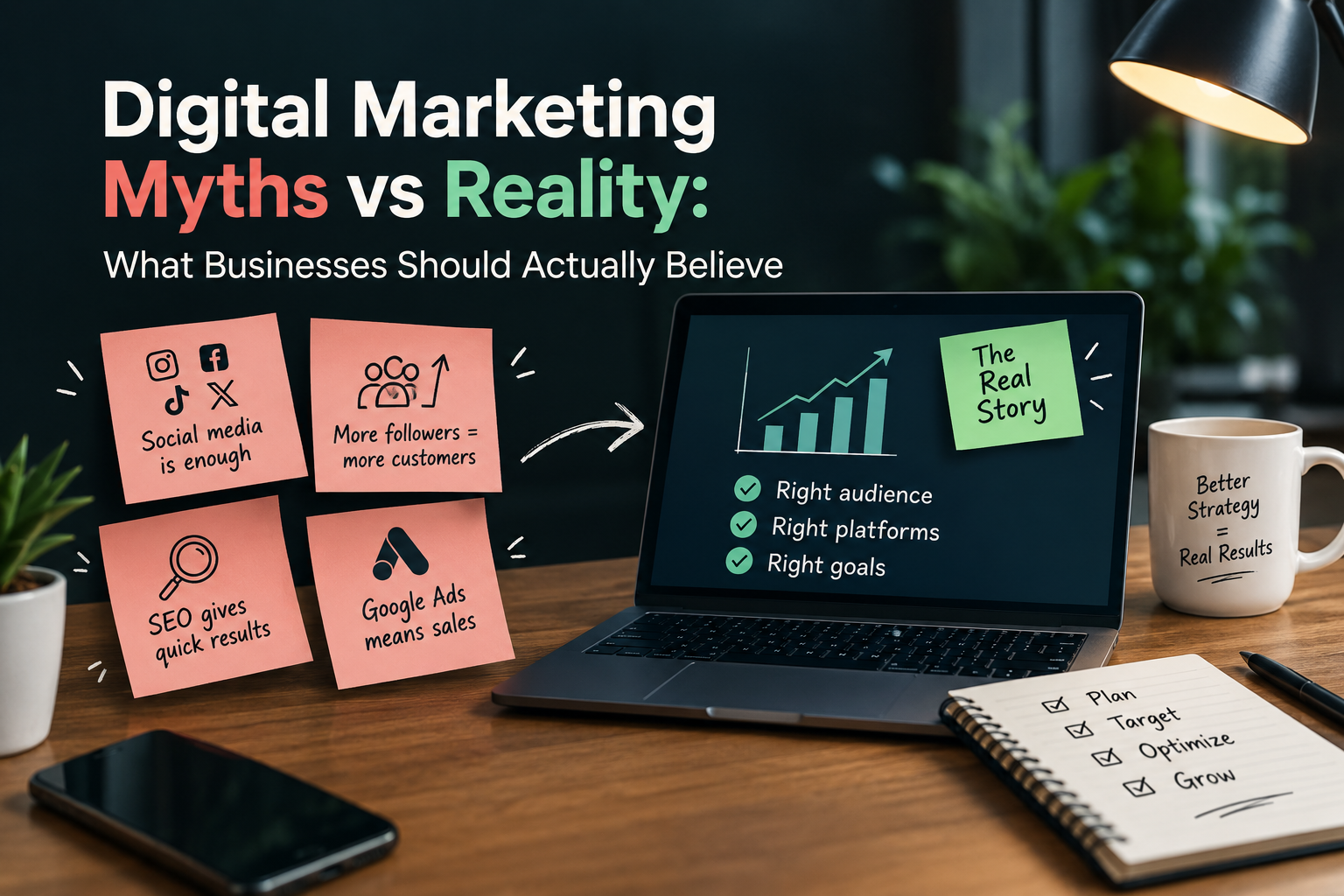
Digital marketing generally works when it is focused on the right audience, platforms, and goals. Below are some of the digital marketing myths I encounter most frequently, along with what is actually true and what businesses can do instead.
Table of Contents
Myth 1: Digital marketing is just social media
Social media forms part of online marketing, but for most businesses it makes up only a small portion. The remainder consists of search engine marketing, email marketing, paid advertisements, your website, customer reviews and your Google Business Profile, and it is generally these that cause a potential customer to choose you.
Consider the steps you would take if you were looking for an electrician on your own. You’d most likely enter a search term into Google, look at some of the reviews, go to the website and maybe send a message via WhatsApp. Instagram could have come up at some point, but it seldom results in a customer making a decision. Therefore, before spending any more time on posting, find out from your last ten customers how they discovered you; one or two of the answers will probably be repeated and that is the route on which you should concentrate first.
Myth 2: More followers means more customers
People feel as though they are making progress since they can see the figure going up. The problem is that a follower only informs you that someone has pressed a button once; the person might live in a different city, might be a bot, or may simply like your photos and have no interest in the things you sell. A furniture maker with 40,000 followers who enjoy the workshop videos could easily receive fewer enquiries than a competitor having 2,000 followers who are all homeowners within an hour’s drive.
Although a large audience does help build trust, it is by no means without value. It is not the same as demand, and it is one of the social media marketing myths that causes people to lose out. A good practice is to consider what takes place after someone follows you. For example, are people going on to the website, sending messages, or mentioning a post when they call? It is these small actions that tell you far more than the number of followers.
Myth 3: SEO gives quick results
SEO takes a long time because search engines have to locate your pages, determine what they are about and then decide if they should trust them. A newly established website that is competing with businesses which have been in operation for years may have to wait many months before seeing any real results. A great deal of the misinformation about SEO arises from this impatience, and some agencies are willing to take advantage of it by making promises that they cannot keep.
There’s a positive aspect to the slower approach: once you stop paying for ads, they immediately cease, whereas a well-created page that answers a common question can continue to generate inquiries for many years. If you’re just getting started, then start with the jobs that don’t require waiting—verify that your business details are correct everywhere, complete your Google Business Profile accurately, and ensure that each service has a page clearly stating what you do and the areas you cover. Also, if anyone promises you a certain ranking, leave them alone, since it’s only the search engines that make that decision.
Myth 4: Running Google Ads means sales will follow
There’s a real advantage in being shown to people who are searching for exactly the thing you provide, thanks to Google Ads; however, the service cannot make them decide to buy. For example, a dental clinic may pay for clicks on ’emergency dentist’ and direct all of them to its general homepage, where the phone number is located some way below the fold. Although people do click on the ads, no appointments follow, and the clinic concludes that the ads aren’t effective when in fact the problem lies with the page.
Create a separate page for each campaign, making the next step clear and obvious. Install tracking for calls and forms so that you can tell which advertisements result in actual inquiries rather than just bringing in visitors. Afterwards, periodically go through the search terms that are triggering your ads and block out the ones that are not relevant. Many accounts secretly squander a large part of their budget on searches that would never have led to a conversion. If tracking and campaign cleanup feels like too much to manage alone, working with a dedicated digital marketing agency can save both time and budget.
Myth 5: You need to be on every platform
The idea of being present on all platforms may seem thorough, but it usually ends up with six or so profiles that were last updated in the spring. Each platform has its own kind of audience and its own style, and getting even two of them right takes longer than most small teams realise. A profile that is abandoned can appear worse than one that doesn’t exist at all.
The platforms you use should be based on who you’re selling to; for example, a commercial cleaning business will likely obtain greater results from LinkedIn and positive Google reviews than from posting daily TikToks, whereas a tattoo artist might find it’s the other way around. Select one or two platforms on which your customers actually spend time, keep them active for a few months before adding any others, and never feel uncomfortable about closing an account that you can’t keep.
Myth 6: Once the website is built, the job is done
It seems as though a website launch marks the end of a project, but changes soon begin to occur. Prices are altered, services are added or removed, and a plugin stops working following an update. A site which no one has touched for two years sends the message to visitors and to search engines that no one is paying any attention.
It’s also useful to look at the way people use it: note which pages they leave before reaching them, which ones result in enquiries, and where they abandon the contact form. Most small businesses can afford to review it every three months. Try out the forms, view the site on your phone, make any changes that are out of date, and include a couple of pages giving answers to the questions customers frequently ask when phoning. It doesn’t have to be elaborate, just kept up regularly.
Myth 7: Only big businesses need digital marketing
It is tempting to think that this applies only to companies that have big budgets, whereas in reality it is the smaller businesses that benefit the most. Large companies have names that are already familiar to people, but a local one doesn’t, so if someone is looking for a physiotherapist and only sees a national chain, then the family-run practice next door may as well not be there.
On the other side there is a valid argument; a tradesperson who has booked three months in advance through referrals might not currently need any more leads and would therefore be foolish to spend money on obtaining them. Even so, a simple website together with a Google listing enables people to verify that you are genuine before they make the call. Most local businesses begin their digital marketing efforts in a modest way by filling out their Google Business Profile, putting their services, address and contact information on a simple website, and asking satisfied customers to leave reviews. That simple action often results in a noticeable improvement.
Myth 8: More traffic means better marketing
Although a blog post going viral might seem like a success, if the people who read it end up not making a purchase, your follow-up calls won’t result in any responses, and the sudden increase in traffic could make it more difficult to tell what’s really working. For example, someone searching for “boiler repair near me” and someone reading an article on how heating systems work will both be counted as one visit in your analytics, and only the first of these is likely to call you.
In practice this involves working out which search terms and pages result in genuine enquiries and then improving those pages by making the offer clearer, giving some information about prices, and providing a phone number that people don’t have to search for. You should then compare the number of enquiries from month to month rather than the number of visitors; if traffic falls while the number of enquiries rises, that is generally good news.
Myth 9: AI will replace marketers
AI tools are useful for drawing up emails, condensing reviews or proposing headlines, and they do take up real time on routine tasks. Yet they don’t have a knowledge of your local market, nor do they know why your best customer selected you instead of a competitor, or which opportunity it makes sense to pursue this quarter. Companies that publish AI-generated articles without editing them tend to come across as being like all the other organisations doing the same thing, and readers can tell when a page contains nothing particular to say.
You should use AI to produce initial drafts and to carry out repetitive tasks, then have someone familiar with your business add the things only you can provide—such as your prices, the way you actually operate, and the questions your customers frequently ask. If your team wants to build these skills properly instead of relying on guesswork, a structured digital marketing course can help bridge that gap.
Myth 10: Digital marketing is too expensive for small businesses
It can certainly become expensive, but it doesn’t have to do so at the beginning. Many mistakes in digital marketing result in heavy costs simply because the entire

Nizu Sachdeva is a Digital Marketing Specialist with around 6 years of experience in SEO, content marketing, social media strategy, graphic design, and video editing. She specializes in creating digital strategies and content-driven campaigns that help businesses strengthen their online presence.