Gulsan Goud

Marketing automation AI transforming personalized digital campaigns

Marketing Automation AI Is Reshaping Personalized Digital Campaigns

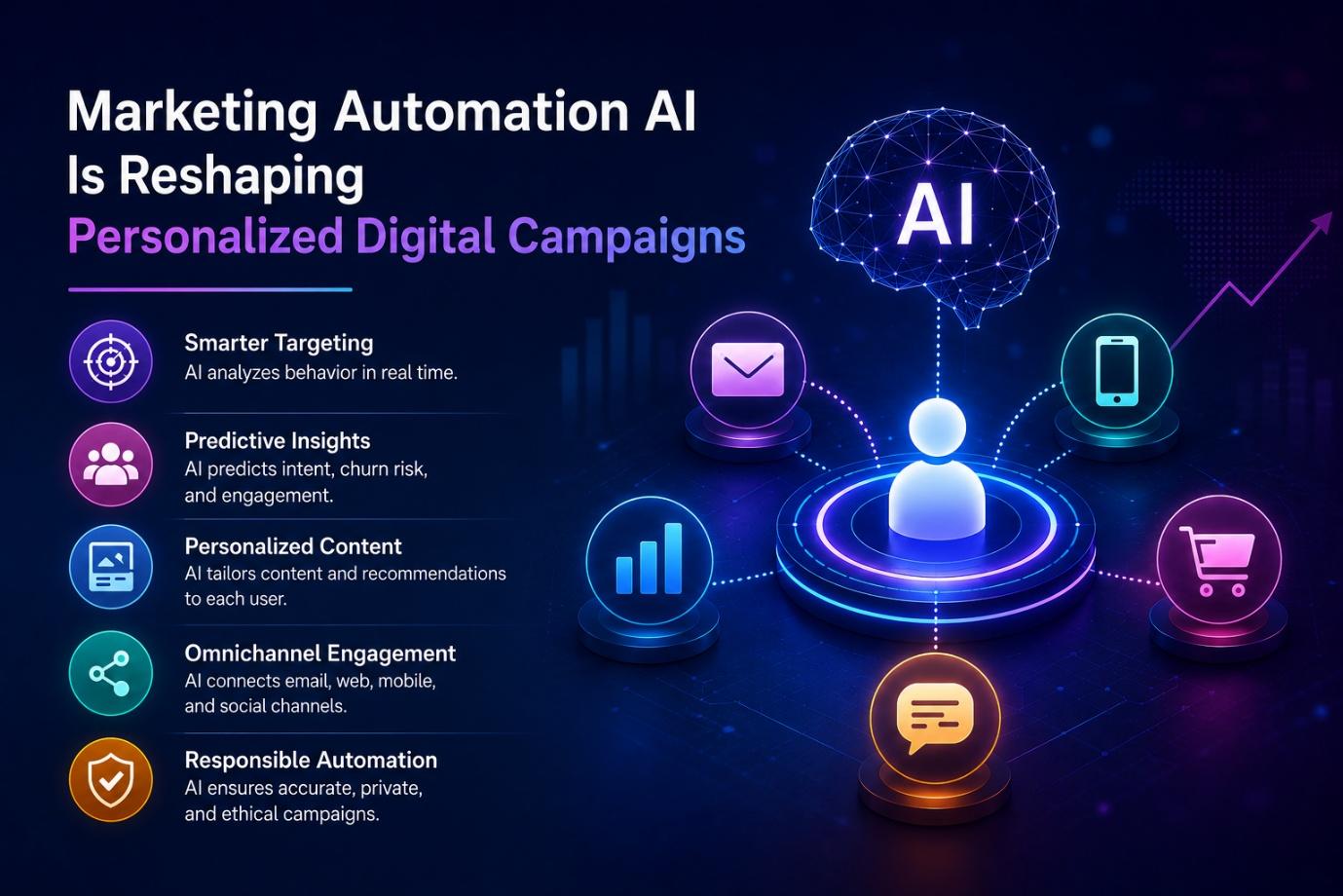
Today’s digital marketing campaign has the capability of reacting to events in the customer journey instead of following a fixed plan laid out days in advance. The fact that a product is seen twice, an email isn’t opened, purchase is finished, or a browsing pattern suddenly changes can impact the next message. The next communication in the campaign program can be adjusted and facilitated by AI technology used for marketing automation.  Technology has seen its success reflected in usage figures. As it has been shown in the survey of 4,450 marketing professionals conducted in 2026, 75% of them have already used AI technology, and 84% of them use conventional marketing methods.  Campaigns Are Getting More Responsive  Automated campaigns still run on simple rules. A customer does something, a predefined workflow sends an email at a chosen interval, such as 24 hours or 48 hours, and the communication is carried on. If these systems are useful when it comes to routine communication, they lack knowledge of what happens in between the triggers. AI changes the calculation. Instead of relying on one event, automated systems can assess several recent interactions before selecting a response. A visitor who repeatedly checks the same product but ignores promotional emails represents a different situation from someone who has just completed a purchase. The difference can show up in campaign results. Research published in 2025 recorded engagement and action rates roughly 10% higher for an AI-supported personalized telecom campaign than for a comparable non-personalized campaign. Content production is changing alongside targeting. Certain generative AI workflows have also been reported to accelerate content development by up to 50 times. Data Is Still the Difficult Part The technology may be capable of processing large amounts of information, but the information itself is often scattered. Customer service records, purchase histories, website activity, and marketing interactions may exist in separate systems. The main challenge for real-time personalization was discovered through research conducted with over 8,000 consumers and around 3,200 customer experience professionals: fragmentation of the data.  The situation has not disappeared as AI adoption has increased. Among 4,450 marketers surveyed in 2026, 58% reported complete access to service data. Complete access stood at 56% for sales data and 51% for commerce data. This leaves a substantial proportion of organizations working with incomplete customer information. The need for systems supporting campaign management can be seen in market statistics as well. According to Data Intello, the Digital Recall Campaign Manager global market will be worth $2.8 billion in 2025 and will grow to $5.9 billion in 2034, registering CAGR of 8.6% for the years between 2026 and 2034. Metric Latest figure What it tells Marketers using AI 75% AI adoption is widespread Generic campaigns 84% Personalization remains uneven Engagement improvement in one study 10% AI-supported targeting showed higher response Content development acceleration Up to 50× Some production tasks can be completed much faster Complete service-data access 58% Data availability remains incomplete Complete commerce-data access 51% Commerce information is particularly fragmented Personalization Has Moved Beyond a First Name A personalized email once meant little more than inserting a customer’s name into the subject line. That approach has become too narrow for the amount of information generated by digital activity. A modern campaign can consider previous purchases, products viewed, frequency of visits, response to earlier messages, and preferred communication channels. These signals can be assessed together rather than independently. The timing aspect is becoming relevant in this case. Based on a survey, conducted in 2026, it has been revealed that 83% of marketers say that customers tend to communicate more with companies in the format of two-way communication. However, it is hard for 69% of them to reply to customers in time.  The received data gives an idea that the right message delivered after the customer’s curiosity has faded won’t lead to any results. Thus, quick analysis is essential, as customers’ intentions can change quickly. Predictive Models Are Changing Audience Selection One more advancement consists of moving from descriptive segmentation to predictive one. In this way, there is no longer a need simply to determine what group a customer is associated with; now, predictive AI technologies can give an estimate of the probability of a future behavior.  The measures of the buyer’s purchase intention, the probability of leaving, engagement, and preferences in content become available as predictive scores based on previous activities. Several studies conducted have unearthed the fact that companies applying AI-driven personalization strategies yielded results in customer satisfaction improvement ranging between 15 and 20 percent. Some reports indicated revenue uplifts of up to 8% and cost reduction of about 30%. The figures provided differ between companies and industries. The variation affects the accepted metrics and methods of measurement.  Consumer behavior adds to the understanding of the trends in personalization and its development. According to research, 56 percent of customers would like to have their purchases considered while personalizing experiences, while 50 percent want personalization on the basis of previously viewed products. Five Innovations Reshaping Campaign Processes  More Data Also Creates More Responsibility There is a less visible side to automated personalization. The more information a system uses, the greater the consequences of inaccurate or outdated records. An example of receiving an irrelevant recommendation can be considered less significant. Repeating the same messages based on old behavior or using personal information without the permission can give rise to bigger problems.  The scope of the issue can be understood from a 2026 data showing that 98% of the surveyed marketers faced challenges in personalizing their messages. Accuracy, privacy, and automation consequently need to be considered together. Customer information requires appropriate consent and security controls, while automated decisions need rules around frequency and relevance. Human review also remains useful for situations that fall outside normal patterns. Where Digital Campaigns Are Heading The biggest change may be the shrinking distance between customer behavior and campaign response. Traditional campaign planning often separates creation, launch, measurement, and adjustment into different stages. AI is gradually bringing those stages closer

Marketing Automation AI Is Reshaping Personalized Digital Campaigns Read More »
Digital Marketing Course in Haryana

Online vs Offline Digital Marketing Courses in Haryana: Which to Choose?

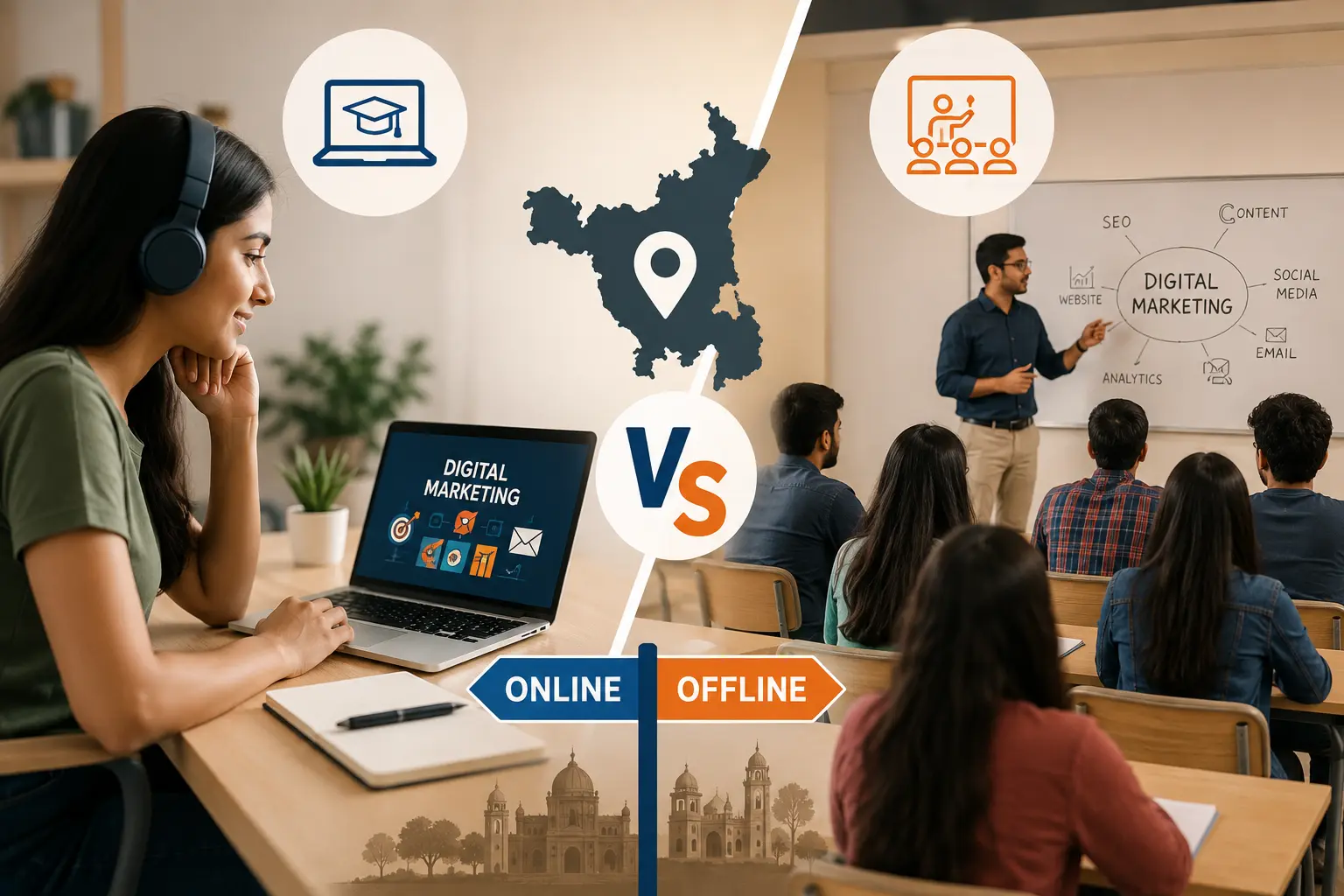
If you’re planning to enroll in a digital marketing course in Haryana, one should understand that this process isn’t as simple as it seems. Long gone are the days when people had to find the nearest educational institution and take the first course offered. With the growing population of digital marketing students in places like Kurukshetra, Karnal, Gurugram, Panipat, and Faridabad, the tough choice students face is whether to pursue an online course or offline classes in person at a physical school or institute. Though one can find success in both of these cases, the paths to success are entirely different.  At this point, you are likely to have gone through the various options in Haryana regarding digital marketing courses and have come across numerous educational institutions and platforms promising to be the best. Students can choose between fully online courses, traditional in-person programmes, or hybrid courses that blend online and classroom learning. In order to make the right choice, one has to get an idea of the pros and cons of the various types of courses and determine which format aligns best with your preferences. Why Digital Marketing Is Worth Learning in Haryana Right Now Haryana’s business environment has been witnessing remarkable developments in recent years. Gurugram city has emerged as a big hub for startups and multinational companies, while towns like Kurukshetra, Karnal, Hisar, Faridabad and Panipat have been slowly developing local businesses that need help with social media marketing, search engine optimisation and paid advertising. The main reason for the increasing demand in Haryana for the best digital marketing course every year is the search for digital marketing professionals by local companies.  Whether you are a university student focused on creating a career path, a working professional willing to change careers, or a small business owner wanting to do marketing on your own, a good digital marketing programme in Haryana is likely to bring you more success than a regular degree. Online Digital Marketing Course in Haryana: What You Get The online digital marketing course in Haryana allows you to study from anywhere at any time without needing to travel to a physical location. Most courses consist of a combination of live doubt-clearing classes and recordings of lectures, assignments, and sometimes supervised exams.  The benefits cannot be overlooked: Here is what makes classroom learning appealing: On the other hand, an offline digital marketing course in Haryana usually costs more, requires daily or weekly travel, and offers less flexibility if your schedule changes unexpectedly. If you live far from a major city, commuting alone can eat into study time. Online vs Offline Digital Marketing Courses: A Side-by-Side Look When comparing online vs offline digital marketing courses, a few factors consistently come up during the decision-making process. The table below breaks it down at a glance: Feature  Online Digital Marketing Course  Offline Digital Marketing Course  Flexibility  Learn from anywhere, anytime. Access recorded lectures and materials at your convenience.  Fixed class timings and location. Requires you to be physically present at the institute. Learning pace  Self-paced learning. You can pause, rewind, and rewatch lessons.  Instructor-paced learning needs to keep up with the batch schedule.  Interaction  Limited face-to-face interaction. Doubt-solving via live lessons and chats  Direct interaction with trainers and peers in real time and better networking opportunities.  Practical learning  Hands-on projects with digital tools may depend on course quality and support.  Hands-on training in labs and classrooms with direct guidance of trainers.   Cost  Generally more affordable, it saves on travel and accommodations. Usually more expensive due to infrastructure and training costs.  Placement support  Depends on the platform and institute offering the course.  Many institutes offer internships and placement assistance.   Best suited for  Working professionals, students, or anyone seeking flexibility.  Students, freshers, and those who prefer a traditional classroom experience.  Typical duration Can stretch beyond 2-4 months if inconsistent Usually completes within 2-4 months Career support Depends on the institute’s placement cell Often includes local agency tie-ups and in-person mock interviews As the table shows, cost and flexibility favour the online digital marketing course in Haryana, while structure and networking favour the offline digital marketing course in Haryana. Certainly, career assistance is more about having real digital marketing courses with placement assistance and not just about the mode of the course. In the end, the choice of an online versus offline digital marketing course in Haryana depends on your learning style, financial resources, and personality traits rather than on the superiority of either method.  What Makes Digital Marketing Institute the Best in Haryana There are some distinguishing features between a good digital marketing course and an ordinary one, irrespective of the mode of learning. Below are some factors to consider when selecting a digital marketing course in Haryana and a few common mistakes to avoid when choosing an institute:  Why a Digital Marketing Course With Placement Matters Acquiring knowledge means just getting halfway through the process. A training in digital marketing with relevant placement services connects theory with practice in actual jobs in the industry. The job placement services can assist you with resume preparation, mock interviews, internship opportunities, and direct connections to employers. Before taking a training course, make sure you ask the question, ‘How many students were placed successfully during previous training? Which positions and companies were involved? Is the placement guaranteed or only a possibility? An honest educational institution will provide comprehensive answers instead of empty promises. Proper training in digital marketing in  Haryana that helps you find your job will be worth much more than a course that gives only a certificate. Hybrid Learning: The Middle Ground Worth Considering If you’re still unsure about whether or not this is the right time to take the plunge, you should consider taking a hybrid digital marketing course in Haryana. Hybrid courses involve the use of recorded online lectures as theory combined with meetings in classrooms for practical experience, live campaign reviews, and networking. Hybrid methods of learning have become popular due to the flexibility of online studying alongside classroom

Online vs Offline Digital Marketing Courses in Haryana: Which to Choose? Read More »