
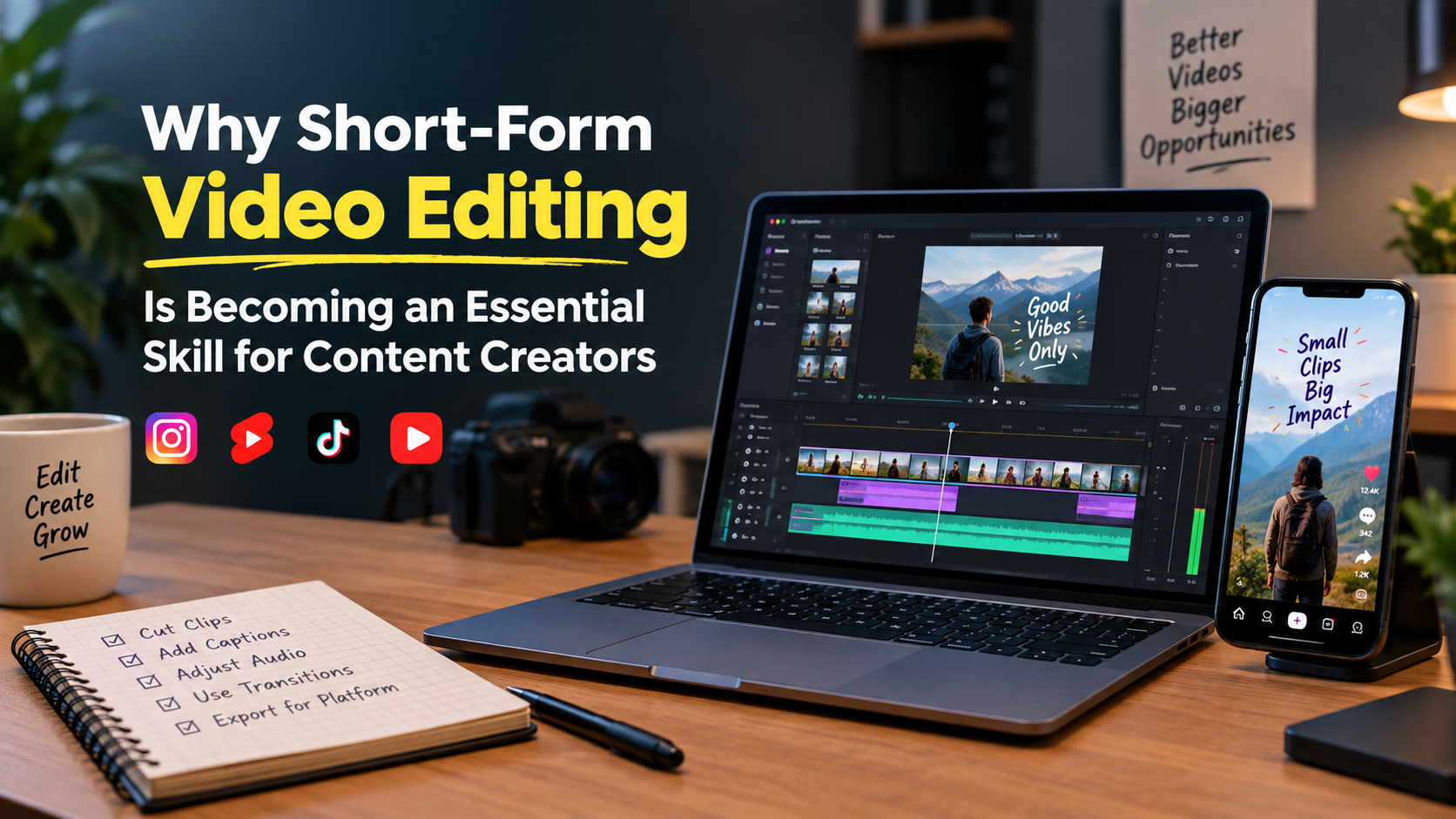
When you are browsing Instagram or YouTube. You will see numerous short videos on everything from cooking and fitness to education and product reviews. Some videos grab your attention. Also, others do not take your eyes off your phone for seconds. The editing process of a video makes a huge difference. In today’s day and age, content makers need more than a camera and a great idea. They should get the message across and capture and hold the viewers’ attention. Hence, the importance of short-form video editing for content creators on social media platforms.
As per the report from Meta in June 2026, based on data from Ipsos, 89% of Gen Z users in India watch Instagram Reels on a daily basis. This speaks to the ubiquity of short videos in life.
Table of Contents
Why Short Videos Are Becoming More Popular
People tend to use social media to learn something quickly, find entertainment, and discover new products. Short videos allow you to convey information without having your viewers watch a lengthy video. Platforms are also providing creators with numerous new options for this format. For instance, YouTube Shorts permits creators to elucidate matters and narrate tales in under three minutes.
But a short video is not necessarily interesting. It may be too choppy with pauses, audio distortion, and misplaced shots that may put viewers to sleep. Creators must keep in mind the content and how they present it. They can offer valuable information without making the viewer’s time go to waste if they are properly edited.
How Short-Form Video Editing Makes Content Better
Raw footage can have errors, delays, repetitions, and irrelevant footage. This can be split into sections to be removed, and the end result will be easier to watch. If you are a fitness creator, you may record a fitness routine that lasts 10 minutes and need to post a fitness exercise guide that lasts 45 seconds. The creator can select the most pertinent clips, add some simple directions, and trim out the superfluous footage to produce a video that is clear and informative.
There are several important video editing skills to have:
- Cutting clips: Edit out any extraneous material and focus on the key points.
- Captions: Make materials understandable to viewers if they hear nothing.
- Manipulating sound: Ensure that speech is audible and background music is not too loud.
- Employing transitions: Link scenes together without going overboard with effects.
- Selecting the right format: Ensure the video is appropriate for the platform and mobile screen.
The goal of editing isn’t to add to the effects. It’s for understanding and appreciation of content.
Why Content Creators Should Learn Editing
The first phase of a creator’s journey is for them to record videos on their phones and handle their own social media presence. They will gain control of the final product by learning the basics of editing.
Example: A foodie could cut out part of the lead-in time of a recipe video, show how to do some of the cooking steps, and post the finished product at the end of the video. Text can be inserted to explain difficult parts of the video without re-recording.
The editing skills also enable creators to experiment with various styles. They can try out a new beginning, move clips around, and even create various variations of the same video for various platforms. Not all creators need to be professional editors. But the basics can save time, improve content quality, and put ideas into videos more easily. If you want to learn these basics step by step, a structured video editing course can help you practise cutting and exporting with proper guidance.
How Storytelling Makes Short Videos More Interesting
Successful short- form video editing require more than catchy graphics or tunes. It should tell viewers why they need to watch. Suppose a creator is making a video about a new product they have created. It is important to show random clips of the product, as this may help clarify why it is useful. Instead, the creator may pose a shared issue and demonstrate how the product functions, and then end with the primary benefit.
This makes a simple story that a viewer can follow.
There are 3 parts to a basic structure:
- Beginning: Introduce a question, problem, or interesting moment.
- Middle: Show the process or explain the main information.
- Ending: Share the result or answer the question.
This is not always required in a video. Different video styles can be used for comedy, travel, and lifestyle videos. The key is to ensure the scenes flow together and the meaning is clear.
How Editing Helps Creators Build a Recognisable Style
A reader who encounters this writing style frequently may start to identify the writer’s particular style. Videos can appear connected as they share the same fonts, colours, captions, and music. For instance, an education creator might offer obvious subtitles and simple graphics, and a travel creator might have photographs of the beauty in the environment.
A consistent style will be achieved with the same fonts, readable captions, music and other visual elements of the video. Consistency is not equal to uniformity. Creators can experiment with new formats but may retain familiar and familiar aspects.
Why Businesses Need Short Form Video Editors
Short videos are now being used for businesses to introduce products, explain services, answer customer questions, and demonstrate how products function.
For example, a restaurant might post a video on their Twitter demonstrating how their food is prepared, while a clothing company could show a video of their product in different styles. These videos are intended to be used to inform prospective customers of what the company does.
Video editors capable of turning raw footage into a clear and engaging video might get a shot at brands, video agencies, or individual video makers. But good editing does not necessarily yield results. A video editor should also be able to know the type of video, the appropriate audience, and the message that the business wants to share with others.
Important Video Editing Skills to Learn
If you are a beginner, you don’t have to know all the tools that you can edit. It’s easier to build confidence with the basics. Unnecessary footage is cut out for the proper flow, and clips are used to shorten in a natural way.
- Audio Editing – improves speech intelligibility and removes background noise.
- Colour correction adjusts the brightness, contrast, and colour to balance footage.
- Viewers can better understand the message and key information through captions and text.
- Export parameters guarantee a completed video that is the right size, resolution, and shape for the platform.
- Reels and Shorts are normally recorded in the 9:16 aspect ratio.
Here are some tools to help beginners practice these skills: CapCut, VN Video Editor, Adobe Premiere Pro, and DaVinci Resolve. It will be dependent on their device, budget and needs.
How AI Is Changing Short-Form Video Editing
AI is helping to speed up some editing jobs. They can create captions, eliminate pauses, enhance audio quality, and aid in determining helpful moments during longer conversations. For example, an AI can be used to analyze a podcast and decide what should be included in short snippets that can be turned into short videos. However, automation tools can’t be entirely substituted with human beings. AI could select the incorrect video and/or read the wrong caption for the video. It might also fail to capture the feeling or sense in a talk.
An editor can see these results and make improvements when they know the time, story, and the needs of the audience. The ability to work with AI editing tools in conjunction with the fundamentals of editing can enhance creators’ efficiency while maintaining control over the final video. To see how these tools fit into a real workflow, you can read this guide on AI video editing tools for professionals.
Conclusion
The world has recognized the importance of short videos to convey information, entertain, and promote businesses. However, merely recording a video isn’t enough. The material should be clear, well-structured, and appropriate for the audience viewing it.
Short-form video editing is a tool used by creators to enhance their videos, tell better stories, and build their own style. It also enables them to acquire a valuable skill for working with brands and businesses.
The fundamentals of video editing will be useful as the tools and software used for video editing evolve. An understanding of video editing can help as the tools and software develop. It’s knowing what to remove from the picture and what to leave in and how to put the message in a way that will be understood by viewers.
FAQs
Why is short-form video editing important?
This allows you to cut out any extra footage, put captions in, improve the audio quality and provide information. This can make your videos more accessible and entertaining.
What is the easiest video editing software for beginners?
CapCut and VN Video Editor are good resources to use if you’re new to video editing. DaVinci Resolve and Adobe Premiere Pro have more advanced features. What you choose to use depends on your system and what type of editing you’re going to do.
Is it possible to teach yourself video editing?
It can be learnt from tutorials and practicing online. Start with basic effects such as cutting clips, captions, and audio edits.
Does video editing help increase engagement?
Having a good edit can make your audience understand what you are trying to portray with your video. Having good opens, pacing, and clear captions can help; however, it depends on what the video is about and who is watching.
Will AI Tools Make Short-Form Video Editing Obsolete?
Yes. Although AI can help with some parts of editing, it is important to have human intuition. This will help with telling a good story, timing, and accuracy. Knowing how to edit will also help when verifying and improving what has been created by AI.

Vandana is a Content Writer and Digital Marketing Executive with 1+ years of experience in SEO content writing, website content, and digital marketing. She specialises in creating engaging, SEO-friendly content, keyword research, and content planning to help brands improve their online presence and audience reach.