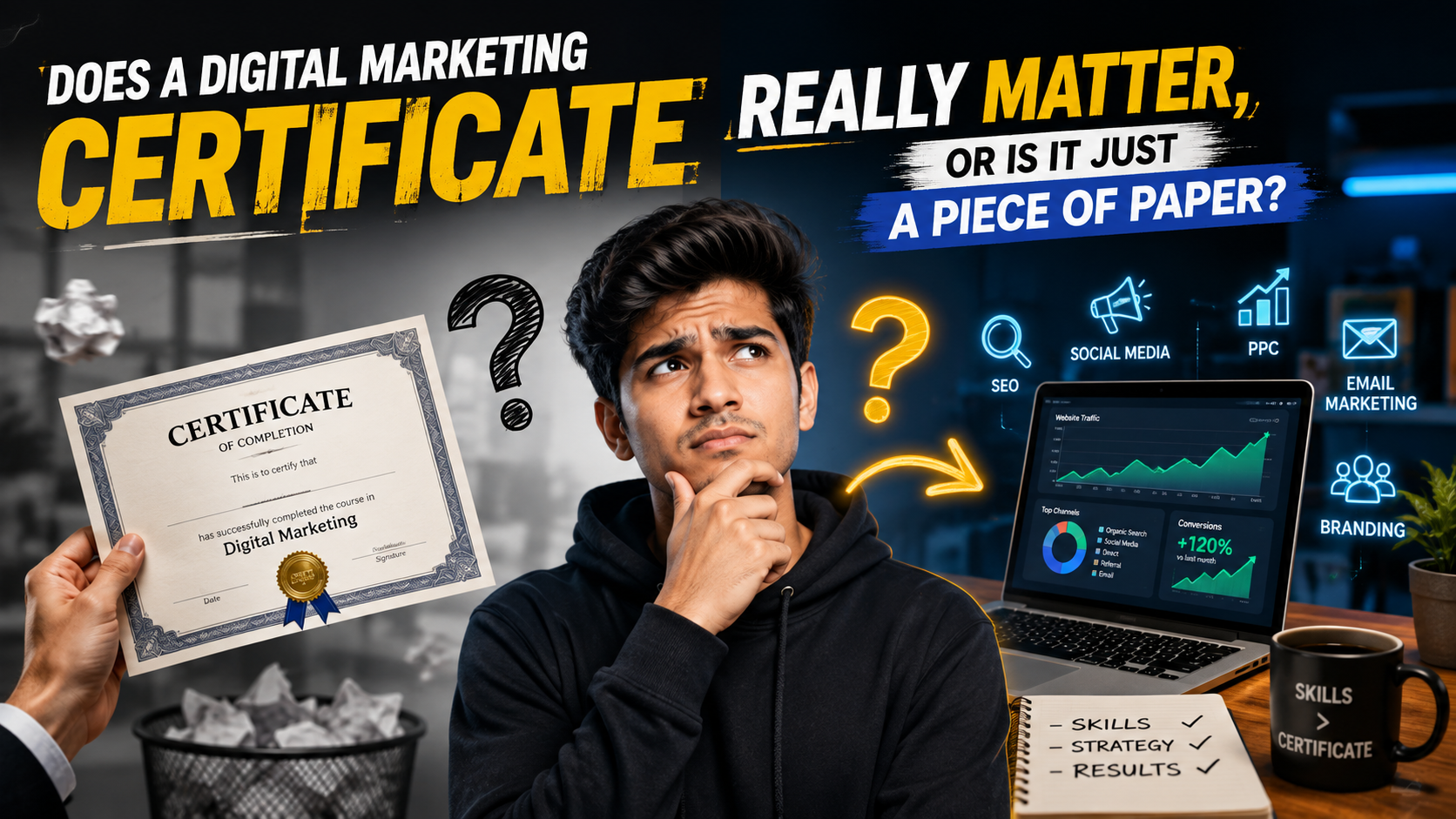
This has to be one of the top questions on your mind when you’re thinking about enrolling in a digital marketing course for yourself. You put your time, effort, and money into obtaining the certificate. But would it help you get a new opportunity, or would it just be collecting dust in files?
It is a legitimate question. Digital marketing is one of the fastest-paced industries on the planet, and millions are enrolling in these courses to upskill. However, not every course works the same way, and not every certificate means the same thing. Let’s look into this practically — but first, avoid these common mistakes students make while choosing an institute:
Table of Contents
What a Certificate Actually Proves
A certificate confirms that you know and understand something. Now, after all of your hard work, you want to know: what does your certificate really represent? It’s evidence you’ve learned and completed a curriculum in Social Media marketing, SEO, content marketing, Google Ads, email marketing, etc. And most importantly, what your employer will be seeing is: ‘You didn’t just learn from an online course. You built the confidence and experience to work on real digital marketing projects.”
There are so many free online YouTube courses and random blogs. But a certificate proves you’ve completed formal training, and your skills and experience are what truly make the difference. This means you have acquired all the information required and revised the whole syllabus right from top to bottom. Also, you have completed all the assignments that were needed to complete the course.
However, the certificate in itself is not going to get you a job. What you gain from the training will get you a job.
The Real Value Is Not In Paper, But In Skill
Say you bought a gym membership, but you never showed up for a workout; what is the purpose of the membership then? None. In the same way, getting a driving licence doesn’t make you a fantastic driver. The time you spend driving is what will turn you into a competent driver.
With digital marketing, the situation is also kind of the same. The certificate is similar to the gym membership in this analogy. The real benefit comes from what you do during the course, such as:
- Knowing how Google SEO actually works in a hands-on approach rather than just memorising the term.
- Running actual Google Ads campaigns using proven pay-per-click strategies.
- Managing social media pages and calendars.
- Knowing tools like Google Analytics, Google Search Console, SEMrush, and other free keyword research tools.
- Creating content for Google based on keywords.
- Working on actual projects for real clients (not case studies or assignments).
- Knowing how to work on Canva or Photoshop for designing marketing creatives.
What if a course gives you a paper certificate but not the above skills? Then yes, it’s a piece of paper. If it gives you all the skills, then this paper becomes evidence of what you learned and earned. There’s a big difference, and that’s also the difference between “a course worth it” vs “a resume filler”.
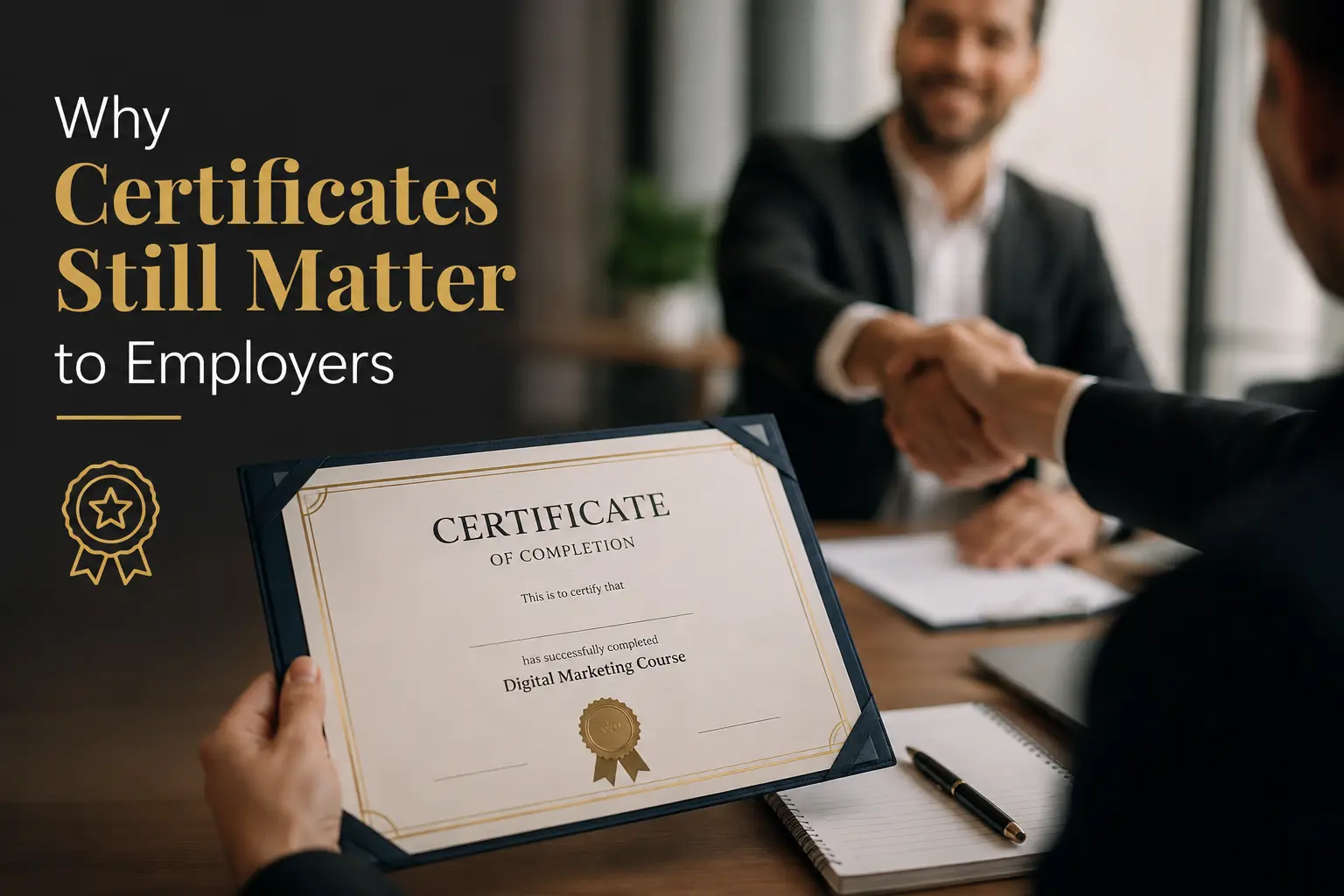
Why Certificates Still Matter to Employers
Although skills are more important now, the certificate is not meaningless either. Here is why employers are still interested in certificates:
1. Shows dedication. Completing a three- to six-month course proves to an employer that you can be persistent and determined till the finish. Given that digital marketing is a rapidly evolving field, employers are looking for candidates who can remain committed to the cause, rather than giving up midway.
2. Shows credibility. Having a certificate from a popular training institution that involves certifications from Google and Meta makes you appear more credible and recognised. Recruiters use these certifications as validation of the fact that you’ve learned valuable job skills in the field and are committed to a digital marketing career.
3. Get you shortlisted. When recruiters review your resume as an initial step – mainly in early-stage jobs – they often look at certifications as the first line of filter. Even if you are talented and possess the necessary skills, you are often overlooked if you do not have a certificate on your CV. After working for a few years, your skills and experience take over. But at the start, certification helps you get through the door.
4. Your Gateway to an Interview. A certificate can be useful to get an interview and a good starting point for the conversation. It allows you to discuss your skills and experiences, what you learned, and your qualifications. But a certificate can only get you in the interview; your knowledge and practical skills will get you the job.
The Other Side: When a Certificate Really Is Just Paper
Let’s be honest here too. There are courses out there that only focus on giving you a certificate at the end without teaching you anything practical. These are the courses where:
- You only watch recorded videos with no live interaction
- There are no real projects or case studies
- The trainers do not have real industry experience
- There is no placement support or career guidance
- The course finishes fast just so you can get your certificate quickly
If you enrol yourself in a course, you’ll end up with a piece of paper that looks impressive and will work wonders on your LinkedIn profile but may be useless while applying for a job. Nowadays, companies are quite clever, and while interviewing, questions like “How would you set up an SEO campaign for this site?” or “Take me through the Google Ads Report and pull one of the ones made by you” will be thrown at you. If you cannot explain it in detail and in a certain manner, then your piece of paper becomes useless.
This is where the value of the brand of the institution plays a role. A certificate of a training institution that emphasises practical assignments, real tools, and trainers who come from industry is worth a thousand times more than a certificate of an institution that is focused only on registering students and handing out certificates.
Certificate + Skills = The Winning Combination
The smartest way to look at this is not “certificate vs. skills”. It should be “certificate with skills”.
A good digital marketing course should give you both:
- A certificate to prove you completed proper training
- Live projects, internships, and hands-on experience for real, job-ready skills.
This mix is what creates a career. The certificate is the key to the first door, but the skills will keep all the doors you’ll face open. This is the reason why practical training centres are much more popular than theoretical centres. Today’s students don’t just want a piece of paper to put in files; they want to go out of the training centre knowing exactly how to launch a marketing campaign, create SEO content, prepare a graphic on Canva, administer an account on Facebook Ads, or configure a site on WordPress.
When training centres offer you an internship and projects with the skills included, you’re not just learning digital marketing academically. You’re practising it just as if you were in a job. This will smooth out your transition from student to professional.
Here are a few easy questions to ask yourself
before enrolling in a digital marketing course: Ask these simple questions
Does it include live projects and actual client work?
You learn better when you’re actively doing. Listening to lectures all day isn’t the same as managing campaigns for actual clients and gaining hands-on experience.
Am I getting hands-on with tools such as Google Ads, Google Analytics, and SEO tools?
You can know the entire theory behind SEO, but actually using tools such as Search Console and SEMrush to identify and fix website ranking issues is an entirely different ballgame.
Will I get placement support or help in interviews?
Learning isn’t the end game; preparing for it and applying what you learnt successfully is what matters most. Most good digital marketing programmes assist with resume making, conducting mock interviews, and networking with companies.
Will I also receive certifications from firms such as Google and Meta and not just their in-house certificate?
Receiving Google, Meta, and Facebook certifications not only strengthens your resume but also helps validate your skills from a third-party perspective rather than solely from your certificate provider’s brand.
Do students from the institute get jobs after completion of the course?
There are various platforms where you can check their performance from alumni feedback and testimonials and/or even directly connect with former students.
Are the trainers of the institute actively in-demand in the industry?
A trainer who has actual industry experience and manages real campaigns can tell you everything that you’ll never find in any book.
If the answer is yes to most of the above, then that certificate is well worth it. It’s your proof of a genuine learning experience and not just a piece of paper.

What This Means for Your Career
One of the easiest industries to get into is digital marketing since there is no technical background or coding required to start it. You do need to have a desire to learn and the proper training.
This course takes a blend of theory, assignments, real-life projects, and placement support to ensure you’re ready for the real world, not just an exam.
The certificate you obtain will be added to your resume, giving it more credibility, while the skills you have acquired will prepare you for positions like an SEO specialist, a social media manager, a paid ads manager, or a content writer. With experience, you can even go as far as becoming a digital marketing manager or even go into the business of starting your own agency. A certificate can help you get in the door, but it’s your knowledge, hands-on experience, and achievements that will get you a successful career.
Final Thoughts
Therefore, does a digital marketing certificate really matter? The answer is yes, but only if the skills come with it.
Without actual knowledge, a certificate is just a piece of paper. However, when it is earned through practical training, live projects, and hands-on use of industry tools, it becomes a true reflection of your skills, helps build trust with employers, and gives you the confidence to start your digital marketing career.
If you decide to pursue the career, make sure you get a practical training programme and not a theoretical one so that your certificate is not just on paper but proof that you have actually got it, and it is a step towards building the right sort of career and not just an ornament on your resume.
I want to reply to this job post to say that I can do the work. Could you please let me know the duration of the videos and the rate per video?

Nizu Sachdeva is a Digital Marketing Specialist with around 6 years of experience in SEO, content marketing, social media strategy, graphic design, and video editing. She specializes in creating digital strategies and content-driven campaigns that help businesses strengthen their online presence.