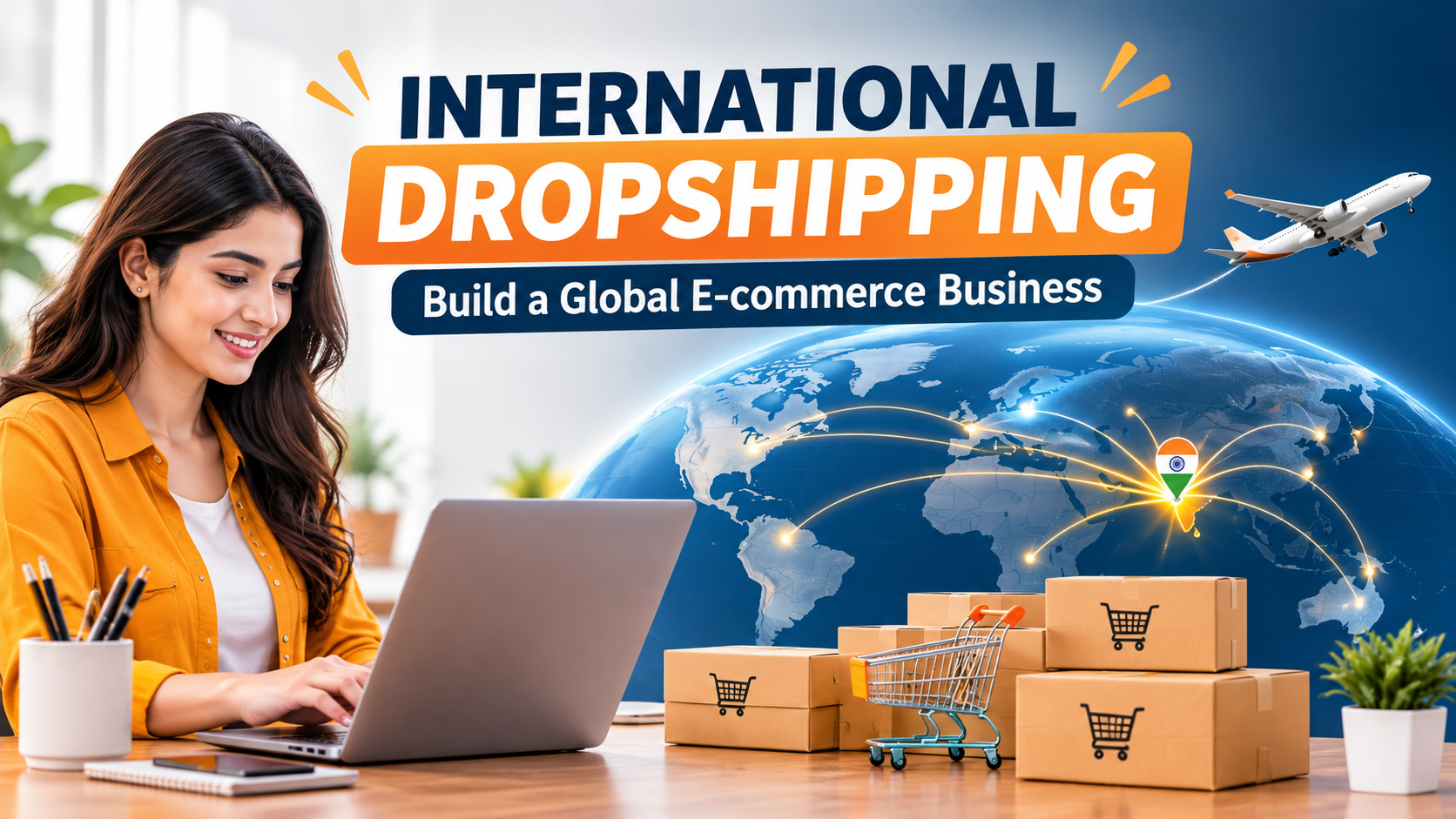
Online shopping is now a growing industry, creating opportunities for individuals to pursue their own business ventures. In today’s times, it’s not necessary to have a physical shop to sell products to customers. Having an online store allows you to sell products to customers from other countries, all from the comfort of your Indian business.
One such business model that makes this possible is international dropshipping. This enables the seller to sell products to customers around the world without having to buy and hold inventory or store the products in advance. The supplier is responsible for the storage and delivery of the products, and the seller is responsible for the day-to-day operation of the website, as well as customer acquisition and order management.
With the development of business and e-commerce, internet shopping is also simpler for small businesses and new entrepreneurs. However, it’s not just about building a website if you wish to start an international dropshipping enterprise. Understand product selection, supplier management, digital marketing, advertising, and customer service.
Let’s find out how international dropshipping functions and what you need to know before you get started.
What Is International Dropshipping?
The international dropshipping business model is an online business where you sell a product without having to maintain your own inventory to people who live in other countries.
When the customer clicks “order” on your website, you order the product from a supplier. Then the supplier packs it and sends it directly to the customer’s address. Your profit is derived from the profit from the business minus all of your business costs.
The process generally works in the following way
- One of your website visitors clicks on a product you offer.
- The customer orders and makes payment.
- Order details are sent to you.
- You pass on the order to your supplier.
- Packaging and delivery are handled by the supplier.
- The customer gets the order, and you handle any additional correspondence.
This model minimizes the requirements for stock management and storage. But you still have to handle product information, order updates, refunds, and customer complaints.

Why Start International Dropshipping from India?
India has opportunities for entrepreneurs interested in going global in eCommerce. Internet connectivity and digital business tools allow for many activities to be managed remotely.
Research foreign markets, set up an e-store, contact suppliers, and advertise products without opening a store in a foreign country.
There are several reasons why people see this business model:
- Reduced stock levels – No need to buy bulk quantities of products before orders come in.
- Targeting buyers in other countries through your website – You can reach your customers across the world through your website.
- Flexible working options – Many activities can be performed online from India.
- Various product categories – you have the ability to venture into products as per the needs of the customers.
- Digital opportunities – Online platforms make it easier to manage sales and promotions.
These advantages make international dropshipping an intriguing choice for novices. But success depends on the demand for the product, suppliers’ production quality, competition, and business costs.
Countries You Can Sell To
The selection of the right country is an important aspect of setting up an international dropshipping business. Each market may have different preferences and different buying and product demand patterns.
The countries that entrepreneurs often consider are:
- United States
- United Kingdom
- Canada
- Australia
- New Zealand
- Germany
- France
- Netherlands
- Singapore
- United Arab Emirates
Don’t go after all these countries in one go; go after one or two markets. Before deciding on a purchase, find out what they like to buy, how much the locals are interested in the products, the shipping costs, as well as the local laws.
Who Can Learn International Dropshipping?
International dropshipping doesn’t require any prior experience in business. Students, graduates, working professionals, freelancers, and small business owners can learn how this model operates.
Students can have a look at it to gain knowledge about online business, and working individuals can think of it as a second business opportunity. Other staff members with website development, content writing, or digital marketing expertise can also apply their talents to handle various aspects of an online store.
No advanced technical skills are needed to learn the basics. But practice, patience, and interest in online business are essential.
Why learn before you start?
There are a lot of newbies who start their online shop without realizing how it functions. They can buy products without doing the necessary research, pick unreliable vendors, and waste money on ads with no idea how to measure them.
If you know what to avoid, you can prevent learning these things. Before you invest in your store, you need to know about product sourcing, website management, payment processing, shipping, and customer support.
It’s also essential to understand how to work out product costs, advertising expenditure, and profit margins. This information can aid you in determining whether a product is appropriate for the target market.
Important Steps to Build an International Dropshipping Business
Step 1. Understand the Business Model
The first step is to gain an understanding of the process of an order being placed from a customer to the supplier. Know about the products’ origin, the payment process, the process of handling orders, and delivery.
In addition, you need to understand what to do when the product is sold out, when an order is delayed, or when a customer requests a refund. In e-commerce, these are common situations, so if you have a clear process, it can make running your business easier.
Step 2. Conduct Product Research
Product research can assist you in discovering items that individuals are keen to purchase. The good product should have demand, should be priced well and should have sufficient profit margin.
When choosing products, take into account the following:
- Customer demand in your target country
- Product quality and usefulness
- Selling price and profit margin
- Shipping charges and delivery time
- Competition from other sellers
- Customer reviews and feedback
- Possibility of repeat purchases
Use online marketplaces, social media platforms, and search trends to learn about what customers are interested in. Don’t just buy products because they’re trendy. Use a real value and market fit test to see if they will be valuable and have a market.
Step 3. Analyse Your Competitors
Competitor analysis provides you with knowledge of how different online retail stores are attracting customers and presenting products to them. Go to other websites and review their product pages, prices, website, and customer reviews. You can also learn how trusted e-commerce companies promote their merchandise on search engines and social media.
Customer reviews can be helpful as they reveal the customer’s likes and dislikes and what issues they encounter. For instance, if you don’t know what information is lacking in the product description or communication during delivery, your store could provide a superior experience.
It’s not just about copying another website; it’s about learning from the market and how to adapt that to your own business.
Step 4. Build Your Online Store
After selecting the product category, you will need a website where the customers could navigate the product and place the order for it. Building is not a must; you can use platforms such as Shopify and WooCommerce. You can also learn how to use the Amazon e-commerce marketplace through product listings and customer reviews, as well as shopping online. Your online store should be simple, easy to navigate, and mobile-friendly. Add Product photos, descriptions, prices, and product information.
Also, maintain key pages such as Return Policy, Privacy Policy, Shipping Policy, Contact Us, and About Us. Ensure checkout is easy to understand and functional across devices.
Step 5. Learn Digital Marketing
Building a website is not enough to drive traffic and sales to your online business. Digital marketing is essential in conveying awareness of your products to people. Key areas to consider are Search Engine Optimization (SEO), Google Ads, Meta Ads, social media marketing, and content marketing. E-commerce marketing helps businesses reach out to potential customers via various online channels. SEO can get your website to show up in appropriate search results, and paid ads can attract audiences. Your social media posts introduce your products to the right people who may want to purchase them. Knowing what these methods are will allow you to find the appropriate ways of promoting your store, rather than relying on just one marketing avenue.
Step 6. Understand Google Ads and Meta Ads
Google Ads and Meta Ads are both helpful platforms to promote products online, but they operate differently. Google Ads will bring users who are already looking for specific products to you. For instance, if a customer is looking for home gym equipment or pet accessories, they might be ready to buy the products.
Meta Ads enable you to market products on Facebook and Instagram. Showing product features and grabbing attention can be achieved by using image ads, video ads, carousel ads, and Reels. Learn to use the features of selecting audiences, creating ads, and tracking campaign performance. Start with proper testing before increasing your advertising budget.
Step 7. Explore AI Tools
Artificial Intelligence can be used to assist in a number of tasks in the daily functioning of e-commerce. It can assist you with making product descriptions, composing ad copy, arranging blog material, and composing email drafts. AI can also be leveraged to create video content plans and organise customer queries. It can save you time, particularly if you’re working with a number of products.
But be sure to verify the information prior to use. The product information, cost, and the customers’ response need to be right. While AI can assist you, make sure you do your due diligence before taking any action.
Step 8. Understand Shipping and Customer Support
International selling is an important area of shipping. Customers would want to be aware of the time and method for tracking their orders.
Know what to consider when evaluating the service provided by a supplier, including shipping options, delivery time, product quality, and communication. Know the destination countries’ customs and requirements, packaging, and return requirements.
Customer support is of equal importance. Be polite and clear when answering questions about products, payments, and orders. If an order is late or the product is damaged, provide possible solutions and abide by your policies.
Step 9. Track Your Business Performance
Monitoring your business performance enables you to decide if your store is on the proper path. Some of the key metrics that can be measured are:
- Website traffic
- Conversion rate
- Average Order Value (AOV)
- The expense associated with acquiring a new customer.
- Return on Ad Spend (ROAS)
- Return and refund percentages
- Repeat purchase rate
You might need to improve your product pages, prices, or checkout process if you are getting traffic to your website and don’t have any orders. Also, calculate the product price, shipping, and advertising expenses to determine the actual profit.
Build a Brand and Use Content Marketing
The best online store should have more than just various products. It needs to be very distinct and easy to identify for customers. Begin with a professional logo, consistent website design, and product information. Ensure that you have a uniform website and social media style. You can use content marketing to educate your shoppers about your products, too. You can publish buying guides, product comparisons, informative blogs, tutorials, and social media posts related to your selected category. One other effective method for remaining connected with buyers is via email marketing. You can send order updates, new product announcements, abandoned cart reminders, and relevant offers.
Complete Learning Roadmap for Six Months
A simple learning schedule can help beginners understand different parts of the business step by step.
Month 1 – Understand the Basics
- Learn how dropshipping works.
- Explore global e-commerce markets.
- Research different product categories.
Month 2 – Develop Your Store
- Select a suitable niche.
- Compare suppliers.
- Learn Shopify or WooCommerce.
- Create product pages.
Month 3 – Learn Marketing
- Understand SEO basics.
- Explore Google Ads and Meta Ads.
- Learn website analytics.
Month 4 – Practise and Test
- Create sample advertising campaigns.
- Test product pages.
- Study campaign performance.
Month 5 – Improve Your Skills
- Explore AI tools.
- Learn video and content marketing.
- Understand email marketing and customer support.
Month 6 – Review and Improve
- Check sales and expenses.
- Identify better-performing products.
- Improve marketing campaigns.
- Research other target markets.
This is a suggested learning plan, not a fixed timeline for earning profits. Your progress will depend on your knowledge, practice, and business decisions.
Benefits of Learning International Dropshipping
Learning international dropshipping can help you understand how online businesses operate and develop skills that are useful in different fields.
Some important benefits include
- Understanding global e-commerce.
- Learning product research and supplier management.
- Developing digital marketing skills.
- Gaining experience with online selling platforms.
- Understanding customer behaviour in different countries.
- Learning to manage business costs and sales.
- Exploring opportunities to build an international brand.
These skills can also be useful in e-business management, digital marketing, and other online business roles.
Final Thoughts
International dropshipping from India offers a chance for entrepreneurs to sell their products in international markets without keeping their own stock. But if you’re aiming to create a profitable company, you must have the correct strategies and know-how about how online selling works.
The first step is to conduct market research, identify the right products, and identify good suppliers. Discover how to maintain your website, market products, and accept customer orders. Carefully monitor your business costs and check your results before investing more heavily. By learning regularly and through hands-on experience and thorough planning, you can acquire the necessary skills to run an international dropshipping business.

Vandana is a Content Writer and Digital Marketing Executive with 1+ years of experience in SEO content writing, website content, and digital marketing. She specialises in creating engaging, SEO-friendly content, keyword research, and content planning to help brands improve their online presence and audience reach.