
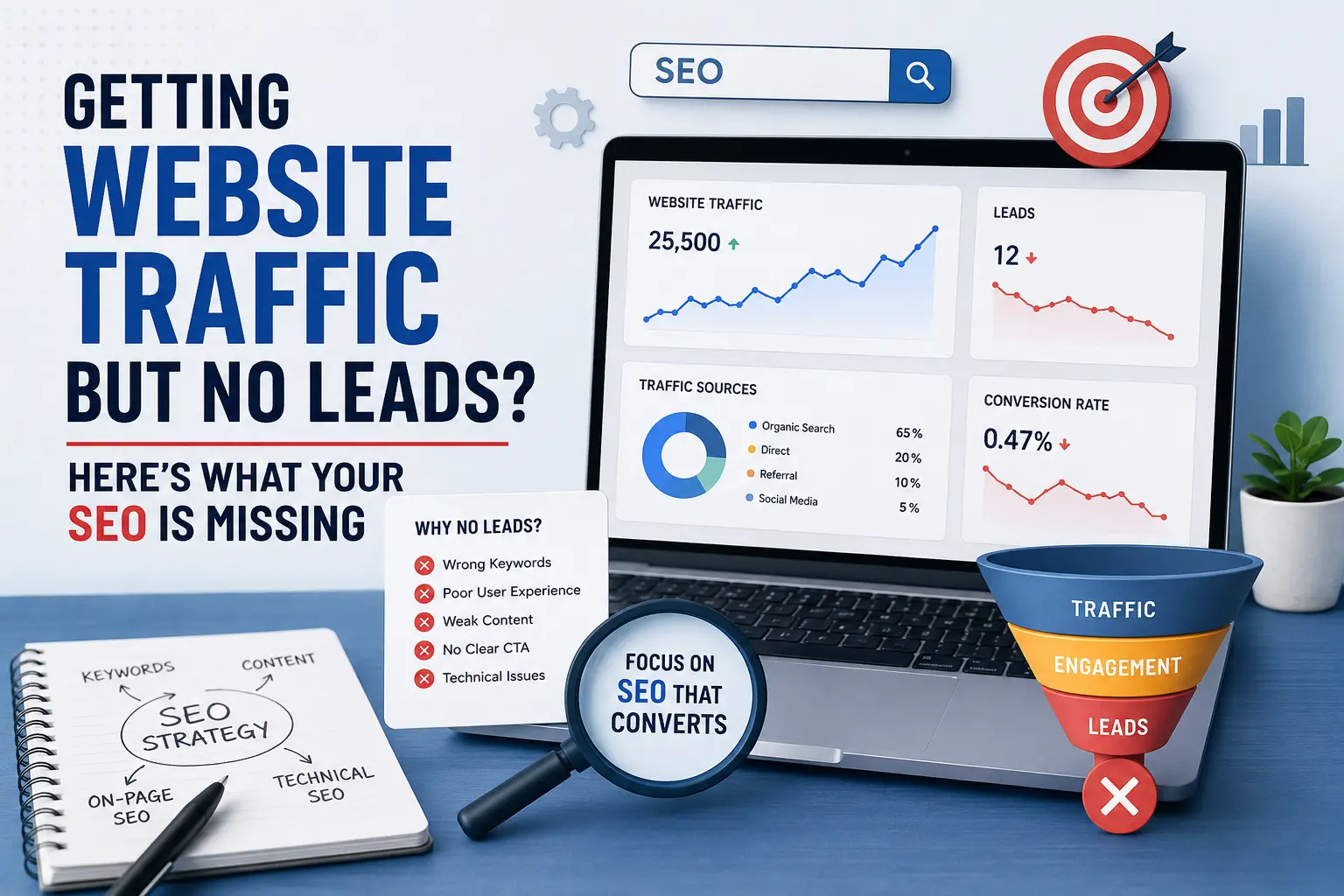
One of the initial objectives of SEO is to drive traffic to the website. However, what if your website is getting traffic daily and is yet not converting into leads?
This is an issue that most businesses face. High traffic on the website looks great in the metrics, but website traffic alone does not guarantee inquiries, calls, subscriptions, or even sales. It’s important to get the right traffic to the site and then convert it into leads. Your SEO strategy can be lacking some basic aspects if your website is getting traffic but no leads.
Table of Contents
Website Traffic vs. Lead Generation: What’s the Difference?
In this type of situation, website traffic could be described as the number of individuals who visit your website.
Through various means like Google, social networking, pay-per-click, and backlinks. Lead generation is another term that can be defined as the process of turning web visitors into leads.
A lead is anybody who fills a form, requests a quote, calls your business, makes an appointment, or subscribes to anything.
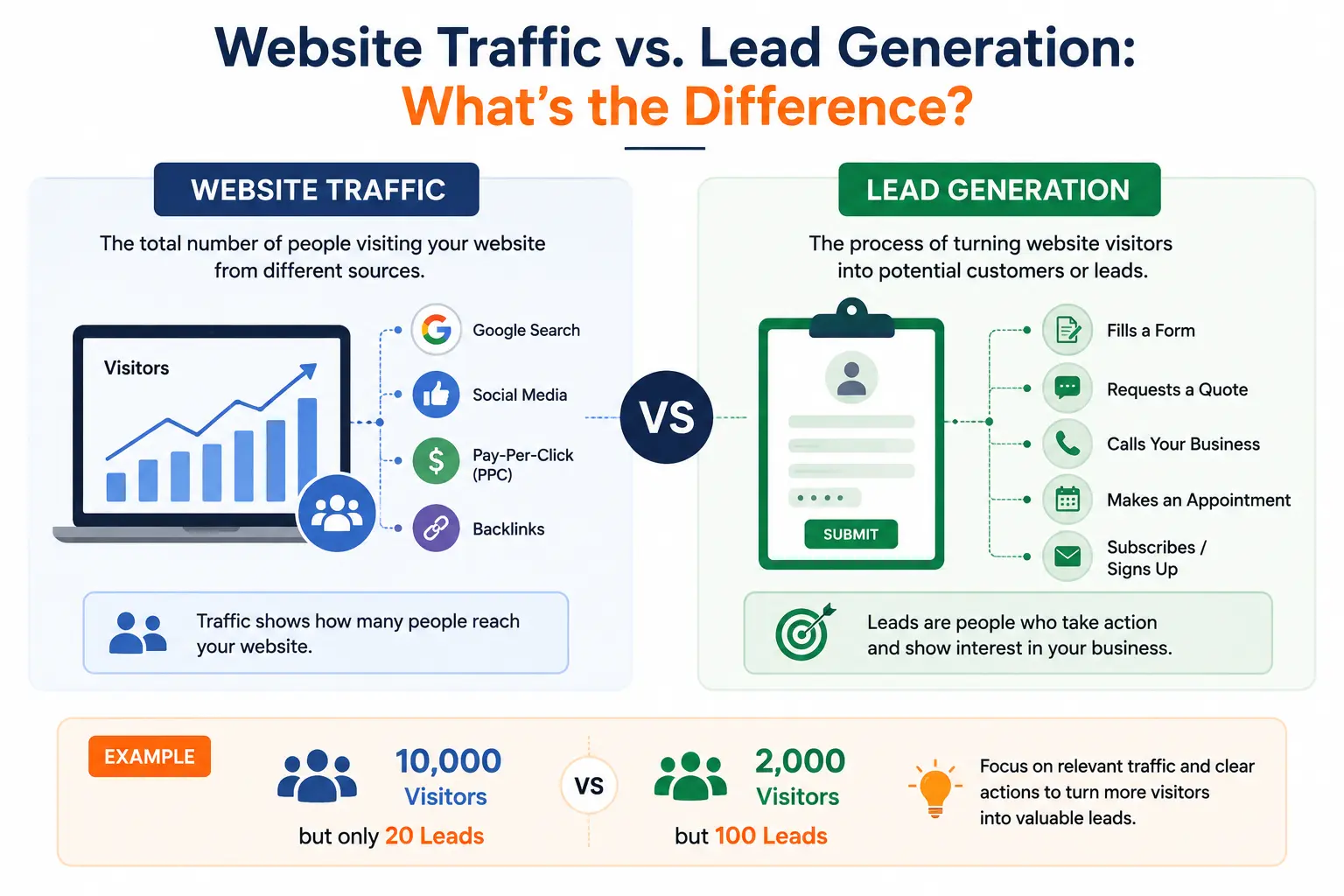
In this case, for instance, one website may have 10,000 visitors in a month but produce 20 leads, whereas another website might have 2,000 visitors yet produce 100 leads. From this illustration, it is evident that the purpose of SEO is not just about increasing website traffic but about relevant website traffic.
Why Your Website Is Getting Traffic, But No Leads
1. You’re Targeting the Wrong Keywords
The primary reason behind low leads is the lack of proper keyword research. A keyword can attract thousands of visitors but be worthless from a commercial perspective. A person looking up ‘What is Digital Marketing’ just wants to learn.
However, if someone is looking for a ‘Digital Marketing Course,’ then he definitely has some commercial interest. While devising your SEO strategy, you need to always take into account the search intent of the keyword.
There are several types of keywords according to the category, which are
- Related to your products/services
- Linked to customer issues
- Valuable commercially
- Suitable for your audience
- Consistent with various stages of the purchasing process
The proper keywords will assist you in attracting fewer yet more profitable visitors.
2. Landing Page Not Working For You
Although SEO can bring you good visitors to your site, bad landing pages can ruin your conversion rate. It is important for the user to understand at the outset what they are going to get, how it will benefit them, and what actions they need to take further.
Here are some common problems with landing pages:
- Blurry headlines
- Weak calls-to-action
- Too much content
- Complex forms
- Bad mobile user experience
- Lacking trust signals
- Long load times
An effective SEO campaign shouldn’t just end once the visitor clicks on your search listing.
3. Your Content Doesn’t Match Search Intent
Content marketing is very important for SEO, but not everyone who sees the content on your website is ready to buy something. A person who searches “SEO tips” is a beginner. A person searching for “SEO services” is shopping around. That’s where the need to comprehend search intent comes into play.
The content you create should solve the user’s problem and at the same time offer a natural step forward. For instance, a blog that provides education can direct the user to a related page that discusses the company’s services, guide, case study, or contact page.
4. Your Website Has a Poor User Experience
Your site can be ranked well but still have customers slip through due to a bad user experience.
Your site will drive visitors away if it is:
- Difficult to navigate
- Slow loading
- Not mobile-friendly
- Messy
- Difficult to read
- Lacking clear contact details
A good site should allow visitors to get what they want easily.
What Your SEO Strategy Could Be Missing
Better Keyword Research
The very first thing that one has to do in order to have an optimized SEO campaign is to know his target audience. While choosing the keywords, one must not just choose those that are popular and widely searched. He must also consider other aspects such as relevance, competition, and business importance.
Strong On-Page SEO
On-page SEO assists search engines and people in comprehending your web pages.
The following factors must be considered:
- SEO friendly page titles
- Use H1 and H2 headings
- Keyword relevancy
- SEO-friendly meta description
- Links to other pages
- Alt text for images
- Informative and unique content
You should not put your keywords in every paragraph. This creates a pleasant user experience for the reader.
Technical SEO
Technical SEO refers to the technical aspects of the website that affect crawling, indexing, loading speed, and user experience.
Look out for:
- Broken links
- Pages that load slowly
- Issues with mobile user experience
- Indexation issues
- Duplicate content
- Improper redirections
- Site architecture
Periodic technical checks may help you detect potential issues related to rankings and conversions.
Quality Backlinks
Backlinks can aid in increasing the authority and visibility of your website if they are received from relevant and reputable websites.
The emphasis should not be placed on getting thousands of backlinks but rather on gaining relevant backlinks by means of:
- Quality guest blogging
- Research
- Guides
- Digital PR
- Resources
- Content
Guest blogging is also an effective method of introducing your website to new audiences.
How SEO Optimization Benefits Lead Generation
SEO and lead generation must go hand in hand. Such a strategy may have the following sequence of steps:
Search > Relevant Content > Trust > Landing Page > CTA > Lead
To begin with, SEO will get people to your site through searches. After this, you give out information that will answer any questions that the visitor may have posed. Finally, the optimized landing page and CTA persuade the visitor to take some action. And this is how SEO for lead generation will become truly useful for your business development.
How to Boost Your Website Conversion Rate
When there is some organic traffic coming to your site, then increasing the conversion rate might prove to be more useful than increasing the website traffic.
Use Clear Calls to Action
Tell your site visitors where they are to proceed from there. Use such call-to-action buttons as “Request a Quote,” “Schedule an Appointment,” “Contact Us,” and “Sign Up.”
Place CTAs in places where they will not be difficult to see, and use verbs that tell what needs to be done. A good CTA will help avoid any ambiguity and prompt the visitor to act right away.
Improve Your Landing Pages
It is imperative that the landing page is relevant to the keyword as well as the intent of the visitor when searching. The headline, the content, images, and call-to-action should all be relevant to what the visitor was expecting. Having a landing page will ensure that the visitor learns more about the offer.
Build Trust
It is not necessary to compel visitors to give unnecessary information. You can help yourself by shortening and simplifying the form. The process of establishing your credibility involves customer testimonials, reviews, ratings, case studies, trust badges, and your company’s information. This will help the visitors gain confidence in purchasing your product/service.
Improve and Simplify Lead Forms
No need to ask your visitors for any additional information. You should try making it brief and concise.
It would be good if you asked for just those details that are required by you, such as name, email address, or phone number. Short forms would simplify your task.
Improve Website Speed
Inactive web pages create a bad user experience, which makes users leave the website without doing anything. But in addition, a website that loads slowly can make you less engaged and converted.
It is recommended that you optimize your pictures, remove any useless scripts, clear your cache, and get good web hosting.
Optimize for Mobile
It has to function without any glitches in the mobile phone environment. All of these things, including text, buttons, forms, and even the navigation bar, should be user-friendly.
Let your readers explore your content, click the buttons, submit forms, and navigate through pages effortlessly using their mobile devices. Perhaps having a mobile-friendly website will discourage visitors from leaving your website.
SEO Audit – Discover Why Your Website Is Not Converting
Using SEO analysis, it becomes possible to determine what is holding back the process of converting website traffic into leads.
Ensure that:
- You are using the correct keywords
- Your organic website traffic is relevant to your brand
- Your content is meeting the search intent
- Your landing pages are optimized
- Your calls to action (CTAs) are clearly communicated
- Your website design is mobile-friendly
- Your pages are fast-loading
- Your site has technical SEO issues
- Your forms are easy to fill
- Users can find your contact/service page.
Why You Need Both SEO and Digital Marketing
SEO is one component of digital marketing but is not the sole method by which customers can be created.
In addition to SEO, businesses can use:
- Content marketing
- Social media marketing
- Email marketing
- Paid advertising
- Remarketing
- Online reputation management
While SEO helps to capture active searchers, other digital marketing methods can help to nurture them into becoming customers. For those looking to expand their presence on the Internet, using SEO techniques together with a wider digital marketing strategy may improve the customer experience.
Bottom Line: Traffic is just the beginning.
At first, you need to drive traffic to your website. This, however, is not the end of the process. If you have traffic on your site but cannot generate leads from it, it does not mean that you have no traffic whatsoever. To start, let’s review your keyword research, search intent, content, landing pages, and SEO in general.
The best SEO approach is not to achieve high rankings. The best SEO approach is to reach the target audience and give them reasons for action. Properly performed SEO, content, user experience, and conversion optimization allow you to collect valuable leads from organic website traffic.

Bodh Raj is a Digital Marketing Manager with around 5 years of experience in SEO, content marketing, Meta Ads, Google Ads, and digital growth strategies. He has worked on website optimization, content planning, lead generation, and online marketing campaigns across different industries, helping businesses improve their digital presence and organic visibility.