
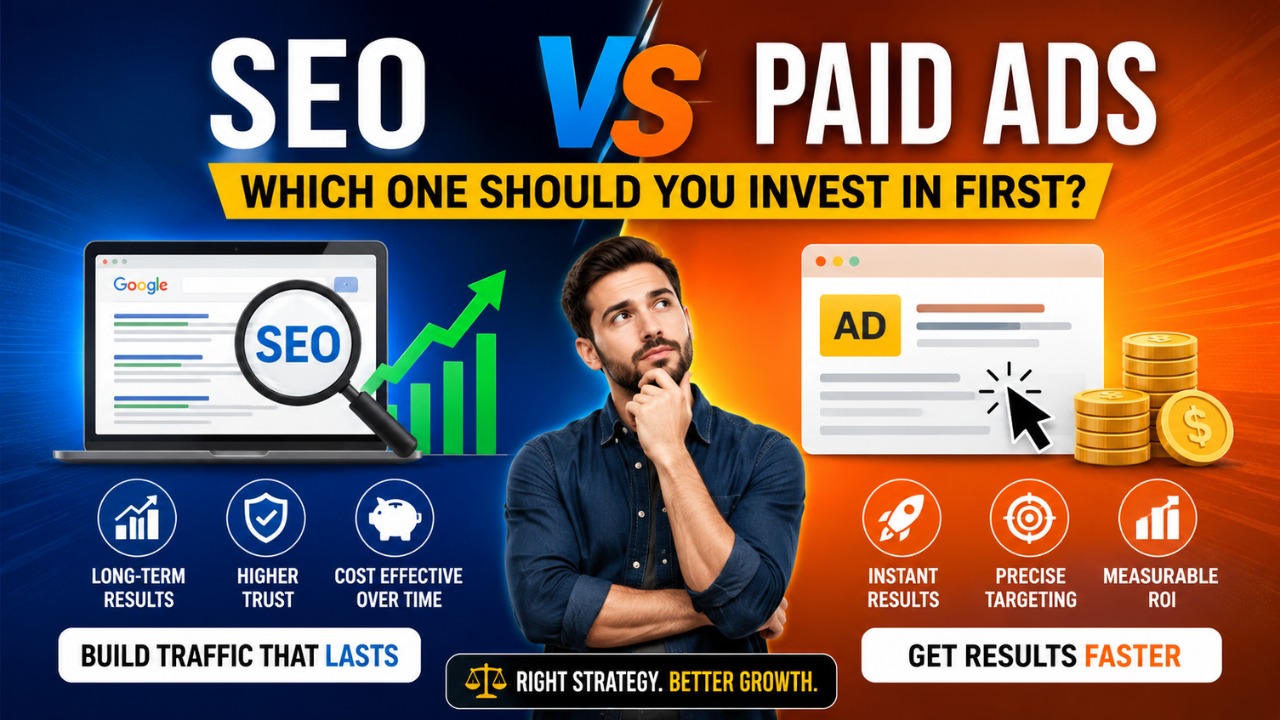
If you’ve ever sat down to plan a marketing budget, you’ve probably hit this exact question — should the money go into SEO or paid ads first? It’s not a small decision either. Get it wrong, and you either burn cash on ads that stop working the day you pause them, or you wait months for SEO to kick in while competitors take the traffic.
The honest answer is: it depends on where your business stands right now. SEO builds traffic that compounds over time. Paid ads bring people in immediately, but only for as long as you keep paying. Once you understand how each one actually behaves, the decision gets a lot easier.
Table of Contents
Why This Decision Actually Matters
Here’s what happens when businesses get this wrong. Some pour their entire budget into ads, and the moment spending stops, so does the traffic. Others go all-in on SEO and get frustrated three months in when nothing’s ranking yet.
Neither mistake is fatal, but both waste time and money that could’ve gone further with a clearer plan. Most businesses that succeed long-term end up using both — the real question is just which one to lean on first.
Key Differences Between SEO and Paid Ads
Laying these two side by side makes the decision much less confusing.
| Factor | SEO | Paid Ads |
| Cost Over Time | Drops as rankings stabilize | Stays constant, or rises with competition |
| Time to Results | Usually 3–6 months | Days, sometimes hours |
| Traffic Longevity | Keeps compounding | Stops the moment you stop paying |
| Trust Factor | Feels more credible to users | Recognized as an ad, less trusted |
| Best Fit For | Long-term brand building | Launches, promotions, quick tests |
How SEO Builds Long-Term Value
SEO is a slow burn, but that’s exactly what makes it valuable. A page that ranks well can keep bringing in visitors for years without any extra spend.
It Compounds
The traffic doesn’t reset every month like ad traffic does. Once you’re ranking, you’re ranking — until something changes.
People Trust It More
There’s a reason organic results still get more clicks than ads in most searches. Ranking naturally signals that Google (and by extension, the user) considers you relevant.
It Gets Affordable Over Time
Yes, SEO needs upfront work — content, technical fixes, sometimes backlinks. But once a page stabilizes in rankings, the effective cost per visitor keeps dropping.
If you’re trying to figure out what that upfront investment actually looks like, this breakdown of SEO pricing in Delhi is worth a look before you commit a budget.
How Paid Ads Win on Speed
Paid ads exist for one reason — speed. You can have a campaign live within the hour, and traffic starts flowing almost immediately.
Instant Visibility
No waiting for algorithms to catch up. You’re in front of your audience as soon as the campaign goes live.
Sharp Targeting
You can narrow down by age, location, interests, even past buying behavior — something organic search simply can’t offer with the same precision.
Numbers You Can Actually Measure
Every rupee spent shows up in the data. Clicks, conversions, cost per lead — it’s all right there, which makes it easy to know what’s working.
So, Where Should the Budget Go First?
This really comes down to where your business is today.
If you’re starting from zero — no traffic, no reviews, no visibility — paid ads buy you time and data while SEO builds quietly in the background. If you’re already established with steady traffic, shifting more budget toward SEO usually pays off, since it reduces your dependence on ad spend over the long run.
Competitive industries often need both running at once. A business weighing SEO services in Delhi against a paid ads budget, for instance, will usually get further by using a small ad spend for quick wins while SEO work compounds underneath it.
Mistakes That Waste Budget on Both Sides
| Mistake | What’s Actually Happening | The Result | The Fix |
| Expecting SEO to work like ads | Treating SEO as instant | Frustration, early quitting | Plan for 3–6 months minimum |
| Killing ads with no SEO backup | Zero organic presence built | Traffic drops to zero overnight | Build SEO alongside ad spend |
| Sending ad traffic to weak pages | Ignoring the landing page | High spend, low conversions | Fix the page before scaling ads |
| Running both with no clear goal | No defined outcome per channel | Budget gets wasted | Set a specific goal for each channel |
| Never checking the data | Skipping analytics review | No idea what’s working | Review performance monthly |
What to Actually Track
| Metric | What It Tells You | Why It Matters |
| Organic Traffic | Visitors coming from search | Shows SEO progress |
| Keyword Rankings | Where you sit for target terms | Tracks SEO movement over time |
| CTR | How many people click your listing/ad | Signals relevance |
| CPC | Average cost per click | Shows ad spend efficiency |
| Conversion Rate | People who complete the desired action | Measures real effectiveness |
| ROAS | Revenue earned per rupee spent | Shows if ads are actually profitable |
Making Both Channels Work Together
The businesses that grow fastest rarely pick just one. They typically start with paid ads for quick visibility, then reinvest part of that budget into SEO as it starts gaining traction.
- Start with ads for quick data and traffic.
- Build SEO in parallel, not after.
- Shift ad savings into content and backlinks as rankings improve.
- Check performance on both channels regularly.
- Rebalance budget as the business grows.
Doing It Yourself vs Hiring an Agency
Running SEO and paid ads properly — keyword research, technical fixes, campaign management, landing page tweaks, weekly reporting — realistically takes 12 to 22 hours a week. For most small teams, that’s close to a part-time job on top of everything else.
The cost math often doesn’t favor going it alone either. A full-time hire strong in both SEO and ads usually costs more than most small businesses budget for marketing. Two freelancers — one for each channel — fix the skill gap but create a coordination gap, since you end up managing two strategies yourself. A team that handles both together tends to earn its cost back through one shared data view and one accountable point of contact.
Before committing, ask a few quick questions: Can they show real ranking and ROAS numbers, not just testimonials? Do they report on SEO and ads together, or as separate dashboards? Is one person overseeing both channels, or will you get bounced between teams? If you can’t spare 12+ hours a week internally, outsourcing to a team that treats SEO and ads as one integrated effort is usually the better bet.
Frequently Asked Questions
Should a new business start with SEO or paid ads?
Paid ads usually make more sense first for a brand-new business. They generate traffic and data immediately while SEO groundwork builds in the background.
How long does SEO actually take compared to ads?
Ads can show results within days. SEO typically needs 3 to 6 months before you see real movement, depending on how competitive your industry is.
Is SEO really cheaper than ads long-term?
Generally, yes. SEO takes upfront investment, but once rankings settle, the cost per visitor drops significantly — unlike ads, which require continuous spend to keep the traffic coming.
Can SEO and paid ads run at the same time?
Absolutely, and for many businesses, that’s the smartest approach — using ads for immediate visibility while SEO builds toward long-term, sustainable traffic.
Does SEO work for small businesses with limited budgets?
Yes. SEO can be more cost-effective than paid ads for small businesses since it doesn’t require continuous spend once rankings improve, though it does need consistent effort over several months.
What happens if I stop paying for ads?
Traffic stops almost immediately once ad spend stops, since paid visibility depends entirely on active budget. This is different from SEO, where rankings and traffic can continue without ongoing payment.
Which is better for local businesses — SEO or paid ads?
Local businesses often benefit from a mix: paid ads for immediate local visibility, combined with local SEO efforts like Google Business Profile optimization for sustained, long-term traffic.
How much budget should I allocate to SEO vs paid ads?
There’s no fixed ratio, but many businesses start with a 60-40 or 70-30 split favoring paid ads early on, then gradually shift more budget toward SEO as organic rankings improve.
Final Thoughts
There’s no single right answer here — it depends on your budget, your timeline, and where your business currently stands. New businesses often lean on paid ads first for quick visibility. Established businesses tend to get more value from doubling down on SEO.
But the businesses that actually win long-term rarely treat this as either-or. They build a strategy where both channels support each other, track what’s working, and adjust the budget as real data comes in.

Akshit Rana is the Co-Founder of Digimaniac and a performance marketing professional with around 7 years of experience in digital advertising and growth strategies. He specializes in performance marketing, paid campaigns, and helping businesses improve online visibility and lead generation.