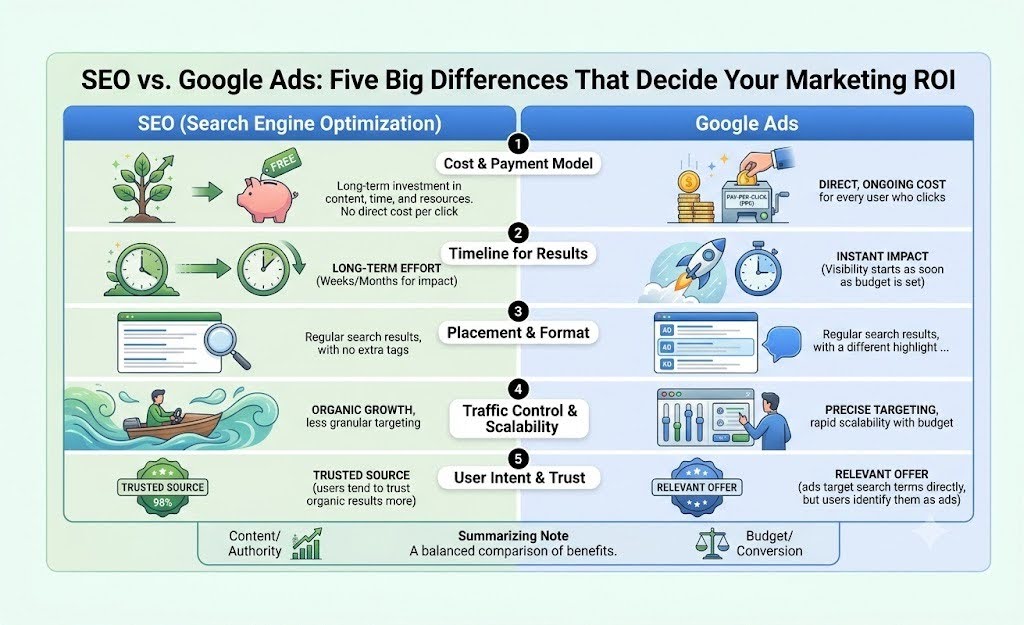
SEO vs. Google Ads: Five Big Differences That Decide Your Marketing ROI
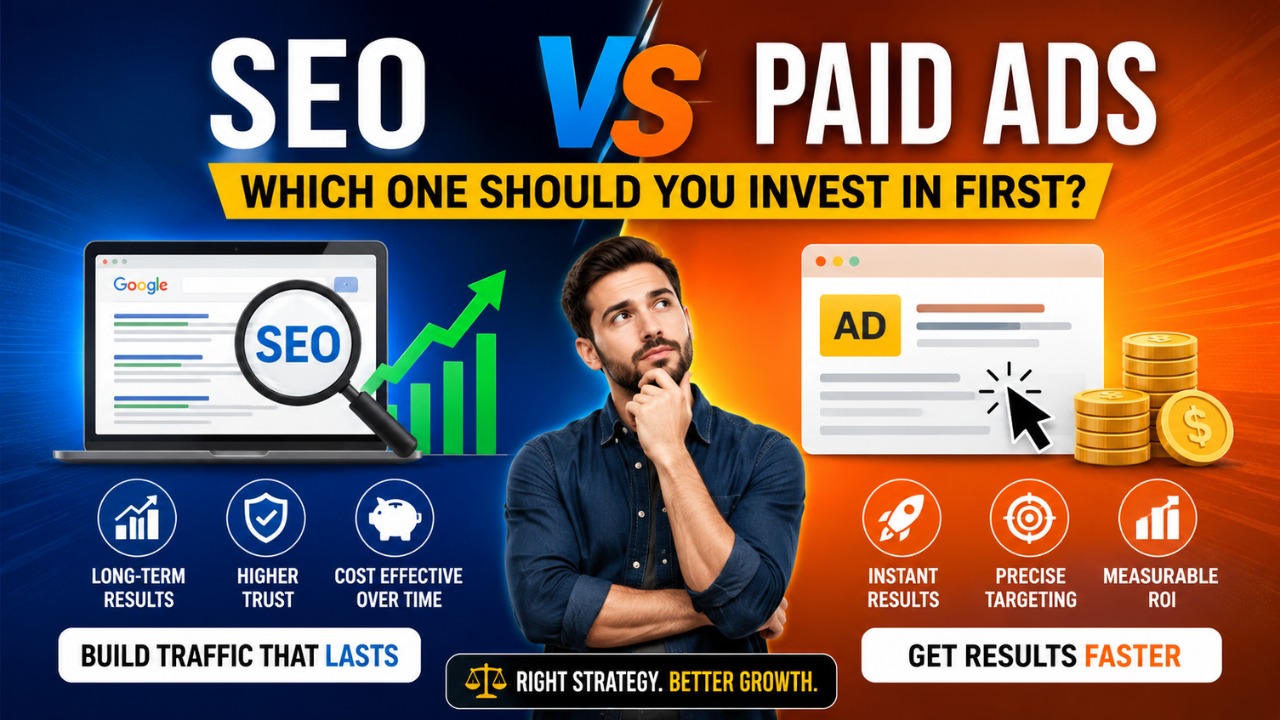
Two strategies tend to be thrown into the ring when businesses are looking to boost their online visibility: SEO vs Google Ads. Both can be used to attract potential customers from the search engines, but in very different ways. In summary, SEO is long-term, and Google Ads is short-term.The decision isn’t just a matter of which is “better,” and there’s no definitive answer. The better question is, what strategy will get you the desired results in your time, budget, and business? The fact that there are differences between paid search and SEO helps you make better marketing decisions and boost your ROI. SEO vs. Google Ads: What’s the Difference? Here are the five main distinctions between SEO and Google Ads quickly. Factor SEO Google Ads 1. Cost Requires investing in content, optimization, technical SEO, and maintenance. The per-click advertising fee for organic clicks is not applicable. Implements a paid advertising platform; often users are paid for interacting with ads (e.g., clicking on them). 2. Speed Usually takes a long time to gain rankings and organic traffic. It can take weeks or months to get results, depending on competition and website authority. Once approved and in motion, it can create targeted visibility and traffic much quicker. 3. Traffic & Visibility Performs search engine optimization (SEO). Good rankings can help to drive traffic in the long term. Offers paid visibility in the search results in eligible auctions during the advertising campaign. 4. Control & Targeting Provides more indirect ranking opportunities since organic listings are based on search engine algorithms and ranking factors. Gives more control over budget, targeting, locations, keywords, schedules, ad copy, and landing pages 5. Long-Term ROI Can deliver high value in the long run, since an effective organic ranking can bring traffic without having to pay for each click. Can offer tangible ROI in the short term, but regular paid visibility usually requires regular advertising budgets. There are several key differences between SEO and Google Ads. 1. Cost: Organic investment vs. pay-per-click (PPC) One of the initial aspects businesses take into account while weighing SEO or Google Ads is cost. Usually, Google Ads will charge you for clicks or any interaction with the ads. This is influenced by various factors, including keyword competition, targeting, bidding strategy, ad quality, and campaign settings. The advertising expense determines the amount of paid traffic that can be generated; therefore, costs can escalate during the duration of the campaign. The cost of SEO is different. You don’t have to pay Google for every organic click. Rather, your money is spent on things like website optimization, technical SEO, keyword research, content creation, and website improvement and authority building. This does not mean that SEO is free. It takes time, expertise, and resources to do SEO professionally. Once a page reaches a high organic ranking, however, the extra traffic it receives is not an immediate cost to the advertiser for every click. That disparity is significant, especially when assessing long-term ROI. Google Ads can offer hard facts on how much is being spent and how many conversions are being achieved in the campaign. In contrast, SEO can build an organic traffic asset that will continue to generate revenue after the hard work is done. In summary, Google Ads needs to continue to be invested in to gain visibility through ads, whilst SEO needs to be invested in to achieve organic visibility. 2. Speed: Long-Term Growth vs. Immediate Results The most obvious difference between Google Ads and SEO is how fast you can get traffic on each of these strategies. With a good campaign set up and approved, Google Ads can begin to drive visibility right away. This is the reason paid search can prove to be useful for businesses that need immediate traffic, a new service they want to market, or a time-sensitive offer. The general rule is that SEO takes time to work—the search engines take time to find, evaluate, and index pages. There are various factors that influence results like website authority, content quality, competition, technical health, and search intent. Industry comparisons are often made by noting that PPC is quicker to get off the ground, whereas SEO results are mostly gradual. For instance, a company that is going to introduce a new service next month. Waiting for organic results could provide insufficient visibility before the launch. Meanwhile, while Google is developing its SEO strategy, Google Ads can help generate immediate exposure. That being said, SEO can have greater value if the business wants a consistent amount of organic traffic for the next couple of years. Takeaway: While Google Ads can bring immediate website traffic, SEO is more effective over the longer term to support your website’s organic growth. 3. Traffic and Visibility: Organic Rankings vs Paid Placement. The other important consideration in the SEO vs ads debate is where and how your site will rank in search results. When the campaign is qualified to display for a relevant query, Google Ads will prominently display the ads on search engine results pages. The targeting, budget, ad message, and landing page are under the control of the business. SEO works differently. The organic position of a page is determined by Google’s assessment of relevance, the quality of content, the user experience of a page, its authority, and so on. Organic visibility can be an important marketing asset in the longer term. Once you’ve optimized a page to rank for clicks that are relevant to your business, it can continue to generate traffic you don’t have to pay for. But SEO rankings do not come easily. Search algorithms, competitors, users’ behavior, and the layout of search results may vary. Organic visibility is not something that can be achieved in one go but needs continuous effort. The other drawback of Google Ads is that they must be paid for to be viewed, and ad performance leads to visibility. If a campaign is turned off or the budget is exhausted, the paid traffic will stop. So, if
SEO vs. Google Ads: Five Big Differences That Decide Your Marketing ROI Read More »