
Content Writing Training

The Rise of AI Search and Its Impact on SEO

The Rise of AI Search and Its Impact on SEO

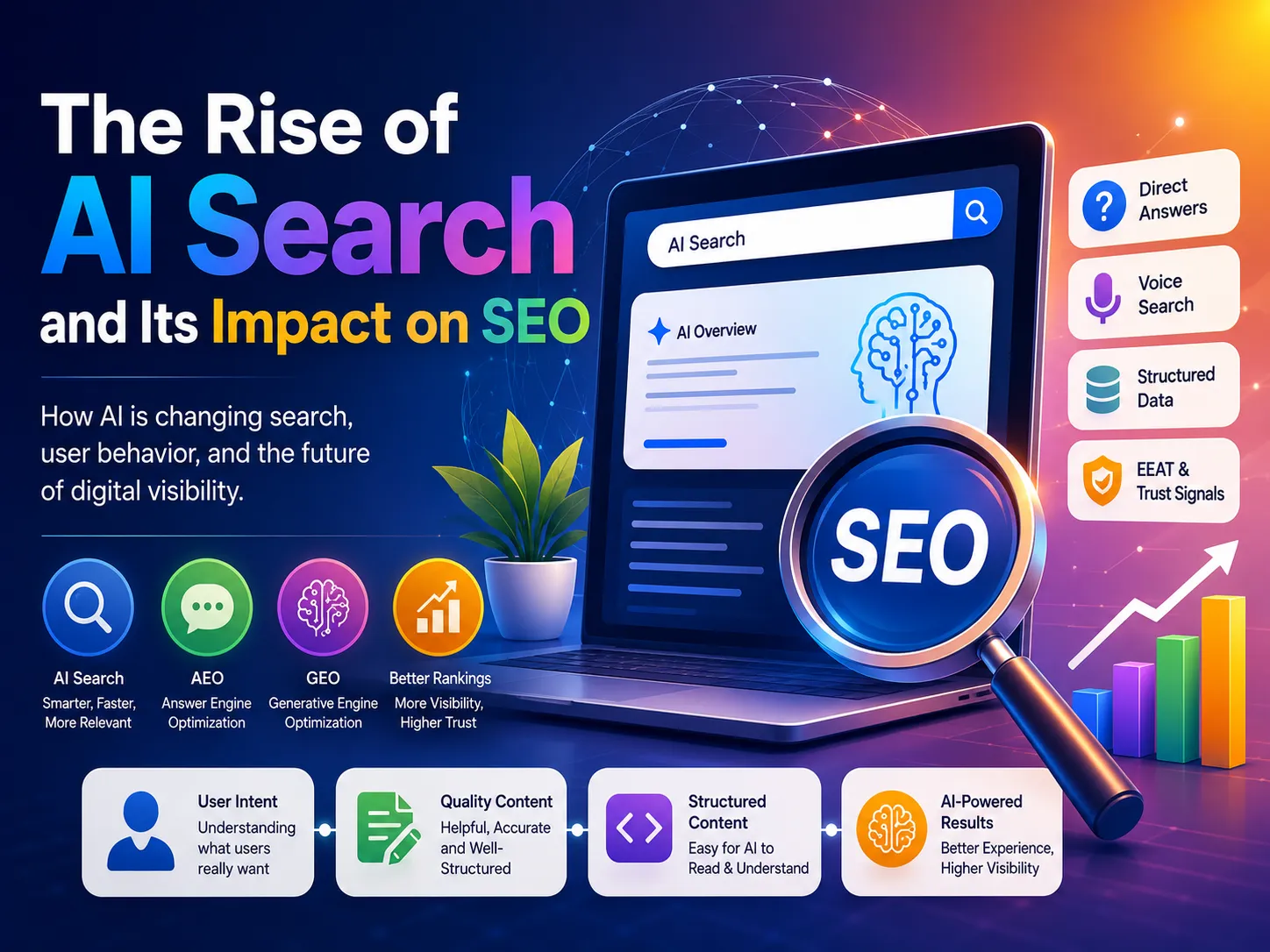
The online marketing environment is evolving at a rapid pace. One of the major transformations of recent years is the introduction of artificial intelligence in search engines. Nowadays, people do not simply rely on the normal search results any longer. AI-enabled search engines can interpret your queries, produce the relevant answers, and offer you the personalized information immediately. This development has set the stage for a completely different kind of search optimization. Companies, because of this, need to grasp what AI Search is and its impact on SEO if they want to stay competitive on the web. The conventional SEO strategies are still important but now they are accompanied by Answer Engine Optimization (AEO) and Generative Engine Optimization (GEO). With AI leading the change in how people search, those companies that change their working models will be the ones to get the highest spots, earn the greatest trust, and have the highest levels of user interaction. What Is AI Search? AI search is the use of artificial intelligence and machine learning to comprehend the intent of a user and deliver direct, relevant answers. Unlike traditional search engines that only show links, AI-powered search systems examine the information and come up with a summary from several sources. Some of the examples are: Knowing AI Search and SEO Implications will allow companies to be ready for these new search scenarios. How AI Search Changes the Ways Users Act Today users desire instant responses that are correct. Rather than opening multiple websites, searchers usually want search engines to give them instant data. This alteration impacts: That means, enterprises should give priority to AI-supported SEO approaches that bring straightforward advantages to customers. Why AI Search Matters for SEO What is the impact of AI search on the ranking of websites on search engines? Rankings based on traditional factors are still valid But search engines also consider: Companies that comprehend AI Search and Its Impact on SEO will be able to produce content that does well in both traditional and AI-led search results. The link between AI search and AEO Answer Engine Optimization (AEO) is all about making a content that answers what users  Implementing AEO involves Because AI focuses on direct answers, it is AEO that mainly decides the traffic. That is why it has become a must for the companies who want to be found. Companies need to think about their content structure so that AI systems can easily extract the information. GEO and the Future of Search Generative engine optimization (GEO) has the potential to be a mega trend in the oncoming times. GEO is about getting your content ready so that it can be used as source information for AI-generated responses. One of the most important GEO methods are: Modern AI Search and Its Impact on SEO strategies require businesses to think beyond rankings and focus on becoming trusted information sources. Why Quality Content Matters Content has always been the basis of good SEO results. Though, AI based search engines have gotten much better at evaluating content. So organizations should make content that is: Powerful AI-powered SEO tactics focus on delivering user value rather than just overusing keywords.Great content can greatly help your chances of getting featured in AI-generated responses. EEAT and AI Search Google stresses the importance of EEAT: Experience Content should not only be based on knowledge acquired from books and lectures but also from the world around us and personal experiences. Expertise Authors need to prove that they have deep knowledge of the subject. Authority Companies should make themselves known as reliable sources of information. Trust Data should be trustworthy and open to verification. The Role of Structured Data Structured data is a great helper for the search engines as it allows them to understand the content of a website better. Schema markup is an excellent tool to: Structured data supports both AEO and GEO efforts by making content easier for AI systems to interpret. Voice Search and AI Search The use of voice search is becoming more widespread. Users tend to phrase their questions in a natural manner, for example: This move not only supports the AI Search and Its Impact on SEO productivity but also results in better visibility in voice-based search outcomes. How businesses can get adjust Actually, to be successful at AI-powered search, businesses should adhere several points mentioned below: Zero in on User Intent Gain knowledge of what users want to get when they search. Develop Content Based on Answers Give straightforward and meaningful answers. Boost Technical SEO Always have a website that is fast and mobile-friendly. Establish Topical Authority Generate content that is deep and detailed in each single subject areas. Apply Structured Formatting Arrange content using headings, FAQS, and well-organized sections. Common challenges Businesses might encounter some stumbling blocks while adjusting to AI search. Such problems are : However, companies that focus on optimizing search experience will be able to keep attracting qualified visitors and building brand authority. What AI search holds AI search is bound to change in the future. Here are some possible changes in the future: Knowing AI Search and Its Impact on SEO at present is a great way for companies to get ready for the search scene of the future. Conclusion AI search has changed how users search for information. Companies should not depend only on the conventional SEO methods. On the contrary, they should accept AEO GEO structured content, and optimization focusing on the user. Thanks to accurate AI-powered SEO tactics and enhancing search experience optimization, companies can uphold their visibility and competitiveness in an AI-dominated future. Those companies that emphasize on developing superior content, adhering to EEAT standards, and optimizing for the answers will do well in the long run. FAQs 1. What exactly is AI Search and how can it transform SEO? Artificial Intelligence (AI) Search and Its Impact on SEO address that a new AI technology modifies the way search engines comprehend the question, produce answers, and order the results. That’s

The Rise of AI Search and Its Impact on SEO Read More »

Laptop showing website analytics dashboard with SEO traffic and user activity data.

Before Traffic Drops: The SEO Metrics Marketers Should Watch Early

Most businesses notice SEO problems too late. They usually check rankings, traffic, and clicks after performance has already dropped. By then, the real issue may have been building quietly for days, weeks, or even months. A page may have disappeared from the index. A redirect may have broken. A landing page may have slowed down. A form may have stopped working. Visitors may still be arriving, but fewer of them may be taking action. This is why SEO reporting needs to move beyond simple ranking updates. Rankings and traffic still matter. But they do not show the full picture. A useful SEO analytics process should help marketers spot problems before organic visibility, leads, and revenue decline. For marketers, learners, and professionals, the goal is simple: track the signals that explain why SEO performance changes, not just the numbers that show it changed. Why Rankings Are Not Enough Keyword rankings are useful because they show where your pages appear in search results. But rankings alone do not prove that SEO is working. A page can rank and still attract the wrong audience. A blog post can gain traffic but produce no leads. A website can show steady organic sessions while important service pages lose visibility. This creates a gap between SEO activity and business results. Traditional SEO reports often focus on impressions, clicks, ranking movement, and total traffic. These numbers are helpful, but they do not always answer the most important question: is organic search helping the business grow? A better SEO report connects visibility with user intent, engagement, and conversions. It shows whether people are finding the right pages, interacting with the content, and moving closer to action. This is why understanding how SEO supports traffic and business growth is more valuable than tracking rankings in isolation. SEO should not only show where a website appears. It should show whether search visibility is bringing the right people to the right pages. Start With Indexing Before a page can rank, search engines need to discover, crawl, and index it. Google explains that crawling and indexing are the processes that allow web pages to become eligible for search results. If a page is not indexed, it cannot appear in Google Search, no matter how useful the content may be. This makes indexing one of the first SEO signals marketers should monitor. Many businesses publish new pages and assume search engines will automatically find them. Sometimes they do. But indexing is not guaranteed. Thin content, duplicate pages, poor internal linking, blocked resources, crawl issues, and incorrect canonical tags can all affect whether a page appears in search results. This matters most for websites that publish often. Service pages, product pages, location pages, and blog posts all need to be discoverable if they are expected to generate traffic. A practical SEO analytics process should help teams see whether key pages are indexed, whether new pages are discovered quickly, and whether important URLs drop out of search results. This is especially important in competitive industries. When competitors seem to rank faster, the issue is not always better writing or more backlinks. Sometimes their pages are simply easier for search engines to discover, crawl, and index. Understanding why competitors rank faster can help marketers treat indexing as a core SEO metric rather than a technical afterthought. Monitor Technical Health Continuously Technical SEO should not be treated as a one-time audit. Websites change constantly. New pages are added. Plugins are updated. Tracking scripts are installed. Redirects are changed. Forms are edited. Design updates go live. Any of these changes can create problems that affect SEO performance. A page may load slowly. A redirect may point to the wrong URL. Internal links may break. A form may fail. A page may become unavailable for users or search engines. The problem is that many of these issues do not appear immediately in standard analytics reports. By the time traffic drops, the technical issue may have already affected crawling, indexing, engagement, or conversions. Google explains that pages need to be accessible, useful, and technically available to be eligible for strong search performance. Google also recommends site owners improve Core Web Vitals because they measure real-world user experience, including loading performance, interactivity, and visual stability. This is why marketers should connect technical SEO with analytics. A strong SEO dashboard should help teams see whether important pages are available, load properly, allow users to complete key actions, and are accessible to search engines. Technical clarity also helps search engines understand a website more easily. A broader understanding of SEO and digital marketing can help marketers see how site structure, content, analytics, and user experience work together. Website monitoring also plays a key role. When teams understand how website monitoring tools work, they can detect problems faster and protect organic performance before small issues become larger ones. Measure Traffic Quality More traffic does not always mean better SEO. A page can attract many visitors who leave quickly, never visit a service page, and never take action. At the same time, a smaller number of qualified visitors can create better results if they engage with the content and convert. This is why marketers should measure traffic quality, not just traffic volume. Traffic quality looks at what visitors do after they arrive. Do they read the page? Do they scroll? Do they visit another page? Do they return later? Do they submit a form, call, book, buy, or subscribe? These signals help marketers understand whether the traffic is useful. For example, a blog article might bring many top-of-funnel visitors. That can be valuable if the article introduces the brand and guides readers to relevant next steps. But if the article has no internal links, no clear journey, and no connection to business goals, the traffic may not lead anywhere. The same applies to local and service-based businesses. A business does not simply need more visitors. It needs visitors with the right intent. Someone searching for a nearby service with a clear need is usually

Before Traffic Drops: The SEO Metrics Marketers Should Watch Early Read More »

AI SEO

LLM txt for SEO: Complete Guide to AI Search Engine Optimization & GEO Strategy

Online trends in searching are evolving quickly. AI-powered platforms like ChatGPT, Gemini, Claude, and Perplexity have taken over from traditional Google search to directly answer user questions, altering how websites attract visitors. With the rise of AI tools such as ChatGPT, Gemini, Claude, and Perplexity to directly answer user questions, the landscape of website traffic is changing. This change has introduced a fresh way for website owners to gear their content for AI systems – which is where LLM txt comes into play. With the advent of LLM txt for SEO, businesses are examining ways to make websites more accessible to AI systems. This new optimization technique has many marketers convinced that it will be the way to the future of search visibility. Meanwhile, the pros provide insights on the importance of SEO fundamentals over shortcuts. According to multiple industry blogs, LLM txt is not a magic ranking factor but can help an AI language model better understand website content. Here, you will find out what LLM txt is, how LLM txt for SEO works, why it is important for AI search engine optimization, and how brands are using LLM txt as part of their modern geo strategy and geo in digital marketing.  What is LLM txt? LLM txt is a plain text or Markdown file placed in the root directory of a website. The purpose of this file is to help an AI language model understand the most important pages, categories, and information on a website. Most competitor blogs explain LLM txt as a roadmap for AI systems. Instead of making AI tools crawl every page manually, the file guides them toward useful and high-value content. A simple LLM txt file usually contains: Unlike robots.txt, LLM txt for SEO is not mainly about blocking crawlers. Instead, it focuses on improving AI understanding and helping an AI language model identify the context of a website more efficiently. Why LLM txt for SEO Is Becoming Popular The growth of AI search platforms has completely changed how users discover information online. Earlier, SEO focused mainly on ranking webpages on Google. Now, businesses also want their content cited inside AI-generated answers. This is where LLM txt for SEO enters the discussion. Several SEO experts explain that modern ai search engine optimization is no longer only about keywords and backlinks. AI systems analyze entities, context, topical relevance, and structured information. A properly organized LLM txt file may help AI systems understand the structure of a website more clearly. Many companies are already adopting LLM txt because implementation is simple and inexpensive. Brands like Anthropic, Cloudflare, Vercel, and Stripe have published their own files to support AI accessibility. At the same time, experts also warn that LLM txt for SEO should not replace technical SEO, content quality, or authority building. Websites that perform best in AI search still rely heavily on strong content strategies and trust signals. How an AI Language Model Reads Website Content An AI language model does not process websites the same way humans do. AI systems receive raw HTML files filled with scripts, menus, ads, navigation elements, and unnecessary clutter. This creates challenges because an AI language model has limited context windows. Competitor research shows that AI systems may struggle to identify the most valuable content from large webpages. That is why LLM txt is becoming part of modern AI search engine optimization. The file provides structured information directly to AI systems and reduces confusion. When an AI language model clearly understands website structure, it becomes easier for AI platforms to: This process supports stronger visibility in AI-generated answers. LLM txt for SEO vs Traditional SEO Many people think LLM txt for SEO will replace traditional SEO, but industry experts strongly disagree. Traditional SEO still focuses on: Meanwhile, AI search engine optimization focuses on improving AI discoverability and helping an AI language model interpret content correctly. This difference is why marketers now combine SEO with geo in digital marketing strategies. GEO stands for Generative Engine Optimization, which focuses on improving visibility inside AI-generated search experiences. A successful geo strategy usually combines: Because of this, many businesses now treat LLM txt as a supporting layer rather than a complete replacement for SEO. Why GEO in Digital Marketing Matters The rise of AI search has increased the importance of geo in digital marketing. Instead of simply ranking webpages, marketers now optimize content for AI-generated answers and conversational search experiences. Modern geo strategy focuses on making content understandable for both humans and AI systems. According to industry discussions, websites with strong authority, clear content structures, and consistent branding are more likely to appear in AI-generated responses. This is where LLM txt for SEO becomes valuable as part of a larger geo strategy. An effective geo in a digital marketing approach includes: When these techniques work together, an AI language model can better understand website relevance and context. Does LLMtxt actually improve AI Search Visibility? This is currently one of the biggest debates in the SEO industry. Some experts believe LLM txt improves AI discoverability, while others argue that major AI crawlers still do not use it consistently. Several studies and Reddit discussions show mixed opinions regarding the actual ranking impact. Many competitor blogs agree on one important point: LLMtxt for SEO is not harmful and requires very little effort to implement. Because of this, businesses are using it as a future-proofing tactic for AI search engine optimization. The reality is that no single file alone can guarantee visibility in AI search. Strong geo strategy, quality content, authority signals, and structured information still matter much more. However, LLM txt may become increasingly important as AI search evolves further. Best Practices for LLM txt for SEO If you want to improve AI search engine optimization, your LLM txt file should remain clean, focused, and easy to understand. A strong geo strategy for implementation usually includes: Many experts also recommend using schema markup, semantic headings, and topical authority alongside LLM txt for stronger AI search engine

LLM txt for SEO: Complete Guide to AI Search Engine Optimization & GEO Strategy Read More »

Content in SEO

Why “More Content” Isn’t the Answer to Your Growth Problem

As the digital marketing sector continues to evolve, there still remains a persistent myth that “more content = more growth”. A lot of businesses experience stagnation in their website traffic and/or decline in their social media engagement, resulting in them producing more blogs, social media posts, and videos, hoping that increasing the volume of all types of content will help address the issue. But the reality is that – content without strategy doesn’t yield positive growth, it just creates more noise.  In this article, we shall break down why simply producing more content isn’t the solution, and what would actually work if you are looking at long-term sustainable results.  The “More Content” Myth At first glance, the logic seems right: More Content = More Visibility = More Traffic = Increased Customers.  However, this logic ignores a critical factor, i.e Quality & Relevance.  The thing is, publishing 50 articles that aren’t of high value will never outperform the ones that are exceptionally valuable and are well-optimised. The users along with search engines have become selective on the kind of content that they consume. Algorithms are now designed to promote only “Helpful”, “Authoritative” and “User Focused” content, and is not just because you created it frequently. Reason Why “More Content” Often Underperforms Absence of Strategy I’ve noticed that there are a lot of businesses out there that lack direction and a goal in their content. Are you trying to: Without a clear objective and purpose, content tends to become scattered, disorganized and ineffective.  Misaligned Audience Targeting It doesn’t matter how much content you produce if your content doesn’t address the real needs of your users, your content will never perform to the level you expect. Content should create growth through solving specific problems, rather than creating general information. Quality Decline When teams emphasise quantity rather than quality, the resulting decrease in quality will likely lead to: Search engines can also detect this, which may result in your site being decreased in rank. Content Overload Now-a-days the internet is flooded with content. Adding onto it, isn’t enough to create an impact. In order for your content to have a significant impact, it should be: Only then will you be able to make a difference and stand out in this overcrowded market.  What Actually Fuels Growth? Instead of asking “How much of a good content we create?” shift your focus to “How well does our content perform?” Here’s what actually truly matters: Strategy Over Volume In order to create an effective content strategy you need to have: This is why many top digital marketing companies emphasise strategy first, execution second. High-Quality, Value-Driven Content The content you produce should: 1. Answer real questions; 2. Offer actionable insights; and 3. Show your expertise. Try to think of each of the pieces of content you create as an asset, and not just another post. SEO Optimization Growth comes from visibility; therefore, visibility comes from using effective search engine optimization: 1. Target relevant keywords (i.e., ‘Top Digital Marketing Companies’); 2. Optimize your content’s structure (i.e., headings, internal links); and 3. Focus on searcher intent. It’s not about stuffing keywords, but rather making sure your content is relevant! The Importance of Distribution A solid piece of content may not be able to deliver to anyone or receive without a proper promotion. Promotional Methods: If nobody ever sees your content, it isn’t going to grow your business. Updating Content Many businesses miss out on the growth potential of existing content that they could improve. Instead of adding new content, try making updates to your existing content. This could include: Often times this method will produce faster results than adding new content! Role of Experts Many companies struggle to grow as they try to do everything in-house without the right kind of expertise. That is when a lot of companies seek help from top digital marketing companies to help them with: Experienced professionals focus on impact, not just the output. A More Effective Method for Growing Your Business Instead of trying to increase quantity through lots of different channels, consider using the following process: The above method produces: Final Thoughts “More content” may seem like it is going to get you somewhere; oftentimes, though, it serves only to distract you from what really matters. The way to drive growth isn’t the amount of content that you create; it’s the way that your content: If what you are currently doing isn’t giving you results then more content isn’t the solution – what you need is better content. Stop asking yourself, “How much content do we need to create?” Start asking yourself, “Does this content really work?”. The simple act of changing your question will have a huge impact on how successful you will be in creating a successful growth strategy. Nizu SachdevaNizu Sachdeva is a Digital Marketing Specialist with around 6 years of experience in SEO, content marketing, social media strategy, graphic design, and video editing. She specializes in creating digital strategies and content-driven campaigns that help businesses strengthen their online presence. digimaniac.in

Why “More Content” Isn’t the Answer to Your Growth Problem Read More »

Top 10 Free Keywords Research Tools

Top 10 Free Keywords Research Tools

There’s no shortage of tools purpose-built for keyword research (literally hundreds of them), and they run the gamut from beginner-focused to highly advanced. They also range from totally basic and unhelpful to super valuable. When done right, the best keyword research tools simplify and streamline your workflow—they make it easier to find the right keywords to target and give you the data you need to actually rank for them. But they shouldn’t require you to empty out your bank account and sell your first-born child in order to access that data. That’s why using free SEO tools for keyword research has become a smart choice for beginners and professionals who want powerful insights without the heavy price tag.  1. Google Keyword Planner ( keyword Research Tool) Google Keyword Planner has long been considered the gold standard for keyword research, primarily because it’s the only tool that pulls data directly from Google’s advertising platform. It’s also one of the most reliable free SEO tools, making it accessible for beginners and professionals who want accurate keyword insights without paying for expensive software. While it remains a powerful option, especially for PPC campaigns, my extensive testing reveals some significant limitations compared to specialized keyword research tools. The tool’s greatest strength lies in its direct access to Google’s advertising data. You get real search volume ranges, bid estimates, and competition levels straight from the source. I particularly appreciate its ability to show historical trends and provide location-based data, which can be invaluable for seasonal planning and local SEO campaigns. However, there’s a catch – you need to create a Google Ads account to access the tool, and non-advertisers only receive broad search volume ranges rather than specific numbers. While Answer Socrates might not provide direct search volumes, its ability to generate over 1,000 related keywords and organize them into topic clusters offers far more value for content planning and SEO strategy. In my experience, Keyword Planner’s keyword suggestions tend to be limited and heavily focused on commercial intent. It often groups similar keywords together, which can mask valuable long-tail opportunities. Compare this to Answer Socrates, which uses recursive search to uncover deeper layers of related queries and questions that people actually ask. The mobile vs. desktop breakdown feature is useful, but without the advanced clustering capabilities of Answer Socrates, you’ll spend considerable time manually organizing keywords into a coherent content strategy. I’ve found that what takes hours in Keyword Planner can be accomplished in minutes with Answer Socrates’s automated clustering.  2. Google Autocomplete While some might not consider this a tool, it’s the first thing I start with every time I do keyword research. Google Autocomplete means simply going to google.com (ideally in an incognito window) and slowly typing out a topic that you want to write about. As you type, you want to look at the autocomplete options. These are great keyword ideas because they are things that people are searching for in real time. And often, some paid SEO keyword research tools don’t even show these keywords because they might be brand new. This strategy is how I have been able to drive some of my highest performing blog posts. And I combine this with Google Keyword Planner to find hidden gem keywords (mentioned earlier in this post). Anyways, this tool is probably the best one out of any keyword research tool because it’s actually how people are searching for things in Google. What is autocomplete in Google Search? Autocomplete in Google Search is simply typing in a topic and seeing what results show up to autocomplete the keyword. These are things that people are searching for in real time, so they often can change based on search trends and what’s currently happening in whatever topic that you’re writing about. Google Autocomplete pros and cons Here are some of the pros and cons of using Google Autocomplete for keyword research. Pros: Cons: That’s it, there really are no cons to using Google Autocomplete. It’s free, always up to date, and shows you exactly what people are searching for right now.  3.  Semrush Semrush pros: Semrush cons: If you’re looking for something more advanced, Semrush shares a ton of keyword data and makes it easy to dig into the details, like SERP features (featured snippet, reviews, site links, image pack, and so on) and granular analysis of current results. Semrush offers a broad range of keyword research tools, too, from the standard traffic and search volume data to content-driven keyword research and competitive keyword gap analysis. That range is what really sets Semrush apart, including the standard Keyword Overview, the Keyword Magic Tool for exploratory keyword research, a Keyword Manager and position tracking, competitive Keyword Gap analysis, keyword cannibalization report, and Organic Traffic Insights, which—when connected with your Google Analytics or Search Console account—can uncover those famously tricky “not provided” keywords. As an added bonus, the SEO Content Template tool lets you automatically create a content brief and optimize content as you write by grading your content in real-time for readability, originality, tone of voice, and SEO: it uses a handy bullseye graphic to help you strike the right balance. Plus, the tool visually checks off SEO recommendations (like using your target and related keywords and adding relevant links and images) as you go. The app’s Copilot AIwill even make proactive recommendations: flagging when your rankings drop for tracked keywords, for example, making technical SEO recommendations, and prompting you to add additional information to help fine-tune your data. All of this means that upgrading will cost you a pretty penny—but you can use it for free at low volumes to start.  You can do more with Semrush by connecting it with Zapier, turning keyword insights into orchestrated workflows across your business. For example, you can automate site edits and re-crawls. At the same time, AI can flag keywords with sudden ranking drops, create prioritized tasks in your project management tool, and update campaign dashboards with real-time data.  4. KWFinder KWFinder pros: KWFinder

Top 10 Free Keywords Research Tools Read More »