
Having a job today is not only about acquiring a degree or collecting certificates. There is an obvious question that many students and freshers want to have an answer to: are certificates or skills more relevant in getting a job today? Every organization is searching for individuals who can perform certain work, so practical skills have become essential for career development.
A certificate may indicate course completion, while a skill shows what you can do in practice; a person with strong skills can often do a better job at an organization than someone with only a certificate and no practical knowledge.
In this guide, we will explain skills vs. certificates, why practical skills are becoming an important requirement, the use of certificates, and what students need to achieve to enhance their employability.
| Certificate | Skill |
| A certificate is proof that you have completed a course, training program, workshop, or certification. | A skill is your ability to use what you have learned in a practical situation. |
| It shows that you have studied a particular subject and gained knowledge. | It shows that you can apply your knowledge to complete a task and get a job. |
| For example, you can complete a graphic design course and receive a certificate. | Creating a professional logo, poster, or social media design demonstrates what you can do with the help of a graphic design course. |
| Shows what you have learned. | Shows what you can actually do. |
Table of Contents
Are Certificates Important for Getting a Job?
Yes, certificates can be useful, particularly for students, freshers, and professionals changing fields. For career novices or people making a career transition with little or no professional experience, certificates show that you can actively look things up online and learn on your own. Thus, someone looking to build a career in web development could take a relevant course, learn the basics, earn a certificate, and add it to their profile. That would at least serve the purpose of bringing you into consideration.
Benefits of Certification are:
- Demonstrates learning.
- Offers foundational knowledge.
- Impresses employers.
- Enhances resume.
- Signals career interest.
However, obtaining only certificates does not lead you to a job! Employers would also want you to demonstrate your actual competence in how you can execute your learned skills.
Why Practical Skills Matter in Today’s Jobs
Skills let people see what you do; it lets them demonstrate and show instead of it just being what you were learning. For example, if a website development firm wants somebody to build a website, maybe they could ask them for websites they have built; if they desire content writing for their company, maybe they want him/her to show off their writing.
Similarly, if a graphic design firm wants a professional graphic designer, they can just give them samples of their work from the past, thus making practical skills more of a benefit than knowing. If someone just completed a course doesn’t mean all learning must end for him/her; one should also dedicate a certain period of his/her time to practicing it.
What Skills Do Employers Look For?
Employers usually look for a combination of technical and soft skills. The exact skills depend on the job, but some qualities are useful in almost every career.
Technical Skills
These are skills you use to complete a job. For example, if you are a web developer, they include website design, coding in different languages, video editing, creating digital graphic illustrations with computers, analyzing data or a business report, writing different pieces of content, or using AI technology and so much more. These skills let you do a good job at what you are working on using correct resources. Technical skills required will vary greatly depending upon the kind of work you will be employed doing.
Communication Skills
You should be able to communicate your ideas effectively and clearly, comprehend given assignments, and interact well with colleagues or customers. You must communicate your instructions and work ideas to people you will be interacting with and listen with proper comprehension to execute work tasks and avoid conflict or misunderstanding. Building working relationships with colleagues or clients can also be aided by the quality of communication.
Problem-Solving Skills
Skills
Employers look for job hopefuls who can spot problems and identify or create the correct solutions without giving up when an issue arises. Whatever the kind of job, challenges are always anticipated; being capable of resolving them effectively can provide for easy completion of your tasks and responsibilities. Great problem-solving abilities encourage a healthy attitude toward stress and allow for effective assessment, troubleshooting, and resolution.
Teamwork
A majority of jobs involve collaboration with your colleagues. The ability to co-operate and share ideas well with your colleagues is vital. Doing this will let you and your group achieve your tasks faster and solve difficulties together. Collaboration ability also indicates that you are willing to contribute to the betterment of the team.
Learning Ability
Technology is ever-advancing; you’re most likely going to encounter situations where you’re learning new things. Employers value this aptitude of individuals to be willing to pick up on new methods as they emerge. This can contribute greatly to your career advancement by ensuring you are adaptable to changing technology.
Can Certificates Help Freshers Get Their First Job?
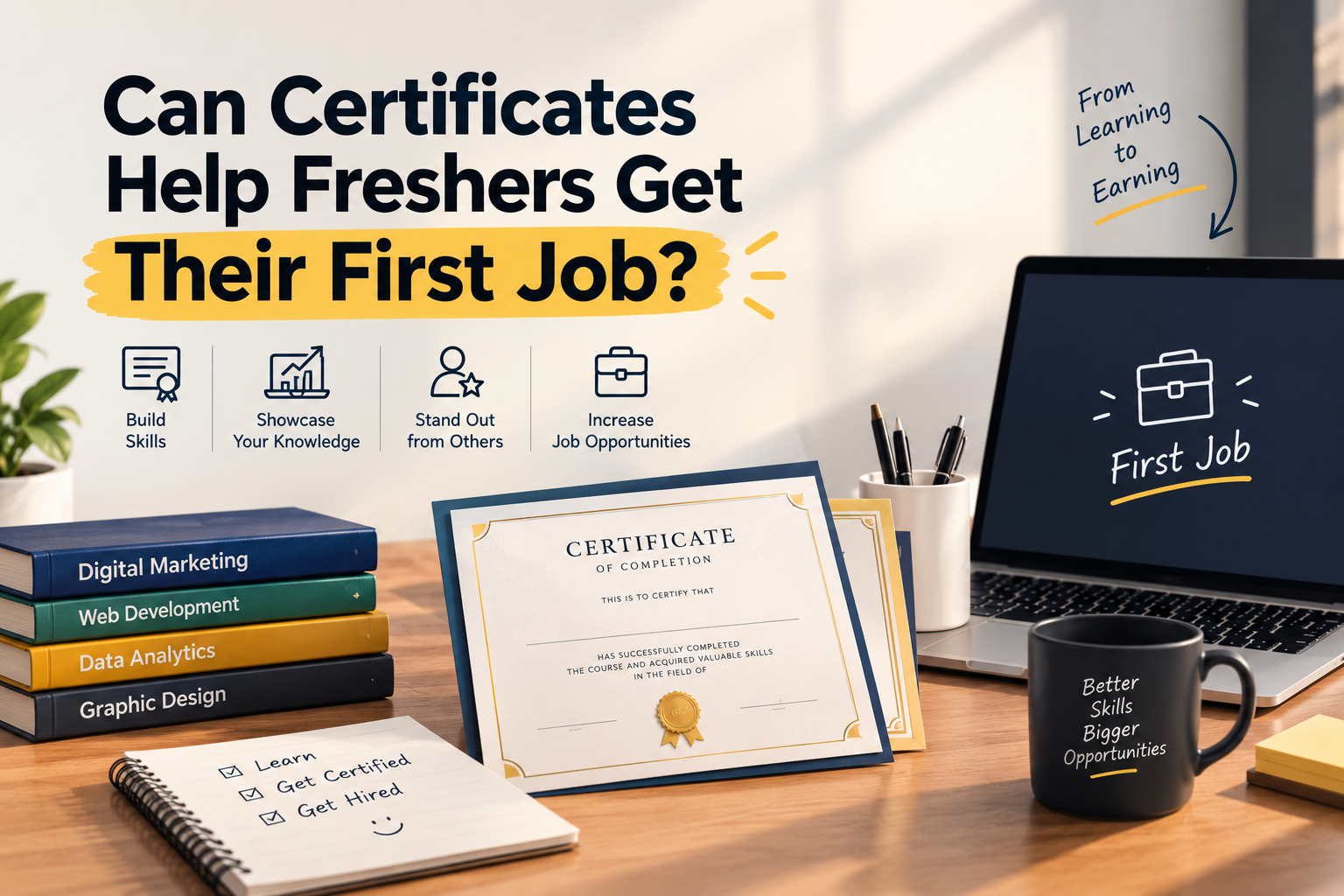
Yes, for a fresher, a certificate can really help you get your first job. As a fresher, you do not get much of a experience, but a relevant certificate will enable you to show your employer that you have acquired knowledge in the respective domain. However, do not clutter your CV by putting all certificates you know of in it.
If you want to be a web developer, don’t be eager to submit all the certificates about entirely different trades you might possess; rather, go for web development courses or projects. They complement your skills; practical experience will be a great advantage for them.
Why a Portfolio Can Be More Valuable Than Another Certificate
This gives employers an overview of your real work. Examples of portfolio items include:
For the graphic designer, a list of logos, social media post designs, and poster designs.
For a web developer, a portfolio shows websites or applications.
A writer’s portfolio includes an article portfolio.
A video editor has edited videos displayed in their portfolio.
You do not have to have a number of years of professional experience to create a portfolio.
It’s ok to have samples of personal or college projects, practice, or example projects.
This shows off the skill and provides the employer with proof.
How to Turn a Certificate Into a Real Skill
You will only get out of the training as much as you can put back into your work or your desired profession. Take a single skill that is the closest to where you want to go. Take a good course or use a reliable learning resource until you can grasp the fundamentals of the skill.
Then, just start doing!
Practice! That graphic design will come in use when you start designing other graphics. Web development skills can be used to develop web projects or personal projects. Edit a short video, write a piece of an article.
Don’t worry too much about perfection with your first attempt; focus on developing through practice and refinement.
How to Build a Job-Ready Profile
You will take time to build a job-ready profile. In the first place, pick a field you like, get a skill for it; learn the fundamentals, and then continue to enhance your skills via various small tasks and projects. Further, build projects in a good portfolio, and on the other hand, keep brushing up your skills too.
You may get a certificate ready in an instant, but you’ll have time to get job-ready. Take your certificate and apply for intern roles, project-based opportunities, freelancing gigs, college projects, and so on in a field that fascinates you. Lastly, get yourself some certificates, list your new skills, work, and projects on your resume!
Common Mistakes Students Make While Learning Skills
Students are more concerned about course completion than about skills improvement. One of the most frequent mistakes that students make is gathering a lot of certificates but not applying for any kind of job. The second mistake is trying to learn to be a master in a lot of skills when one has not learned to be an expert in any skill. Some Students delay working on a project until they become an expert.
Learning slows down their pace. Start simple with one skill; practice this skill; work on a few easy projects and learn from failures, then scale up slowly to more advanced things. The aim is not to become the expert overnight but to keep on growing and keep on adding things.
What Should Students Focus on for Career Growth?
You need to build skills relevant to your dream job and industry demand. Some of them are AI, web development, graphic design, video editing, communication, data analysis, content writing, coding, and other technology skills. You don’t need to master all these skills.
Just choose one, get a foundation, practice rigorously, and gain hands-on experience.
A certificate is a nice addition to the course, but your practical ability is a far bigger value. The true answer to what defines a good candidate – be it skills vs. certificates- is actually a combination of relevant certificates, practical skills, projects, a portfolio, and experience. Certificates show you are taught to know. Skills show your ability to apply what you know and use that knowledge to solve practical problems. Projects can become your proof, and a portfolio is the best method to show your work.
Experience proves that you have used your skills in a real environment. When you blend the above, it forms a strong profile for you.
Final Thoughts: Skills or Certificates — What Matters More?
So which is considered when a job is to be hired: certificates or skills? Certificates help you show that you have learnt and will enhance your resume in turn. Practical skills assist you in showing what work is going to be done as a result of it.
Therefore, if you’re a fresher or planning to change a career stream, please don’t make collecting certificates the one thing around which your job search revolves.
Instead, opt for a handy skill, do it in depth, apply for a position, and even after entering the workforce, make a point to continue applying for new jobs and enhancing your practical and soft skills. Certificates can, therefore, prove you’ve attained a specific certification; however, let your sensible experience and a strong skill set speak for you. So let your practical skills get you hired instead of the certificates.

Akshit Rana is the Co-Founder of Digimaniac and a performance marketing professional with around 7 years of experience in digital advertising and growth strategies. He specializes in performance marketing, paid campaigns, and helping businesses improve online visibility and lead generation.