Digi Maniac

Graphic Designing Course

Professional video editing improves good footage for a polished final video

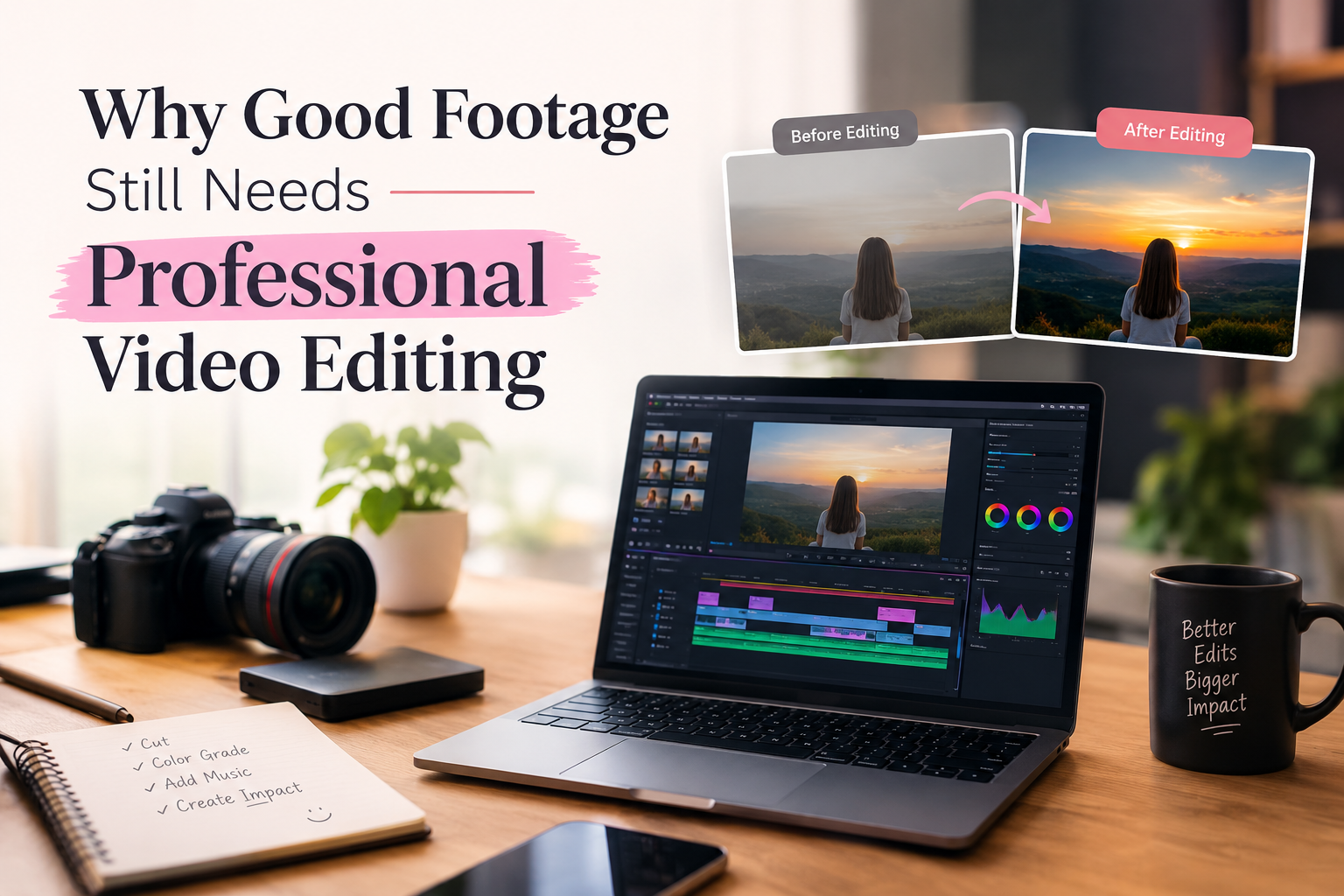
Why Good Footage Still Needs Professional Video Editing?

As we all know, in this digital era, most people are interested in social media platforms where they can post their daily schedules, shorts, videos, and blogs. For this reason, editing plays an important role. A camera can capture beautiful shots, clear images, and interesting moments, but raw footage is still just the beginning. Many people think that if the footage looks good, there is no need for professional editing.  However, even high-quality footage can feel incomplete when the clips are not properly arranged, the audio is uneven, or unnecessary parts are left in the final video. This is where Video Editing Services can make a real difference. Professional editing helps bring all the individual clips together, improve the overall quality, and create a smooth video that communicates the right message. Good Footage Is Only the Beginning Good footage makes a good video, but shooting good footage is only the start. No matter how high-quality your video is, or how well-lit or beautiful the backdrop of your shot, without good video editing, you might not have a professional-looking video. Video Editing Services can use your footage to produce a visual story that is nice to look at and easy to follow. By editing clips together, trimming excess footage, improving sound quality, inserting music that complements the clip, adjusting the color, and inserting a few effects, a video editor can help you produce a video that will keep the eyes of the viewers glued to the screen.Video is everywhere. If you do any type of business, have a social media presence, or have a brand of your own, then you will know that it is important to use video to promote, entertain, or educate your audience. So Why Does Good Footage Sometimes Fall Short? Good footage is a must, but it is just 1 of the various parts you want to have to make a very good online video. The choice of clips, its editing, and how it looks can change the overall quality of the ultimate online video. Here are ten explanations of why professional online video editing can distinguish between an average and a properly completed online video. 1. Choosing the Right Shots for Your Video When you create a video, you’re going to have a lot of footage. Some of it may be unnecessary, parts of it may be too long, and some clips may not fit well with the other parts. For example, take a product video. You could have footage of the product from various perspectives, close-up shots, and wide-angle shots of the product. With great footage, if you don’t end up using it properly and in sequence, your product video ends up being choppy or lagging. A Professional Video Editor can review the footage to select the appropriate clips. They can decide which shots should be used and where each clip should appear. Good footage gives the video editor good building blocks, while editing creates a proper structure for those building blocks. 2. Editing Gives a Good Flow One of the main reasons that even excellent footage still requires professional video editing is how the footage is arranged. It is not necessary for every video to follow a story structure, but it should have a progression that is easy for the viewer to follow. For a social media short, the content should progress smoothly and interestingly. A Professional Video Editor will know which shot to place first, when to cut between shots, when to switch to a different scene, and how long each shot should be. All of these are vital factors in the overall viewing experience of the film. Good Video Editing Services will not only be concerned with the aesthetic of a film but also its accessibility and viewer enjoyment. 3. Eliminates Unnecessary Parts Removes the excess material in your unedited videos. Your unedited footage can have mistakes and sections of the video that weren’t meant to be in the finished version. There could be long silences, repeats, portions where the audio/video wasn’t quite ready, or segments where the video is doing nothing. This can make your finished video appear slow. An editor can go through the footage and remove all the bits that aren’t necessary and only keep the bits that help tell the story or get the message across. This is another aspect of Video Editing Services that is best done by professional editors. It takes an editor a long time and patience to watch hours of footage and identify only the good parts. Experienced editors will chop a video down by cutting out all the unnecessary parts. 4. Better Editing Improves Sound Quality Video can sometimes be more difficult to achieve than quality audio. What can ruin a good video is the audio. You can hear strange ambient noises, volume fluctuations, wind noise, jumbled voices, and/or sharp changes in volume. Good quality video editing will combat these problems by removing the ambient noise, balancing the volumes, and bringing out the voice and/or music. Music can add mood to a video as well. A slow and soft music track can add a relaxed atmosphere to a promotional video, while lively music can add energy to an action-packed video. A Video Editing Company can harmonise the audio and video so that the material is more consistent and pleasing to the eye. 5. Color Correction Produces Consistent Footage Video shots may have different colors or brightness levels, which can be distracting. Some shots seem very warm, and some seem very cool. Some shots are too dark, and some are too light. Once we know what looks natural, color grading is used to create the style or mood that you want to achieve. That is, you can tell it to look very warm, very cool, or any combination of the two.Even after color correction and color grading, the shots are the same, but they appear more consistent with one another. Therefore, this is a stage of video post-production where the footage of the

Why Good Footage Still Needs Professional Video Editing? Read More »

Certificates vs skills for freshers seeking their first job

Are You Learning Skills or Just Collecting Certificates? 

Having a job today is not only about acquiring a degree or collecting certificates. There is an obvious question that many students and freshers want to have an answer to: are certificates or skills more relevant in getting a job today? Every organization is searching for individuals who can perform certain work, so practical skills have become essential for career development. A certificate may indicate course completion, while a skill shows what you can do in practice; a person with strong skills can often do a better job at an organization than someone with only a certificate and no practical knowledge. In this guide, we will explain skills vs. certificates, why practical skills are becoming an important requirement, the use of certificates, and what students need to achieve to enhance their employability. Certificate Skill A certificate is proof that you have completed a course, training program, workshop, or certification. A skill is your ability to use what you have learned in a practical situation.  It shows that you have studied a particular subject and gained knowledge. It shows that you can apply your knowledge to complete a task and get a job. For example, you can complete a graphic design course and receive a certificate. Creating a professional logo, poster, or social media design demonstrates what you can do with the help of a graphic design course. Shows what you have learned. Shows what you can actually do. Are Certificates Important for Getting a Job? Yes, certificates can be useful, particularly for students, freshers, and professionals changing fields. For career novices or people making a career transition with little or no professional experience, certificates show that you can actively look things up online and learn on your own. Thus, someone looking to build a career in web development could take a relevant course, learn the basics, earn a certificate, and add it to their profile. That would at least serve the purpose of bringing you into consideration. Benefits of Certification are:  However, obtaining only certificates does not lead you to a job! Employers would also want you to demonstrate your actual competence in how you can execute your learned skills. Why Practical Skills Matter in Today’s Jobs Skills let people see what you do; it lets them demonstrate and show instead of it just being what you were learning. For example, if a website development firm wants somebody to build a website, maybe they could ask them for websites they have built; if they desire content writing for their company, maybe they want him/her to show off their writing.  Similarly, if a graphic design firm wants a professional graphic designer, they can just give them samples of their work from the past, thus making practical skills more of a benefit than knowing. If someone just completed a course doesn’t mean all learning must end for him/her; one should also dedicate a certain period of his/her time to practicing it. What Skills Do Employers Look For? Employers usually look for a combination of technical and soft skills. The exact skills depend on the job, but some qualities are useful in almost every career. Technical Skills These are skills you use to complete a job. For example, if you are a web developer, they include website design, coding in different languages, video editing, creating digital graphic illustrations with computers, analyzing data or a business report, writing different pieces of content, or using AI technology and so much more. These skills let you do a good job at what you are working on using correct resources. Technical skills required will vary greatly depending upon the kind of work you will be employed doing. Communication Skills You should be able to communicate your ideas effectively and clearly, comprehend given assignments, and interact well with colleagues or customers. You must communicate your instructions and work ideas to people you will be interacting with and listen with proper comprehension to execute work tasks and avoid conflict or misunderstanding. Building working relationships with colleagues or clients can also be aided by the quality of communication. Problem-Solving Skills Skills Employers look for job hopefuls who can spot problems and identify or create the correct solutions without giving up when an issue arises. Whatever the kind of job, challenges are always anticipated; being capable of resolving them effectively can provide for easy completion of your tasks and responsibilities. Great problem-solving abilities encourage a healthy attitude toward stress and allow for effective assessment, troubleshooting, and resolution. Teamwork A majority of jobs involve collaboration with your colleagues. The ability to co-operate and share ideas well with your colleagues is vital. Doing this will let you and your group achieve your tasks faster and solve difficulties together. Collaboration ability also indicates that you are willing to contribute to the betterment of the team.  Learning Ability Technology is ever-advancing; you’re most likely going to encounter situations where you’re learning new things. Employers value this aptitude of individuals to be willing to pick up on new methods as they emerge. This can contribute greatly to your career advancement by ensuring you are adaptable to changing technology. Can Certificates Help Freshers Get Their First Job? Yes, for a fresher, a certificate can really help you get your first job. As a fresher, you do not get much of a experience, but a relevant certificate will enable you to show your employer that you have acquired knowledge in the respective domain. However, do not clutter your CV by putting all certificates you know of in it. If you want to be a web developer, don’t be eager to submit all the certificates about entirely different trades you might possess; rather, go for web development courses or projects. They complement your skills; practical experience will be a great advantage for them. Why a Portfolio Can Be More Valuable Than Another Certificate This gives employers an overview of your real work. Examples of portfolio items include:  For the graphic designer, a list of logos, social media post

Are You Learning Skills or Just Collecting Certificates?  Read More »

Graphic Design Institutes in Panipat Support Creative Career Paths!

Graphic Design Institutes in Panipat Support Creative Career Paths!

Out here, where screens shape how we see things, understanding creativity feels less like a choice. Every shop, every name people recognize, needs images that speak before words do. That quiet moment when someone notices your work first – that’s what drives many young minds in Panipat toward designing paths after classes end. Sketching ideas, playing with tones, reshaping pictures – these aren’t just hobbies anymore. When color pulls you in, when arranging shapes brings calm, maybe it’s time to walk into one of those known design classrooms scattered through the city. Most folks’ graphic design institutes in Panipat offer affordable classes, making it easier for more people to join without stress. Not far off, graphic work draws interest because openings often arise across fields. Picture crafting marks for brands, visuals on shops, or digital art online – options stretch wide through experience levels. Graphic Design: A Common Career Choice Nowadays, more businesses want eye-catching visuals just to stay visible online. A corner bakery down the street wants them, so does any big firm with offices everywhere. Banners on sites need a sharp look before anyone clicks through. Ads must grab attention fast, even when people scroll quickly. Packaging draws hands toward shelves without saying much. Social updates work better if colors and shapes match correctly. Tiny images preview videos while standing out in crowds. Names mean little unless paired with strong logos made by someone who knows how. Picture this. A world opens up when you learn graphic design – doors swing wide across fields like ads, tech, TV, print shops, and even web promotion spots. Finish training? Suddenly, offices want you. Some folks skip the office life altogether. They set up shop at their kitchen table, building logos or layouts for clients far away. Cash comes in through screens, quietly, while they stay right where they are. Most learners lean toward Graphic Design Institutes in Panipat because they mix imagination with digital tools. Not stuck in a loop of the same tasks, they dream up fresh visuals each morning. Creativity stays active when tech meets original thinking on a screen. Each project feels different – no two days look alike. Ideas take shape through software, sketching, and problem-solving. The work moves beyond routine into something built by hand and mind. Choosing the Right Institute Matters Right choices matter when learning new skills. Not just tools – good schools show how ideas like layout, fonts, brand identity fit together through real tasks. One place might teach a program. Another explains why things look the way they do. Most top graphic design institutes in Panipat mix classroom lessons with doing things firsthand. Because of live tasks, building a collection of work, or tackling actual client jobs, learners practice what they learn. Confidence grows alongside skills when students face realistic challenges early on. Checking trainer experience matters first. Course length might surprise some. Software used in lessons makes a difference, too. Support after finishing the program helps later on. Finishing certificates hold weight sometimes. Learning by doing sticks is better than theory alone. Placement help can change outcomes quietly. Skills Learned in Graphic Design Courses Picture making gets clearer when schools show both crafty tricks and smart methods. Some places teach the real software artists who actually click through every day. Some important skills include: Adobe Photoshop Training With Photoshop, graphic design becomes accessible to many learners worldwide. Starting here, students explore photo editing alongside poster layouts. Social media visuals come into focus after mastering basic adjustments. Instead of skipping steps, they build skills by crafting banners step by step. Image touch-ups follow naturally once fundamentals are clear. Digital drawings emerge later in the learning path. Adobe Illustrator From sketching logos to shaping brand visuals, Illustrator handles clean, resizable artwork. Its strength lies in crafting detailed illustrations that stay sharp at any size. Designers rely on it when building identity systems for companies. Smooth lines, precise shapes – these come naturally here. Work meant to scale without blur finds its home in this tool. CorelDRAW Some schools offer CorelDRAW lessons focused on printed materials like brochures. Others teach it for making business cards, using different methods each time. A few include pamphlets in their coursework, depending on the program’s structure. Flex banners sometimes appear, too, shaped by local demand and instructor preference. Typography and Color Theory Most folks diving into graphic design spend time learning about typefaces and hues. Picking letters carefully can shape how people feel when they see a layout. Colors bring mood to the surface, guiding eyes without words. One choice leads to another – contrast here, spacing there. How things look ties back to why they work the way they do. Branding with Social Media Design These days, companies rely heavily on social platforms to spread their names. Because of this shift, graphic design institutes in Panipat have begun covering topics such as Instagram visuals, catchy YouTube thumbnails, attention-grabbing ads, and brand-building strategies that shape how brands look and feel. Career Paths Following Graphic Design Once training ends at the well-known graphic design institutes in Panipat, graduates step into many work options. Digital fields open different positions based on what someone can do and how much they’ve done it. Among the choices people often pick are jobs like these. Some learners mix graphic design with digital marketing know-how, boosting job options along with income potential. Not everyone follows this path, yet it opens doors through added abilities. Pairing these fields often leads to more roles being available later on. Skills in both areas tend to support stronger financial outcomes over time. Learning Graphic Design in Panipat Fresh chances to learn keep popping up in Panipat, where class fees stay easier on the wallet than big city schools. Students now lean toward this place for career-focused courses that don’t demand high payments. The major benefits include: Affordable Course Fees Starting small, many graphic design institutes in Panipat offer low-cost programs for learners just beginning. Because of this,

Graphic Design Institutes in Panipat Support Creative Career Paths! Read More »