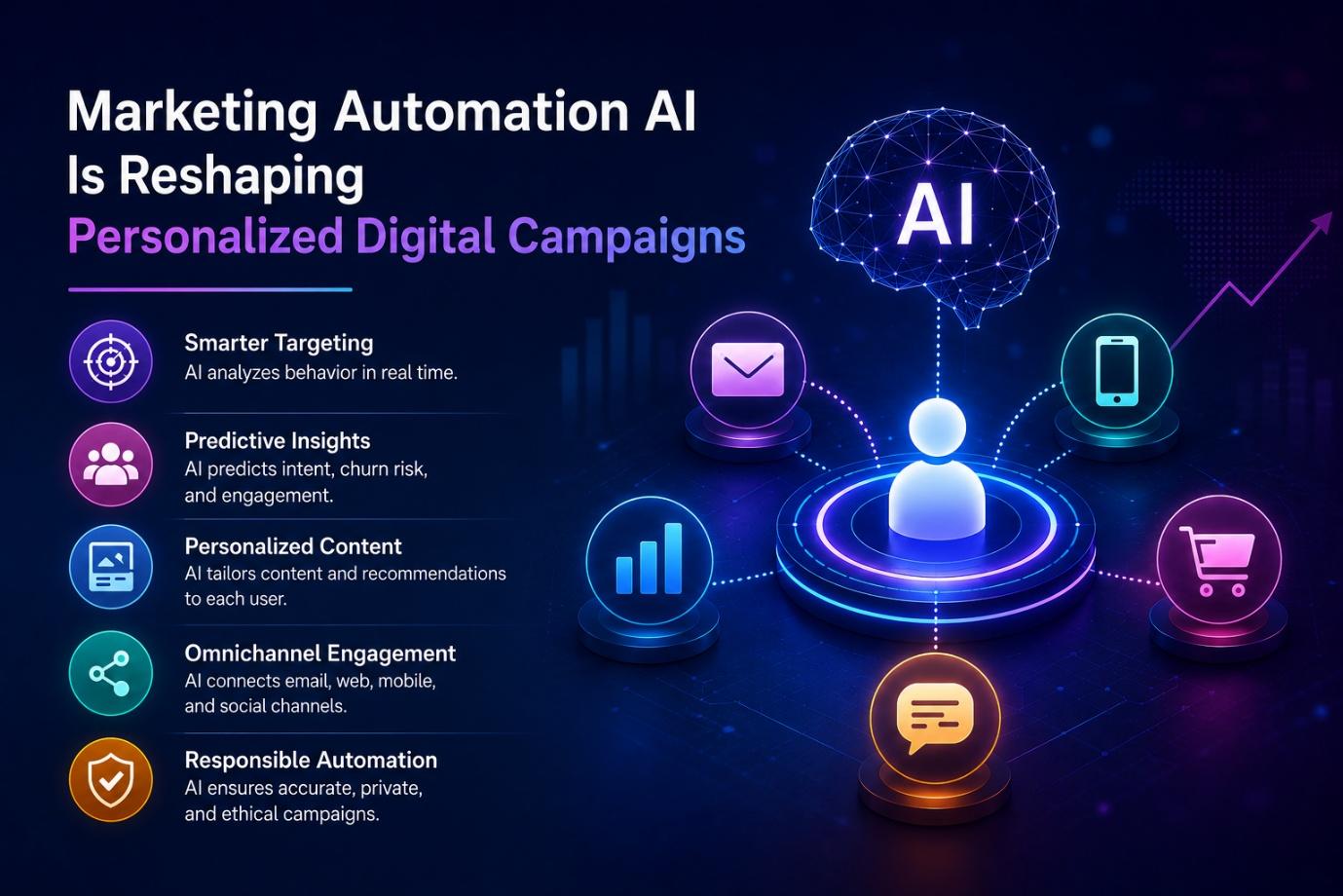


The role of data in digital marketing has also continued to grow. Each website visit, search, browsing of a web page, email received or sent, response to a social network advertisement or interaction, and an online transaction could gather data and indicate how someone encounters, analyzes, and responds to a company. The true problem, however, does not rest in the gathering of the data, but in the interpreting of the data.
The growth of the Digital Marketing Market is part of a broader trend toward quantified and technology-intensive marketing activities. As organizations engage in increasingly multifaceted digital outreach to reach audiences, they also generate a broad range of larger, more sophisticated datasets. Data analytics offer both the processes and the procedures by which this information can be leveraged to yield actionable insight into consumer behaviors, marketing efficacy, and evolving market conditions.
Understanding the Role of Data Analytics in Digital Marketing
Data analysis is the gathering, structuring, and investigating of data in order to find out relationships, patterns, and meaning from it. In digital marketing, this can range from fairly simple site analytics (like hit rates and page visits) to sophisticated actions like forecasting or segmenting.
The power of analytics is the range of questions it can answer. A company may seek to discover why they have increased site traffic, what content yields value to site visitors, where visitors drop off a website, and which actions are typical before a sale. They will now be equipped with evidence rather than making decisions by assumption.
This does not imply that every decision should come down to just a figure; rather, evidence can justify the reason for making a certain choice with context provided from professional experience.
From Looking Back to Predicting What Comes Next
Conventional marketing reports typically describe the past. For example: what number of visits were achieved in a given month, the volume of conversions attributed to a campaign, or revenue derived from a specific channel.
Today’s analysis goes a step beyond the past, identifying trends that may inform decision-makers of potential future action. In Machine Learning, models can analyze the combination of behavioral and historical data and forecast likelihoods such as future purchasing patterns or the churn process of any consumer.
Predictive analysis could play an important role, particularly when large amounts of behavioral data can be accessed, and specific patterns not discoverable through normal viewing would become visible.
However, there exist several limitations: predictions can only ever be as reliable as the underlying data and assumptions,s and new patterns may be triggered in customer behavior or external factors which may impact the reliability of a model. Thus, they should facilitate the work of human managers, not replace it.
Seeing the Customer Journey as a Connected Experience
Today, the customer journey does not simply unfold: it can be a complex path as a consumer initially discovers a brand through searching for a business name or query, visits a website, then reads other online reviews, views a social-media advertisement, returns via an e-mail before finally ordering days later via an online purchase.
Treating each of these touchpoints in isolation can hinder our understanding of what influences the final purchase decision. Data analytics enable organizations to consider each of these touchpoints as a collection. This means broader trends in customer behavior can become apparent when viewed together.
This is exemplified by a single e-mail campaign; the direct transaction figures resulting from its use might be low yet could potentially influence future returns through another channel. Therefore, simply analyzing e-mail conversions could mean you’re failing to appreciate its effect in the wider process.
Indeed, it is partially why the progression and evolution of Email Marketing is tied to wider advances being made in the measurement of our interaction. As e-mail coexists with the realms of search, social media, websites, and other digital arenas, the role of analytics is central to how these channels collaborate and do not work as separate entities.
Through complete analysis of the customer journey, all involved should understand not only initial consumer touchpoints, consumption of data prior to action and how often it is read, and how often the customer returns, but also where there could be friction points and, finally, the role of this information in decisions on content strategy, user experience, and channel performance.
Why First-Party Data Matters More Than Ever
A shift in data collection practices is also being driven by evolving privacy expectations and data tracking technologies. Organizations traditionally relied upon third-party data, but as restrictions are being placed on certain forms of data tracking, more and more reliance on customer-owned data sets is being placed upon customers.
A type of data collection where such information can be generated includes websites, purchase accounts, registrations, customer queries, and customer loyalty, not only on an information set but also information they have submitted themselves.
Data is not solely valued by how big a database is containing such data; a large database which has numerous amounts of old, duplicated, and inaccurately filed information can be considerably less useful than one containing a far smaller set of information if the data has been correctly sorted and entered.
Industry information such as work carried out by Expert Market Research provides context for organizational research, they can aid in understanding the reasoning behind wider industry changes but is not meant to substitute for their own organization data for customers.
Balancing Useful Insights with Privacy
Collecting and utilising information about customers requires customers to understand why it’s collected and how it will be accessed and stored. Collecting and managing this data comes with a variety of obligations which organisations must adhere to; it should not be viewed as a stumbling block for your measurements, and it can be used to improve customer measurement. With good data management, your organisation will better understand the data they already own, and it will ensure better practices are maintained in the company and that it can be used responsibly.
Analytical modelling is also changing to better measure the performance of a company, even if that doesn’t involve analysing customers’ information all the way to the user level.
Behaviour can still be identified with a variety of statistical methods that utilise models without having insight into user-specific information and thus improving performance without users assuming they are being tracked at each touchpoint.
How Artificial Intelligence Is Changing Marketing Analysis
Machine intelligence is a phenomenon that is growing rapidly as organisations perform business activity. Business has for years relied on analysts trawling through rows of spreadsheets or documents as the main way to interpret data. Artificial intelligence makes the analysis process quicker – spotting patterns, abnormalities, or correlations that have not yet come to our attention.
The burgeoning artificial market economy is driven by this trend. Data analysis methods can include forecasting, audience profiling, audience measurement, automated insights generation, or modelling. Companies can use AI as a way of efficiently probing larger volumes of data than it would otherwise have been practical to have analysed at an earlier stage.
With the advent of AI-powered decision-making, some are concerned about getting it wrong. However, because intelligence is only as good as the data it operates on, any AI system will suffer from any biases or deficiencies within that data or its programme or set of programmes, which is what it has learnt or operated on in the first place. If bad data is put into an advanced AI system, the result can be a bad insight, despite the intelligence within.
Companies are encouraged, therefore, to focus on building blocks first: it will always have been prudent for all businesses to concentrate on getting correct data, uniform measurement, and setting clear objectives and governance even if no AI had ever been invented.
Making Audience Segmentation More Meaningful
Data analysis also facilitates a better understanding of the different segments within a target customer base. Traditional methods of segmentation were primarily based on fairly broad demographics such as age, location, and population. Behavioral analysis of individuals enables businesses to go beyond these demographics and see how and what their customers actually do.
A company may uncover one type of segment, which regularly accesses educational information, while there will be other segments with distinct purchasing trends, e.g.
Products, or ones which previously made a purchase but have not yet returned to make another purchase. These trends can often illustrate a far different segment than general demographics. Although segmentation aims to divide customer bases into separate segments, excessive segmentation is also impractical, to the detriment of the analysis itself. Rather, the objective is to uncover segments in which real differences exist to illustrate consumer needs, behavior, or responses.
When properly analyzed and used with purpose, analytics offer an in-depth audience understanding relevant to many business objectives.
Measuring What Actually Matters
Enhanced ability to measure performance is probably the greatest benefit that analytics offers. While simple data like impressions, clicks, and visits might offer insight, they can’t always communicate that an activity has actually yielded an effective result. A campaign may drive loads of traffic but few quality queries, or drive fewer visitors, but those visitors have more valuable, lifetime customers.
That’s precisely why measurement should focus on stated objectives first and foremost. For example, if the objective is customer retention, then metrics like return purchases and customer churn are going to be more useful than page traffic volume; if the objective is lead generation, then volume and eventual result of leads rather than simply form submissions may be more appropriate. Marketing mix modeling and the range of other measurement techniques should give us insight into cross-channel performance; more and more relevant in the world of marketers where aspects of user-level tracking are proving to be less and less reliable.
The Technology Behind Reliable Analytics
Analytics is not just about an analytical tool; the technology underpinning it also needs to transmit, store, and collect data accurately. A system needs appropriate measurement arrangements, in websites and applications, for example, so that significant occurrences are recorded reliably in a consistent way. When a certain tracking or technical issue affects the collection of data, the subsequent analysis might present a deceiving picture.
This highlights a crucial link between analytics and the Web Hosting Services Market; efficient digital infrastructure allows the accurate, consistent compilation and presentation of the most important information generated by websites and applications, which, inevitably, is what the analytics systems compile reports with.
Therefore, technical infrastructure is an indispensable part of the global data picture; analytics professionals can, for instance, build advanced reports as long as these are based on the technical systems capable of maintaining their own underlying data stream.
The Main Challenges of Data-Driven Marketing
While the benefits of data analytics seem substantial, there are several practical issues to contend with. The most pervasive of these is the lack of integrated data. Many companies store data in an array of places-advertising platforms, websites, CRM systems, apps, and sales databases-and consolidating that information can represent a significant logistical undertaking.
Data quality is another issue-missing fields, duplicate entries, inconsistent metric definitions,s and tracking errors are common culprits that throw calculations into question. “This is really dangerous,” states a recent Chief Intelligence Officer for a marketing department, “A slick dashboard can make flawed information look entirely credible.”
Attribution is problematic. Customers often see advertisements and touchpoints on multiple touchpoints before investing, and it can oversimplify things if all credit is assigned to a single event. Different models produce very different results,s and understanding the underlying assumptions is a difficult task.
And so is that of skills. Building a dashboard or chart takes a modest amount of effort, but having relevant information relies more heavily on an analyst’s grasp of data quality, statistics, business goals, ls and the boundaries of any given measurement model.
But organizations should be vigilant not to measure something just because they can. A ton of data can make a lie seem like the truth. The analysis should focus on questions instead of “measure what you can.”
Building a More Effective Analytics Approach
You don’t need a highly complex tech stack for sophisticated analysis. In the simplest cases, it can start with a simpler process, focused on the business questions.
The first step involves defining exactly what the organization really needs to know, whether this is customer retention rates, how a website is performing, the quality of leads being generated, purchase behavior, or how well particular channels are working. Defining the question in advance defines the data that is really useful.
Once what needs to be known has been defined, the existing data sources must be investigated. Businesses must know where the data originates, how it is gathered, how accurate the data is, where there are major gaps, and, most importantly, the agreed definitions of certain events and outcomes must be established.
Where the data sources appear reasonably sound, relevant connections are then made. So the website data may be compared with applications data, the business application data with the transactional systems, and customer system data.
Turning these investigations into an ongoing process completes the capability for analysis. The results of analysis are checked against expectations, the results of decisions are turned around to create a learning cycle, and any relevant outcomes are compared against projections.
Looking Ahead: Where Marketing Analytics Is Heading
Several developing trends point toward the probable shape of the future for marketing analytics – including greater synergy among artificial intelligence, predictive modelling, privacy-friendly measurement, and business intelligence. As artificial intelligence applications mature further, organizations are likely to see faster identification of patterns and probable futures, while predictive models are better able to estimate the value of customers and identify warning signals of account churn.
Meanwhile, privacy concerns will further shape the way data is obtained and interpreted. Thus, companies may need to measure in ways that yield useful data without making presumptions about continued access to an individual’s private information.
Businesses may also focus more upon results, as opposed to isolated channel measures – they are likely to continue asking how marketing activities performed in unison produce business results, rather than how a specific action performed individually. Ultimately, this will require human interpretation; while machines may be able to isolate patterns, an individual must still determine whether a pattern is representative of any meaningful information.
Conclusion
To gain clarity amidst the complexities of digital and customer behavior analysis, data analytics has moved to the forefront of digital marketing strategies. In utilizing analytics, a company can develop and discover patterns, evaluate effectiveness, trace the customer experience or purchase path, and develop strategies and plans based upon solid data, rather than speculation.
However, the value of data analytics cannot simply come from the quantity of information extracted. Quality data, dependable measurement,and appropriate privacy policies, combined with an ability to make relevant findings, are equally important.
Technologies such as prediction and artificial intelligence are only going to assist analytics in further recognizing patterns, but the overall importance will be centered around what a company asks. They should have access to clean and unbiased data, understand when the information from their analytics is incomplete, and make a prudent decision based on analysis, not speculation.
This blend of technology with valid data and human intuition will guide the continued development of data-driven digital marketing campaigns.

Bodh Raj is a Digital Marketing Manager with around 5 years of experience in SEO, content marketing, Meta Ads, Google Ads, and digital growth strategies. He has worked on website optimization, content planning, lead generation, and online marketing campaigns across different industries, helping businesses improve their digital presence and organic visibility.