In 2026, people are no longer limited to searching a list of links on Google to find information. Users are increasingly turning to AI-powered search experiences to ask questions, compare products, understand more complex topics and get personalized answers. Instead of visiting several sites, they may be presented with a summary that aggregates information from multiple sources.
This shift has opened doors for businesses, content creators and website owners. While traditional Search Engine Optimisation (SEO) is still a crucial consideration, Answer Engine Optimisation (AEO) and Generative Engine Optimisation (GEO) have also influenced the ways in which content is discovered and presented by search engines.
Knowing the differences between SEO vs AEO vs GEO
can help you create the content that your audience wants to see, appear in a search and connect you with potential users.
In the following guide, we will explain how these three approaches work, where they intersect, how search engines find relevant information and what you can do to improve your website’s visibility in 2026.
What Are SEO vs AEO vs GEO?
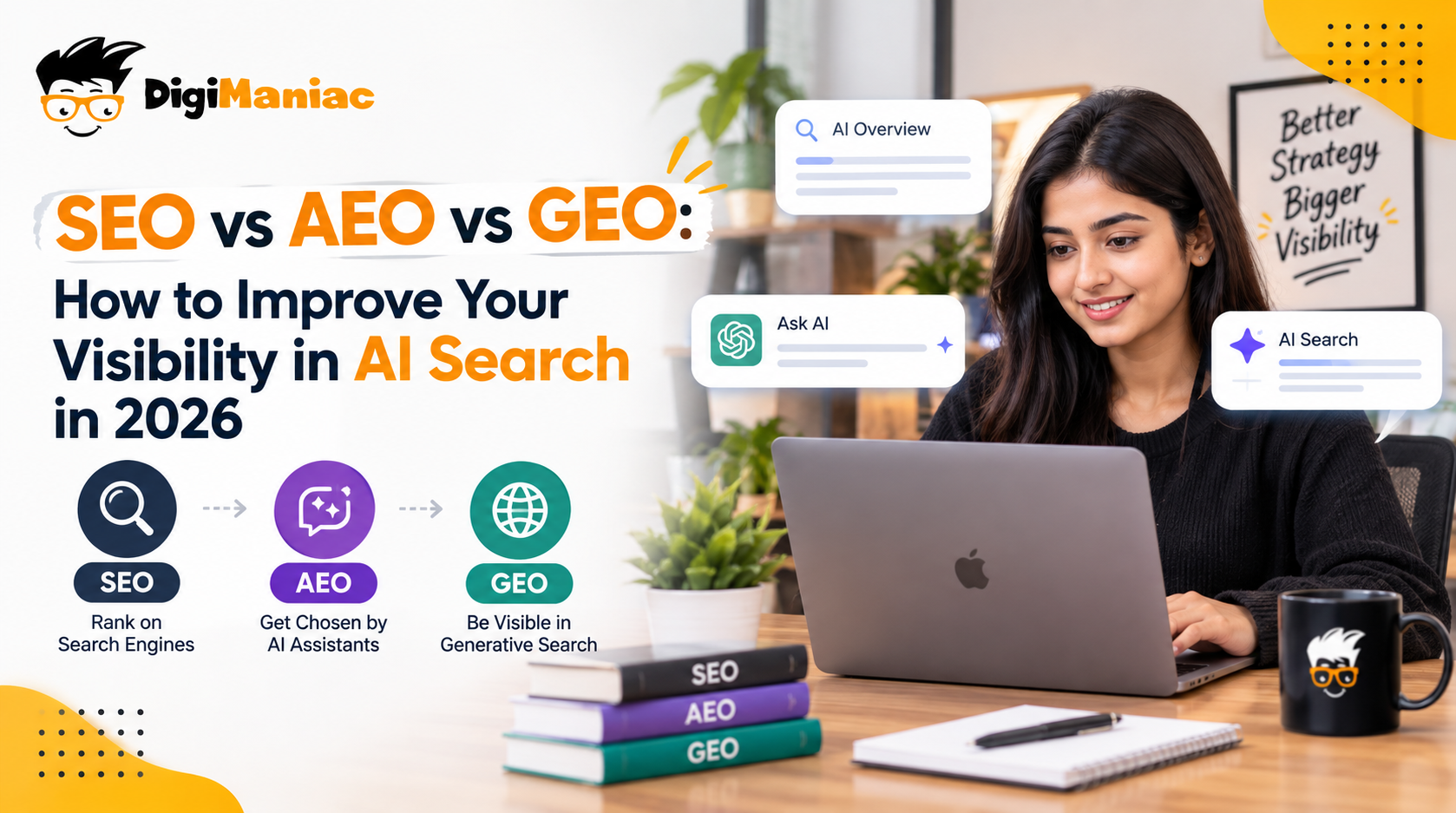
SEO vs AEO vs GEO are concerned with improving the visibility and usability of online content, but each has a specific focus.
- SEO (Search Engine Optimisation): Helps web pages appear and be discovered in traditional search engine results.
- AEO (Answer Engine Optimisation): Organises information in a way that search engines and answer-focused systems can easily identify and present a direct answer.
- GEO (Generative Engine Optimisation): Makes it easy for generative AI systems to find, understand and quote relevant material in their responses.
These strategies are not entirely separate from each other – a well-structured page that answers a user’s question effectively can have a positive impact across all areas. The differences between SEO vs AEO vs GEO mainly lie in the way that information is presented to users.
Traditional search typically presents a list of relevant results, while answer and generative AI experiences may provide a direct response with supporting information.
SEO vs AEO vs GEO: Main Differences
While SEO vs AEO vs GEO share some similarities, each approach has different goals and strategies. Understanding how they are similar and different will help you decide what you want to achieve with your content and how you need to present it.
| Comparison | SEO | AEO | GEO |
| Main goal | Improve search rankings | Provide direct answers | Gain visibility in AI-generated responses |
| Primary focus | Search engine results | Questions and answers | Context, relevance and source selection |
| Content format | Informative, well-structured pages | Concise answers, definitions and explanations | Detailed, trustworthy and context-rich content |
| User experience | Users explore relevant pages | Users find answers quickly | Users receive synthesised information from sources |
| Visibility measurement | Rankings, impressions, clicks | Answer appearances and featured results | AI mentions, citations and linked sources |
| Example outcome | A page ranks for a keyword | A page supplies a direct answer | A page is cited in an AI-generated response |
While these distinctions are useful for planning, they are not strict technical boundaries. A single page can perform well across all areas.
For example, a detailed article about website speed could rank in Google, answer a question about how to improve performance and be cited by an AI assistant explaining how to boost website speed.
Google has also suggested that conventional SEO practices remain relevant for its generative AI search features.
1. What Is SEO (Search Engine Optimisation)?
Search Engine Optimisation helps websites improve a page’s visibility, relevance and overall quality for search engines. When a user looks for information, a search engine considers many variables when deciding what to display. SEO makes your content discoverable, relevant and valuable to the people searching for it.
Optimisation is more than just finding the right keywords and including them in an article. SEO involves technical website improvements, appropriate content presentation, internal linking and building credibility and authority within a topic area.
How SEO Works
1. Crawling and indexing
Search engine crawlers find website pages via links and sitemaps. Eligible pages can then be processed and added to the search index.
2. Search intent and keyword relevance
Content should reflect real-world relevance to what users are looking to learn, compare or find when searching.
3. Technical performance and structure
Clear navigation, descriptive links, mobile-friendly design, accessible content, appropriate internal links and other factors help search engines and visitors understand the website.
4. Content quality and credibility
Content that explains, cites and provides relevant information can be more helpful than a simple repetition of common knowledge.
Example of SEO in Practice
A user may search for “how to improve website loading speed.”
A useful SEO-focused article could explain:
- What causes a website to load slowly.
- What factors affect speed.
- How to compress images and utilise caching.
- How to address hosting and unnecessary scripts.
- Practical steps for improving performance.
The article should address the query effectively without including additional irrelevant information just for the sake of length.
Important SEO Metrics
Focus on the metrics that contribute to understanding how well your website is reaching the right audience.
- Organic impressions and clicks.
- Keyword rankings for relevant queries.
- Click-through rate (CTR).
- Pages that are or are not indexed.
- Landing-page engagement and organisational metrics.
- Technical issues affecting crawling or indexing.
When should you prioritise SEO?
SEO is essential when you want to boost your long-term visibility in search, attract relevant organic traffic and improve website navigation for both humans and machines.
2. What Is AEO (Answer Engine Optimisation)?
Answer Engine Optimisation focuses on making information easily found and presented as a direct answer.
Traditional search results typically require a user to visit a website and find the relevant information themselves. Answer-focused experiences aim to simplify and accelerate this process by providing a concise explanation, a featured snippet or another direct response.
AEO therefore prioritises clear answers, question-based content and appropriate presentation of information.
How AEO Works
Answer engines need relevant content to find the information that directly addresses the question. Content that identifies the answer clearly before expanding can be easier to parse and utilise.
Consider the question: “What is technical SEO?”
A direct response could state: “Technical SEO is the process of improving a website’s technical structure so search engines can crawl, index and understand its pages more effectively.” The article can then elaborate on crawling, indexing, site architecture, page speed and other related topics.
This approach provides the information a user is seeking while also including enough detail for those who want to learn more.
Practical Ways to Improve AEO
1. Answer the main question early
Avoid long introductory paragraphs that obscure the information a user wants to find. Provide a definition or direct explanation early, and then expand on the supporting information.
2. Use question-based headings
Incorporate natural questions that reflect actual user needs, such as:
- What is the difference between SEO and AEO?
- How does website indexing work?
- Why is my page not appearing on Google?
- How can I measure organic traffic?
Only use these headings when the article truly answers the question.
3. Keep explanations focused
A paragraph should address a single point. For a complex process, explain the steps in order rather than presenting all of the information in a single block of text.
4. Add useful examples
Examples help readers determine how a specific explanation is used, and they help distinguish between a generic definition and a detailed explanation.
5. Use structured content where appropriate
Numbered steps, comparison tables, descriptive headings and lists can improve readability. Structured data can help search engines understand supported elements on a page when implemented correctly, but it does not guarantee an appearance as a direct answer.
Example of AEO in Practice
Someone may ask: “How long does SEO take to show results?” The article should explain that SEO timelines vary, depending on a website’s history, the competition for relevant keywords, the existing technical structure, the quality of content and the effort needed to resolve technical or content-related issues.
The answer can then discuss the difference between early signs of improvement and meaningful changes in rankings, traffic or conversions. This is more useful than providing a generic time period for every website.
Important AEO Metrics
Depending on the available tools and reporting options, you may be able to track:
- Featured snippet or direct-answer appearances.
- Search impressions for question-based queries.
- Click-through rate on relevant informational pages.
- Visibility for long-tail searches.
- Referral visits from answer-focused platforms, where measurable.
An answer may satisfy a user’s question without prompting a visit to the article, so traffic is not always an indicator of value.
When should you prioritise AEO?
AEO is ideal for informational content, tutorials, troubleshooting guides, definitions and FAQs where users need a quick and clear response.
3. What Is GEO (Generative Engine Optimisation)?
Generative Engine Optimisation focuses on improving the likelihood that relevant website content will be discovered, understood, referenced or cited by AI-powered search and answer systems.
Tools like ChatGPT search, Google AI Overviews, Google AI Mode, Perplexity and other generative experiences can combine information from multiple sources to provide a response.
Instead of simply showing one page at the top, these systems may pull in several documents, identify relevant passages and present information that synthesises the information from multiple sources.
GEO aims to make your content a valuable contributor throughout this process. However, no optimisation strategy can guarantee that a given AI system will mention or cite a website.
How GEO Works
AI-powered search experiences may use retrieval systems to find relevant information before presenting a response. The process varies depending on the platform, but it generally involves several steps.
Step 1: Understand the question
The system determines what the user is asking, and it may also identify related questions that contribute to a complete answer.
Step 2: Retrieve relevant information
Depending on the platform, the system may utilize a search index or other information sources to identify pages that address the question.
Step 3: Evaluate useful passages
Relevant sections can provide definitions, evidence, examples and supporting details that contribute to the response.
Step 4: Generate the response
The AI combines the information and displays relevant citations.
This is a simplified breakdown that is not a universal technical sequence. Different systems use different indexes, retrieval methods and citation selection. Google’s documentation, for example, covers query fan-out, in which related searches are used to help its generative search features find information for a more complete answer.
Practical Ways to Improve GEO
1. Publish information that adds something new
If your article repeats the same generic advice found on dozens of pages, it does not offer much advantage to your readers.
Publish original analysis, real examples, first-hand observations, useful comparisons or evidence that supports your conclusions.
2. Explain concepts with enough context
Avoid out-of-context statements that could be misleading. Explain what a fact means, why it matters and when it applies.
3. Support important claims
Use reliable sources, relevant data and clear references for factual claims. Make it easy to distinguish between verified information and opinion or assumptions.
4. Build topical depth
Cover the important aspects of a subject and link relevant articles together through internal links. A collection of useful pages can help people explore a topic without forcing them to search repeatedly.
5. Make important information easy to find
Use descriptive headings, meaningful paragraphs, clear definitions and accessible page content. Avoid hiding essential explanations behind interactions that restrict access to them.
6. Maintain consistent, accurate information
Keep names, dates, prices, product specifications and other factual details consistent wherever they appear. Update content when the underlying information changes.
7. Build genuine recognition beyond your website
Useful contributions to industry discussions, independent reviews, relevant publications and credible third-party references can help people discover and assess your work. Focus on earning genuine recognition rather than trying to create artificial mentions to manipulate AI systems.
Example of GEO in Practice
Someone may ask an AI search tool: “Which factors should a small business consider when choosing an email marketing platform?”
A useful article could explain the differences between pricing and subscriber limits, automation features, integration capabilities, delivery and reporting options, ease of use, customer support and the types of businesses that may benefit from a certain option. A balanced comparison and clearly explained information is more useful than an article that simply declares one platform to be the best. An AI-generated response may reference such a page if the content is relevant to the query and selected by the system. It may also cite other sources, or it may not cite any pages.
Important GEO Metrics
Wherever possible, measure AI visibility separately from traditional organic performance.
- Whether your brand appears in relevant AI-generated responses.
- How frequently your pages are cited.
- Which questions and topics trigger mentions.
- Which URLs are referenced.
- Referral traffic from AI platforms.
- Qualified visits and organisational metrics stemming from those referrals
When should you prioritise GEO?
GEO is beneficial when your audience is increasingly relying on AI-powered tools to research, compare products, explain topics and make decisions. It should complement your existing content and SEO strategy, not replace or overshadow it.
How SEO vs AEO vs GEO Work Together
The most practical approach is to combine the three rather than choosing just one. A given page can be technically accessible, rank for a relevant query, provide a concise answer and include detailed supporting information. All of these contribute to an improved experience for the actual reader.
SEO: Make the page discoverable
Improve crawling, indexing, relevance, page structure and overall visibility in organic search.
AEO: Make the answer clear
Address relevant questions directly and present information so that people can quickly understand it.
GEO: Make the content useful as a source
Provide context, evidence, original insights and clear explanations that may be leveraged when an AI system is generating a response.
A Practical Example
Consider an article about “How to Reduce WordPress Website Loading Time.”
- SEO will help the page target the relevant searches and remain accessible to search engines.
- AEO would help the article answer questions such as “Why is my WordPress website slow?”
- GEO would benefit the article by providing detailed explanations, useful evidence and context that an AI system may select when addressing related questions.
The same article can serve all three purposes if it is written around genuine user needs.
How to Rank in AI Search in 2026: 10 Practical Steps
There is no guaranteed roadmap for appearing in AI-generated answers, but the following steps will help you lay the technical, content-related and measurement foundations that support a stronger search strategy.
1. Understand the Questions Your Audience Asks
The first step to optimisation is understanding the problems people want to solve before choosing which keywords to target. Use keyword research, Search Console queries, customer conversations, relevant forums and common support questions to identify genuine search needs.
For each topic, consider whether the user is looking for a definition, a tutorial, a comparison, a recommendation or a solution to a problem. For example, “what is local SEO?” and “how to improve local SEO rankings” are both search queries, but they require different answers.
Action: Create a list of important questions and group them by search intent before planning your content.
2. Write a Direct Answer Before Expanding
People should not have to read several paragraphs before finding the information they are seeking. Introduce the answer near the beginning of the relevant section and then explain the details, limitations, examples and next steps.
For example, a section about XML sitemaps could start by stating that an XML sitemap helps search engines discover important URLs. The following paragraphs can cover sitemap creation, submission and common issues. This structure supports readability without expecting every paragraph to follow a rigid template.
3. Create Original, Helpful Content
Publishing more articles does not always improve search visibility; your content must provide information that your readers cannot get as easily from a superficial summary.
You can improve originality by including:
- First-hand experience and practical examples.
- Original research or analysis where appropriate.
- Comparisons based on clearly defined criteria.
- Common mistakes and their solutions.
- Expert explanations of complicated subjects.
- Updated information supported by credible sources.
Google recommends creating distinctive, people-first content rather than focussing on pages designed to manipulate rankings or AI responses.
4. Improve Technical SEO
Your content cannot consistently appear in search results if important pages are inaccessible or cannot be indexed.
Review these areas:
- Rules in robots.txt, accidental crawler restrictions.
- Accuracy of XML sitemap.
- Noindex directives and canonical tags.
- HTTP status codes and redirect chains.
- Internal links to important pages.
- Mobile usability and page performance.
- Server responses and JavaScript-dependent content.
Check the actual rendered or delivered content, not what appears in a browser, to ensure that every crawler has equal access to your content.
For Google AI search features, the relevant page must meet Google’s technical requirements and be eligible to appear in Search with a snippet. That said, meeting these conditions does not guarantee inclusion.
5. Use Clear Headings and Logical Content Structure
Headings should inform readers of what a given section explains.
For example, an article about website indexing could be structured as follows:
- What Is Website Indexing?
- How Do Search Engines Index a Page?
- Why Is a Page Not Indexed?
- How to Check Indexing Status
- How to Fix Common Indexing Problems
Avoid using headings solely to insert additional keyword variations. Each section should provide useful information to the main topic.
6. Demonstrate Trust and Expertise
People need to know whether the information they are reading is reliable. Provide author details where appropriate, cite sources for important factual claims, explain the basis of recommendations and update information when it becomes outdated.
For subjects that require specialist knowledge, involve appropriately qualified experts. Avoid unsupported guarantees, fabricated statistics and claims that cannot be verified. Trust is an important aspect of Google’s people-first content guidance, as are considerations of experience, expertise and authoritativeness.
7. Use Structured Data Correctly
Structured data enables search engines to understand and represent supported information about a page, such as an article, product or organisation. Use the correct format for the actual content and follow the relevant technical requirements. Keep the markup consistent with what users can see on the page.
Schema markup is not a shortcut to AI visibility. Adding FAQ, Article or other structured data does not guarantee that an AI system will cite your page. Google’s guidance specifically says that special marking is not required to appear in its generative AI search features.
8. Keep Important Information Accessible
Ensure that essential text is available in a form that can be accessed by users and relevant crawlers. Use descriptive links, readable page content and meaningful HTML structure. Avoid putting all important information in images without text alternatives or relying on complicated interactions to show the main answer. Test important pages with search engine inspection tools and see if the delivered content matches what visitors see.
9. Build Genuine Authority Across Relevant Sources
Your website is only one way people learn about a subject or business. Useful educational contributions, independent industry coverage, credible reviews and accurate business information can help build recognition beyond your own pages.
Focus on relevance and trust. Avoid buying fake reviews, publishing misleading comparisons or creating artificial mentions that say your brand is the best option without evidence. The aim is to be a genuinely useful source, not to manufacture signals for an algorithm.
10. Monitor Traditional Search and AI Visibility
Track the performance of your pages after improvements. Use Google Search Console to examine impressions, clicks, queries, indexing and other available search data. Use analytics to understand engagement on landing pages, conversions and referral sources.
For AI visibility, test a consistent set of relevant questions across the platforms important to your audience. Record whether your content is mentioned, which URLs are cited and whether the information is accurate. Repeat the tests periodically because generated answers can vary by question wording, context, location, time and platform.
SEO vs AEO vs GEO: Which Metrics Should You Track?
Each approach requires a slightly different measurement strategy. The table below is a practical starting point.
| Metric | SEO | AEO | GEO |
| Organic impressions | Primary | Useful | Supporting indicator |
| Organic clicks | Primary | Useful | Supporting indicator |
| Keyword rankings | Primary | Supporting | Supporting |
| Direct-answer appearances | Supporting | Primary | Useful |
| AI-generated mentions | Supporting | Useful | Primary |
| AI citations and source URLs | Supporting | Useful | Primary |
| AI referral traffic | Supporting | Supporting | Primary |
| Leads and conversions | Primary business outcome | Primary business outcome | Primary business outcome |
These categories are similar, and the availability of direct-answer and AI citation data depends on the platform.
How to Track AI Search Visibility
Google Search Console: Review available Search performance reports to understand which pages and queries attract search impressions and clicks. AI-related reporting and metrics can vary by feature and reporting interface.
Website analytics: Identify visits referred by AI platforms where referral information is available. Track meaningful outcomes such as engaged visits, enquiries, sign-ups or purchases rather than just traffic.
Manual AI search testing: Prepare a repeatable list of questions related to your subject. Test them across selected AI search platforms and record whether your brand or page appears, which sources are cited and how accurately the response represents your content.
Reporting spreadsheet: Maintain a simple record of the date, platform, query, mention status, cited URL and relevant observations. This creates a baseline for comparing visibility over time.
Remember that AI-generated responses are not always consistent. A page may be cited for one version of a question and omitted for another, so avoid drawing conclusions from one test.
Common SEO vs AEO vs GEO Mistakes to Avoid
Some optimisation practices waste effort because they focus on manipulating search systems rather than improving the information available to users.
Publishing large amounts of repetitive AI content
Generating many similar pages without adding meaningful value can reduce content quality and create search spam risks. Review and improve content before publishing.
Repeating keywords unnaturally
Keyword stuffing makes content harder to read and does not provide a reliable path to better AI visibility. Use terminology naturally within a clear explanation.
Expecting schema to guarantee citations
Structured data should accurately describe supported content. It cannot force an AI system to select your page.
Ignoring technical accessibility
Strong content can still struggle to appear in search if important pages are blocked, inaccessible or not indexed.
Measuring success only through rankings
Rankings matter, but they do not capture every AI mention, citation, referral or business outcome. Use a broader measurement approach.
Creating artificial brand recommendations
Fake reviews, misleading third-party pages and attempts to manipulate generated answers can damage trust and violate applicable spam policies.
Google’s published guidance advises website owners to focus on established SEO practices and valuable, distinctive content rather than on supposed GEO shortcuts.
Conclusion
SEO vs AEO vs GEO address different aspects of how people discover information online. SEO helps your pages appear in traditional search, AEO makes answers easier to identify, and GEO focuses on the role your content may play in AI-generated responses.
The most effective approach is to bring these practices together while not losing sight of the reader. Understand what people need, explain the topic clearly, support your claims, maintain accessible pages and measure the results.
AI search is evolving, so no single tactic can guarantee rankings or citations across every platform. A sustainable strategy is built on content that genuinely helps people and provides a reliable source of information whenever it is relevant to their questions.
1. What is the main difference between SEO vs AEO vs GEO?
SEO vs AEO vs GEO – SEO focuses on improving search engine visibility and rankings. AEO focuses on presenting clear answers to specific questions. GEO focuses on helping relevant content become a useful source for generative AI responses. All three can work together on the same page.
2. Is SEO still important for AI search in 2026?
Yes. Technical accessibility, indexing and relevant content are important for Google’s generative AI search features. However, good SEO does not guarantee that a page will appear in every AI-generated answer.
3. Does GEO replace traditional SEO?
No. GEO is better understood as a complementary optimisation approach. Search engines and AI systems can use overlapping content discovery and retrieval processes, so technical SEO and useful content remain valuable.
4. Is AEO only about featured snippets?
No. Featured snippets are one example of a direct-answer search experience. AEO more broadly concerns making information clear and suitable for answer-focused experiences, although visibility depends on the capabilities and selection processes of each platform.
5. What is the best strategy for SEO vs AEO vs GEO in 2026?
SEO vs AEO vs GEO – Start with a technically accessible website and useful content that directly answers your audience’s questions. Add relevant evidence, clear explanations and original insights, then measure organic search performance and AI visibility separately where possible.

I’m Renu Singroha, an SEO & Content Marketing professional with 5+ years of experience in SEO strategy, content optimization, and digital marketing. I specialize in improving organic visibility, driving relevant traffic, and creating data-driven strategies that support business growth.