
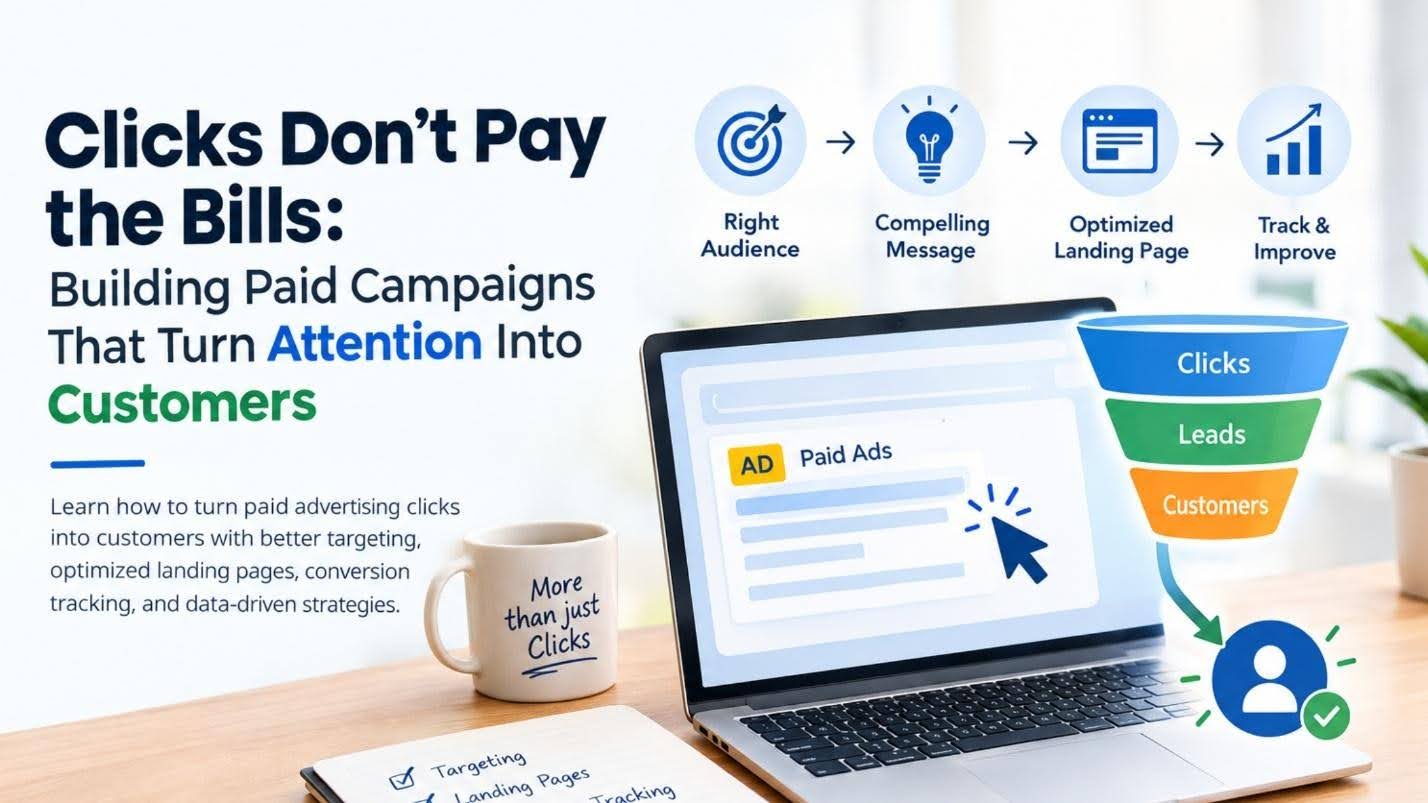
Introduction: When More Clicks Don’t Mean More Business
Imagine a business investing ₹30,000 in paid advertising. The campaign generates hundreds of website visits, plenty of clicks, and an impressive-looking dashboard. Yet, at the end of the month, the business has gained very few customers.
Where did the money go?
The problem may not be the advertising platform itself. It could be the targeting, the message, the landing page, the conversion process, or the way results are measured.
Many businesses judge advertising performance by impressions, clicks, and website traffic because these numbers are easy to track. While they help marketers understand how people interact with advertisements, they do not necessarily reveal whether a campaign contributes to business growth.
A click is an opportunity, not a guarantee of revenue.
Whether a business uses Google Ads to reach people actively searching for solutions or Meta Ads to introduce products to relevant audiences, the objective should go beyond attracting attention. The real challenge is to turn that attention into meaningful actions and, ultimately, paying customers.
Successful paid advertising connects the right audience with the right offer, creates a smooth customer journey, and measures the outcomes that matter to the business.
Here is how businesses can build campaigns around conversions rather than simply chasing clicks.
Table of Contents
1. Start With a Business Goal, Not a Click Target
Before selecting keywords, designing advertisements, or setting a budget, businesses should define what success means.
A campaign designed to increase brand awareness requires a different strategy from one intended to generate qualified leads or online sales. Without a clear objective, marketers may optimize for activity that looks impressive but contributes little to business growth.
Consider three examples:
- An e-commerce store wants customers to complete purchases.
- A local dental clinic wants to generate appointment bookings.
- A B2B company wants enquiries from decision-makers who are likely to become clients.
Each business needs a different conversion strategy.
For example, a coaching institute may receive hundreds of website visits but very few course enquiries. Rather than celebrating the traffic, the marketing team should investigate whether the advertisements reach prospective students, whether course information is clear, and whether the enquiry process is convenient.
Before launching a campaign, answer three questions:
What action should the audience take? Define the primary outcome, such as a purchase, booking, or qualified enquiry.
Who is most likely to take that action? Understand the audience’s needs, location, budget, and readiness to make a decision.
How will success be measured? Choose metrics that connect advertising activity with the intended business outcome.
These decisions provide a foundation for every subsequent optimization.
2. Target Customer Intent Instead of Chasing a Large Audience
Not every click has the same value.
Someone searching for “how to choose a digital marketing agency” may still be researching their options. Someone searching for “hire a digital marketing agency for my business” may be closer to making a decision.
Both searches can be useful, but their intentions differ.
For search advertising, businesses should examine the search terms triggering their advertisements and determine whether those queries match their products or services. Irrelevant searches can consume budget without creating meaningful opportunities.
For social advertising, the challenge is slightly different. Users may not be actively searching for a solution, so the advertisement must establish relevance and give them a compelling reason to engage.
Businesses can improve audience relevance by:
- Aligning keywords with the intent behind a search.
- Reviewing search terms and excluding irrelevant queries where appropriate.
- Choosing geographic and audience targeting that matches the actual customer base.
- Creating advertisements that speak to specific customer problems.
- Evaluating whether generated leads are relevant and qualified.
For instance, a company offering paid advertising management may waste budget attracting people looking only for free advertising courses. Better targeting and clearer messaging can help reduce such mismatches.
The goal is not to reach everyone. It is to reach people who have a genuine reason to consider the offer.
3. Make Every Advertisement Give People a Reason to Act
Even a well-targeted campaign can underperform when its message fails to connect with the audience.
Generic headlines such as “Best Services Available” or “Grow Your Business Today” do little to explain why someone should choose one business over another.
Strong advertising communicates a specific benefit, addresses a relevant need, and makes the next step clear.
Consider a business offering website design services.
A generic advertisement might say:
“Professional Website Design Services. Contact Us Today.”
A more relevant alternative could say:
“Need a Website That Generates More Enquiries? Explore Website Design Built Around Your Business Goals.”
The second version connects the service to a problem the audience may recognize. Its effectiveness would still need to be tested, but the value proposition is clearer.
A useful advertisement generally includes three elements:
A relevant hook: Capture attention by addressing a problem, need, or aspiration.
A clear benefit: Explain what the audience can gain from the offer without making unsupported promises.
A specific call to action: Tell people what to do next, such as requesting a quote, booking a consultation, or exploring a product.
Visuals also matter. On platforms such as Instagram and Facebook, creative content needs to communicate quickly. In search advertising, the headline and description should align with the searcher’s intent.
Rather than assuming one advertisement will work for every audience, test meaningful variations in headlines, offers, and creative formats. Evaluate them against the campaign’s business objective, not just their click-through rates.
4. Turn the Landing Page Into a Natural Next Step
An advertisement makes a promise. The landing page needs to deliver on it.
Imagine clicking an advertisement for a free consultation, only to arrive on a generic homepage with multiple menus and no obvious booking option. Even if the advertisement was relevant, the visitor must work too hard to complete the desired action.
This is why the landing page should be treated as part of the advertising strategy, not as a separate consideration.
A strong landing page should include:
- Message consistency: The headline should match the promise made in the advertisement.
- A clear value proposition: Explain what is offered and why it matters.
- A visible call to action: Make the next step easy to identify.
- Mobile-friendly design: Ensure the page and its forms work well on smaller screens.
- Trust signals: Use genuine testimonials, relevant examples, transparent contact information, or verifiable credentials.
- A simple conversion process: Remove unnecessary form fields and confusing navigation.
For example, an advertisement promoting dental appointments should lead to a relevant appointment or service page rather than forcing visitors to navigate through unrelated information.
Businesses should also check page loading performance, broken forms, and mobile usability. A technical problem can undermine an otherwise effective campaign.
Before increasing advertising spend, investigate whether the website experience is helping visitors take the next step or creating unnecessary barriers.
5. Track Conversions and Measure What Matters
Businesses cannot confidently improve campaign performance if they cannot identify which interactions lead to valuable outcomes.
Conversion tracking helps advertisers measure actions such as purchases, form submissions, calls, and bookings. Google’s official conversion tracking guide explains how advertisers can measure actions that matter to their business.
However, tracking must reflect the actual business objective.
A product page view is not equivalent to a completed purchase. A submitted enquiry form is not necessarily a qualified lead, and a qualified lead is not automatically a paying customer.
Several metrics help marketers understand different stages of campaign performance.
Click-through rate (CTR) measures the proportion of ad impressions that result in clicks. It helps assess whether an advertisement attracts attention, but it does not establish whether that attention is valuable.
Cost per click (CPC) measures the average amount paid for a click. Lower CPC can reduce traffic costs, but inexpensive traffic may have little commercial value.
Conversion rate measures the proportion of eligible ad interactions that result in a tracked conversion. The exact calculation depends on the conversion actions and counting settings used. Google’s conversion rate documentation explains the standard calculation.
Cost per lead measures the advertising cost of generating a lead. For businesses that rely on enquiries, cost per qualified lead can provide additional insight into lead quality.
Customer acquisition cost (CAC) measures the cost of acquiring a customer according to the business’s chosen accounting method. Depending on the calculation, it may include advertising, sales, and other acquisition expenses.
Return on ad spend (ROAS) compares revenue attributed to advertising with the advertising spend. It is useful for evaluating revenue-generating campaigns, but it does not automatically indicate profitability.
Google’s guide to optimizing Search campaigns using data explains how conversion rate, conversion value, and ROAS can help inform advertising decisions.
The key is to evaluate these metrics together. No single number tells the complete story.
6. Follow the Customer Journey to Find Where Budget Is Being Lost
When a campaign underperforms, reducing the budget or changing the advertisement may not solve the problem. Marketers first need to identify where potential customers are dropping out of the journey.
Consider this hypothetical campaign for a service business:
| Campaign stage | Example result |
| Advertising spend | ₹30,000 |
| Website visits from ads | 600 |
| Enquiry forms submitted | 30 |
| Qualified leads | 12 |
| Paying customers | 3 |
These figures are illustrative and do not represent a real campaign.
The business generated 30 enquiries, but only 12 met its qualification criteria, and three became paying customers.
What can the business learn?
The advertising cost per enquiry is ₹1,000. The cost per qualified lead is ₹2,500, while the advertising spend per acquired customer is ₹10,000.
Each metric describes a different stage of the journey. Looking only at the number of enquiries would hide the difference between generating interest and acquiring customers.
The business should investigate several questions:
- Are the visitors relevant to the service?
- Does the landing page communicate the offer clearly?
- Are the advertisements attracting people whose needs and budgets match the service?
- Are qualified leads receiving timely follow-up?
- Are sales conversations addressing the reasons prospects hesitate?
A practical diagnostic approach is to examine each stage separately.
If clicks are low: Review the advertisement’s relevance, audience, and offer.
If clicks are high but enquiries are low: Investigate the landing page, conversion process, and tracking setup.
If enquiries are high but qualified leads are low: Reassess audience targeting, search intent, and the expectations established by the advertisement.
If qualified leads are high but sales are low: Examine pricing, follow-up speed, sales conversations, and the reasons prospects do not proceed.
These patterns are useful diagnostic clues, not automatic explanations. Marketers should investigate the underlying cause before making changes.
7. Optimize Campaigns With Evidence, Not Assumptions
Campaign optimization is an ongoing process, but constantly changing settings without a clear reason can make results difficult to interpret.
A structured review process helps marketers understand what is working and what needs attention.
First, verify that conversion tracking is functioning correctly. Incorrect tracking can create a misleading picture of campaign performance.
Next, review campaign performance by search term, audience, advertisement, device, and landing page where sufficient data is available. Look for patterns in conversion rates, acquisition costs, and lead quality.
Then prioritize the change most likely to address the identified problem.
For example, if a search campaign attracts irrelevant queries, refining keyword targeting may be more useful than redesigning the landing page. If visitors reach the landing page but abandon a complicated form, improving the form may be a better starting point.
Where practical, test one meaningful variable at a time and record the changes made. Allow enough time and data to assess the results fairly, since short-term fluctuations can occur because of competition, seasonality, and changing customer demand.
Businesses can also use a consistent review schedule to identify problems early without making unnecessary daily adjustments.
Businesses looking to strengthen their approach can explore a broader
digital marketing strategy with SNV Everstrive Marketing Agency
, including how advertising fits alongside other digital channels.
Optimization should be a structured learning process, not a series of guesses.
8. Connect Advertising Data With Actual Sales
For many businesses, the most valuable information appears after an enquiry is generated.
A service company may receive 50 enquiries from its campaigns, but only a small proportion may become paying customers. If the marketing team measures success only through form submissions, it may continue investing in campaigns that generate volume without enough business value.
Connecting advertising data with the sales process can provide a more complete picture.
Where practical, businesses should track which enquiries are qualified, which progress to sales conversations, and which ultimately become customers. A customer relationship management system (CRM) or a well-maintained lead-tracking system can help connect these stages.
For eligible advertisers, Google Ads supports importing certain offline conversion events, allowing outcomes that occur outside a website to be connected with advertising interactions. The appropriate setup depends on the business, its tracking capabilities, and applicable privacy requirements.
This connection helps businesses understand which campaigns generate meaningful commercial outcomes rather than simply collecting contact details.
Follow-up is equally important. A relevant enquiry that receives a delayed response may be lost to a competitor. Clear ownership, timely communication, and a consistent sales process can all influence whether an advertising lead becomes a customer.
Marketing performance should therefore be evaluated alongside the sales process, not in isolation.
9. Scale Campaigns Only When the Economics Make Sense
When a campaign starts producing positive results, increasing the budget may seem like the obvious next step. Before scaling, however, businesses should determine whether the results are sustainable.
Consider an online store that reports ₹3 in attributed revenue for every ₹1 spent on advertising. That ratio alone does not establish profitability. Product costs, shipping, discounts, returns, and other operating expenses all affect the final result.
Similarly, a service provider may generate leads at an attractive cost but struggle if only a small proportion become customers or if the resulting projects have narrow margins.
Before increasing spend, evaluate:
- The consistency and quality of conversions.
- The cost of acquiring actual customers.
- Revenue and, where possible, profit contribution.
- The business’s capacity to handle additional demand.
- The reliability of conversion tracking and reporting.
Businesses should also consider whether additional budget is likely to reach equally relevant audiences or introduce diminishing returns.
Scaling should follow evidence that the campaign supports business objectives, not simply because the dashboard shows more clicks or conversions.
Why Measuring Real Business Outcomes Matters
A successful performance marketing campaign should be evaluated by the business results it generates, not just the traffic it attracts. For example, a verified campaign case study could demonstrate how a defined advertising budget, audience targeting, and landing-page strategy contributed to measurable sales. Businesses can explore DigiManiac’s digital marketing services to learn more about its work in digital marketing and advertising.
Conclusion: Build Campaigns Around What Happens After the Click
Paid advertising can help businesses reach new audiences, generate demand, and create valuable customer opportunities. But its effectiveness depends on more than the number of people who click an advertisement.
Businesses need to connect the entire process: define meaningful goals, reach the right audience, communicate a relevant offer, create a smooth landing-page experience, measure valuable actions, and understand how those actions translate into sales.
When a campaign underperforms, the answer is not always to spend more. It may be to improve targeting, clarify the offer, simplify the conversion process, qualify leads more effectively, or strengthen follow-up.
The most useful advertising metrics are those that help businesses make better decisions. Clicks and impressions provide context, but conversion quality, customer acquisition costs, and commercial outcomes reveal whether a campaign is moving the business in the right direction.
Clicks create opportunities. A well-planned customer journey turns those opportunities into business results.

Vandana is a Content Writer and Digital Marketing Executive with 1+ years of experience in SEO content writing, website content, and digital marketing. She specialises in creating engaging, SEO-friendly content, keyword research, and content planning to help brands improve their online presence and audience reach.