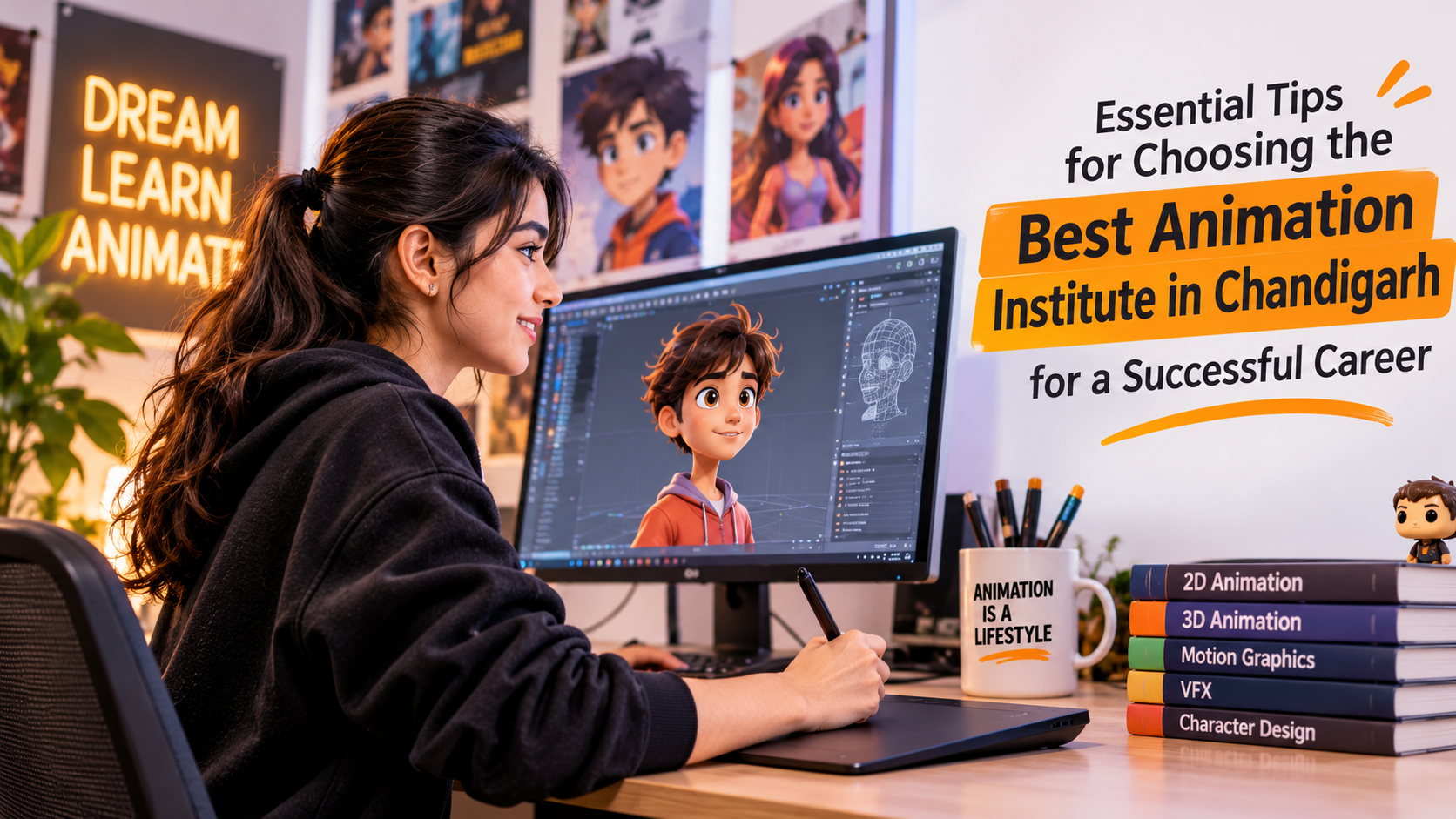
Animation plays a significant role in the entertainment, advertising, gaming, and digital media sectors. There are a lot of different uses for animation, including movies, video games, social media videos, and advertisements for products. With more businesses turning to visual content to engage with their audience, the need for skilled animation professionals continues to rise.
Animation is a career that is interesting for students who like to draw, design, tell stories and work with digital tools. But creativity is not enough for learning animation. Students will also require technical knowledge, regular practice and knowledge of industry needs.
Selecting the top animation institute in Chandigarh is one of the crucial aspects of a career in animation. Students can learn useful skills, get hands-on experience, and explore various career options at the right institute.
Before taking admission, students should compare courses, teaching methods, software training, practical projects, and placement support. Here are some decision points to consider.
1. Understand Your Interest in Animation
Animation is a wide category and has various branches. When choosing a course, know what area you are most interested in. This will guide you towards selecting a course that aligns with your creative abilities and career aspirations.
Popular animation career paths include:
- 2D Animation institute– Making movement with pictures and drawings. It is frequently employed in cartoons and explainer videos. Traditional 2D animation is built on frame-by-frame animation, where every frame is drawn to create smooth movement.
- 3D Animation institute – Designing characters, objects, and environments in 3D to add depth and movement to films and games.
- Motion Graphics – The use of text, images, and movement in promotional and social media videos.
- Visual Effects (VFX) – Inserting digital effects in movies, ads, and other video programming.
- Character Design – Designing characters in various appearances, expressions, and personalities.
Knowing these things will make it easier to choose the right animation course.
2. Check the Course Structure
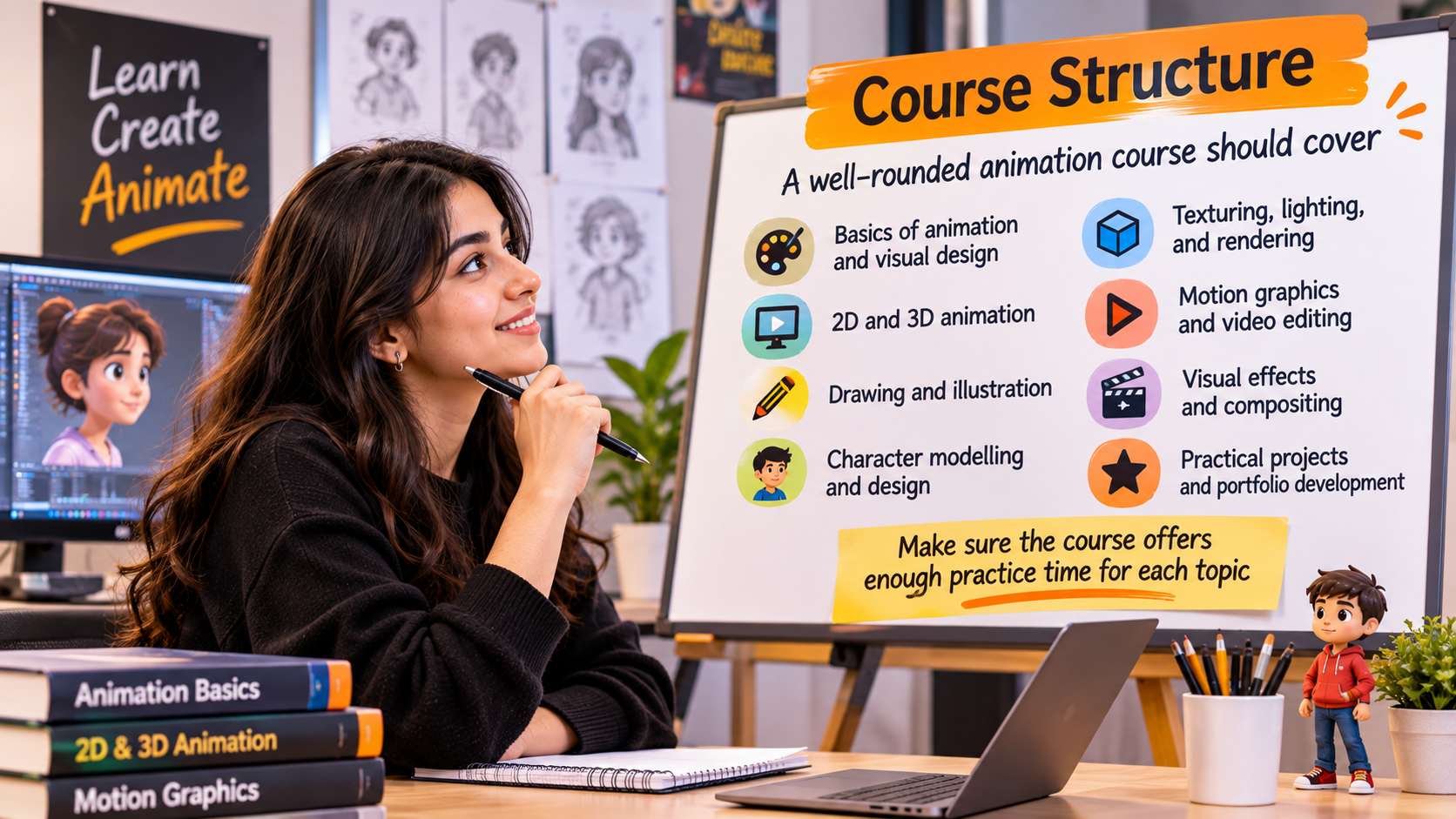
A good animation course should start with some fundamental concepts and progress to more complex techniques. Before tackling more complex projects, students should learn about design, colours, shapes, composition, and movement. Before joining an institute, confirm the following points about the course if they are important:
- Basics of animation and visual design
- 2D and 3D animation
- Drawing and illustration
- Character modelling and design
- Texturing, lighting, and rendering
- Motion graphics and video editing
- Visual effects and compositing
- Practical projects and portfolio development
Also, see how much time is allocated to each topic. It is essential that a good course enables students to learn concepts and to practise them correctly.
3. Focus on Practical Training
Animation is a skill-based profession and practical training is as important as theory. Regular practice is required to learn how animation software works and how creative projects are made. If you’re searching for the best animation institute in Chandigarh, ensure that students have chances to work on tasks and live projects. Through practical learning, students will develop their creative thinking, problem-solving, and grasp of the entire animation production process. For instance, students can create short animation videos, character sketches, product animation, and promotional graphics. These projects also enable them to gain insight into the professional working requirements and build confidence.
4. Learn Industry-Related Software
Animation professionals use different software to create designs, videos, characters, and visual effects. Learning these tools during training can help students develop useful technical skills.
Some commonly used software includes
- Adobe After Effects is a motion graphics and visual effects software.
- Adobe Photoshop for photo editing and digital art.
- Adobe Illustrator is a vector graphics and illustration program.
- Autodesk Maya is a 3D modelling and animation software.
- Blender 3D Design, Animation, and Rendering.
- Adobe Premiere Pro is for video editing.
Students don’t have to learn all tools at once. The software used in the course should be related to their selected field. To see what editors actually use in real projects, check this list of video editing tools for professionals. Trainers should also share knowledge of how these tools can be applied in professional projects.
5. Check the Experience of Trainers
It can be useful to give complex animation concepts a simpler explanation to the experienced trainer. They are able to help students resolve technical issues, discuss creative methods, and provide valuable insights on industry projects.
Research the trainers and how they have taught before enrolling. Additionally, see if they offer one-on-one attention and frequent feedback.
A good trainer should clarify the topics, assist students in enhancing their assignments, and motivate them to think creatively.
You can also get a feel for the class and teaching style during a demo class before making your choice.
6. Build a Strong Animation Portfolio
A portfolio consists of your most successful creative works. It is useful for employers and clients to know your skills and the quality of your work. In the animation world, hands-on experience is quite important. One certificate is not sufficient to demonstrate what you can achieve.
It’s important to build your portfolio during training to include various projects like
- 2D and 3D animated videos
- Character designs and illustrations
- Motion graphics for advertisements
- Product animation videos
- Basic visual effects projects
- Creative video editing samples
A good institute should help students identify and showcase their most suitable work. A solid portfolio can be beneficial for job interviews and freelance applications.
7. Compare Course Fees and Duration
The duration and course costs are also significant points to consider while choosing an animation institute. The fee may vary in different institutes depending on the course, training period, software used, and facilities provided. But do not select any institute on the basis of low fees. Always make sure to confirm the course contents before enrolling.
Compare the following details
- Course fees and payment details
- Course length and class schedules
- The program includes both software and hands-on training.
- Provide study materials and learning support.
- Portfolio development assistance
- Any extra charges, if applicable
This will enable you to understand the worth of the course and stay clear from any last minute surprises.
8. Look for Placement Assistance
If students wish to enter the job market immediately after completion of their animation course, they should also inquire about placement assistance provided by the institute. Career guidance can help students appreciate the various roles, develop a resume, practice interview techniques and apply for appropriate career opportunities. Many institutes also offer interview preparation, job information, and portfolio counseling. However, students should understand that placement assistance does not guarantee a job. Your skills, project experience and performance in the interviews are also a factor.
9. Explore Career Opportunities After Animation Training
There are various career paths in animation, such as in entertainment, gaming, advertising, and digital media. Students may choose a role from their interests and technical skills.
Possible careers include:
- A 2D Animator who is making animated scenes and characters.
- Person who creates characters and objects in three dimensions.
- Graphic specialist who designs moving pictures for advertisements and videos.
- A VFX Artist is a person who enhances films and other video content with digital effects.
- A 3D Modeller is a person who makes digital models of products, characters and environments.
- Video Editor: A person who syncs video, audio, graphics, and effects.
- Freelance Animator who works independently with clients on creative projects.
After developing a solid portfolio, students may also be looking into freelance jobs. However, professional development is needed for regular practice, timely project delivery, and effective communication.
10. Check Student Reviews and Learning Facilities
Take time to learn about the learning environment of an institute before committing to it. If possible, go to the centre to see if they have adequate computer equipment, software, and training area. Current students or former learners can also be contacted to learn about their experience. Seek information on the quality of the teaching, trainer support, course structure, and practical assignments. Student reviews are also another way to compare institutes. Pay attention not just to ratings, but overall feedback on the learning experience.
Final Thoughts
Selecting the best animation institute is a crucial step towards developing creative and technical skills. A well-organized institute should offer a well-structured curriculum, hands-on experience, experienced trainers, familiarity with software tools, and career advice. The top animation institute in Chandigarh should align with your learning requirements and be able to equip you for practical projects. If you’re planning on a career in film, gaming, advertising, or digital media, emphasize developing skills and a professional portfolio. Keep in mind that studying a course is just the first step. With practice, creativity, and ongoing learning, you will develop and be successful in your career in animation.

Bodh Raj is a Digital Marketing Manager with around 5 years of experience in SEO, content marketing, Meta Ads, Google Ads, and digital growth strategies. He has worked on website optimization, content planning, lead generation, and online marketing campaigns across different industries, helping businesses improve their digital presence and organic visibility.