
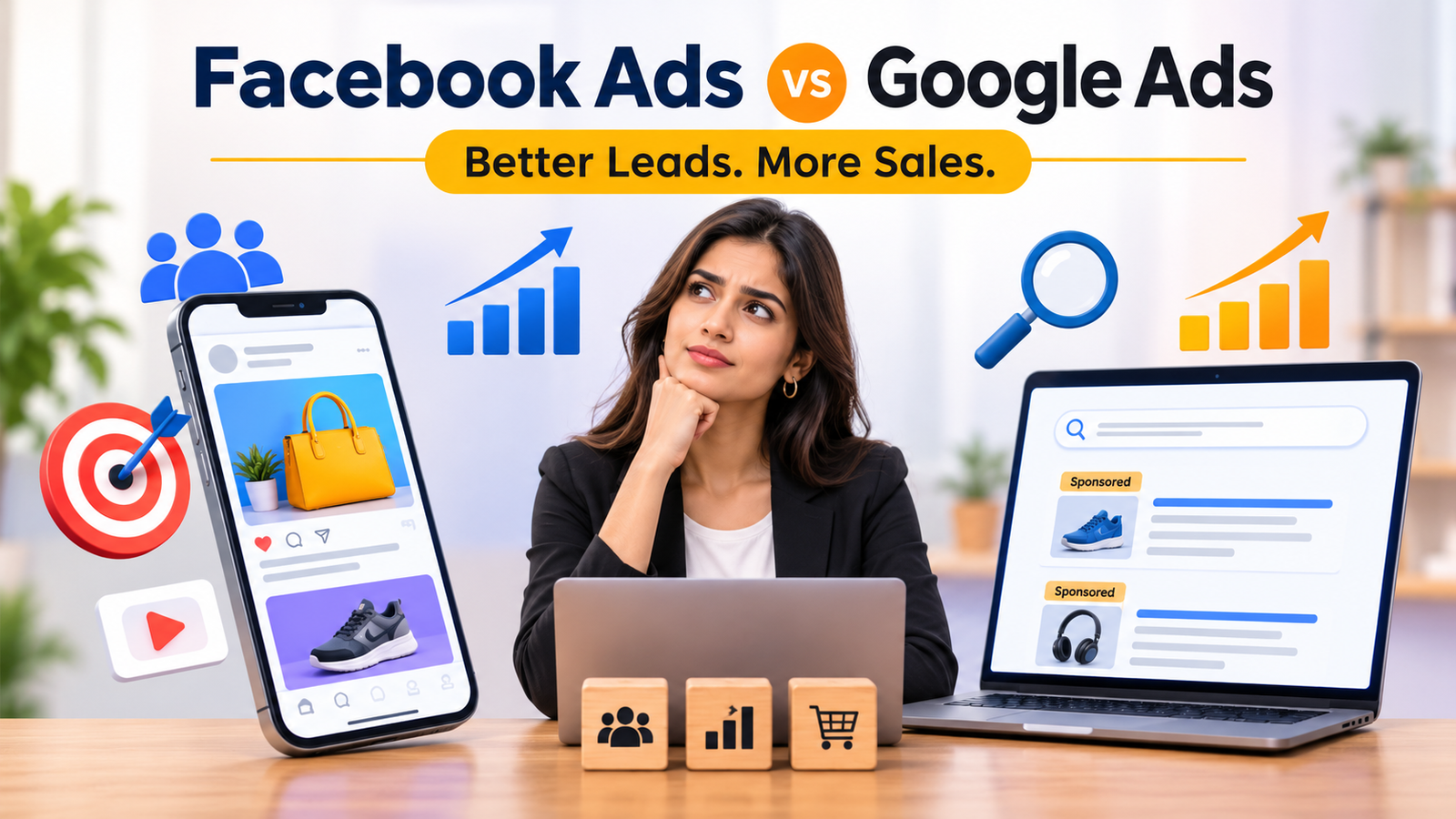
All businesses desire more customers, more regular enquiries, and improved sales. There are a number of advertising channels that can be used, and Facebook and Google are two popular ones. Whilst both Facebook and Google can assist in a business’s digital marketing, they do so in differing ways. Facebook Ads enable brands to tailor advertisements to suit people’s interests and how they behave whilst online.
Google Ads can effectively identify people actively searching for a particular product or service. By analysing these two advertising channels, a business can then assess where best to spend money to effectively market itself and target consumers.
Facebook Ads
Facebook Ads are set up via Meta Ads Manager. Brands can then utilise them to advertise on Facebook, Instagram, Facebook Messenger, and other accepted sites. One of the key features of Facebook advertising is its ability to effectively target consumers. Businesses can tailor advertising based on factors such as a person’s age, geographic area, and behaviour, as well as their interests. For example, a fashion retailer can specifically advertise a new range to those with an interest in fashion. Moreover, a real estate organisation could target house-related projects at property owners in defined geographic areas. Alongside images, video, carousel, lead form, story and reels, Facebook offers a wide range of advertising options. These can be used by a business to showcase and advertise goods and services and also collect enquiries.
Google Ads
Google Ads is another digital advertising mechanism that allows brands to add sponsored adverts to Google Search, YouTube and allied websites and apps. A major advantage of this method is that it can specifically target consumers who are already searching for a product, service or information.
A person may search for ‘best digital marketing course near me’. Those who are searching for digital marketing-related courses may therefore see advertising for digital marketing training organisations. Google Ads can be of a number of different types; namely, Search, Display, Video, Shopping and Performance Max. Businesses can use these to drive web traffic, advertise, and obtain new customers.
Key Differences Between Facebook and Google Advertising
Online ads are also supported by both platforms, but they reach customers in different ways. Facebook Ads target interests and behaviours of their audience, and Google Ads target search intent very strongly.
| Comparison Factor | Facebook Ads | Google Ads |
| Main Purpose | Brand awareness and engagement | Reaching people searching for products or services |
| Targeting | Interests, age, location, and behaviour | Keywords, location, and audience signals |
| Customer Intent | Reaches people who may develop an interest | Reaches people actively searching |
| Ad Formats | Images, videos, carousels, Stories, and Reels | Search, Display, Shopping, and Video Ads |
| Best For | Product discovery and lead generation | Search traffic and sales |
| Cost Model | CPC and CPM bidding | CPC and other bidding strategies |
The main difference is how customers discover a business. Facebook Ads introduce products to relevant audiences, while Google Ads help businesses appear when people search for something specific.
Facebook and Google Advertising Pricing
As with all advertising, pricing is determined by multiple factors, such as the level of competition within an industry, target market, and advertising aims. Neither Facebook nor Google offer a standardised price for advertising. On Facebook, advertising prices will be affected by factors including consumer competition, levels of engagement, and marketing aims. Businesses can then begin to market themselves at an initial budget level and modify expenditure in line with results.
A beauty salon could use Facebook and Instagram advertising to advertise holiday Specials. Customers from the surrounding geographical area can then be encouraged to book an appointment.
Regarding Google advertising, pricing is influenced by competition, bidding processes, and the relevance of advertising. Should a company wish to strive to be at the top of the search engine results page for highly sought-after search terms, it may have to commit further funds in order to do so. Whilst considering which advertising channel to utilise, it is vital that a business analyses which platform provides the most value for money. This is despite what appears to be the lower cost of clicks, and focuses on obtaining high-quality leads and/or actual customers.
Which Advertising Channel is Best For Leads and Sales?
Clicks do not always result in customers. Crucially, the success of a business’ advertising is often reflected in how many people perform a key action in response to advertising. Businesses can successfully use enticing promotions and video content alongside convenient lead form facilities to effectively obtain leads via Facebook Ads. This marketing channel is suitable for a wide range of industries, for example, real estate, educational institutions, beauty salons, and event organisers. Likewise, real estate businesses can use Facebook video adverts to showcase housing projects and obtain queries from those eager to buy property.
Google Ads can specifically target consumers who are already searching for particular goods or services. For example, someone may click on a search for ‘website development company in Chandigarh’ and may already be motivated to locate a relevant service. Although both advertising channels can be used to collect leads, businesses must ensure that they effectively analyse the quality of leads obtained, that landing pages are appropriate for the advertising content, and that there is a prompt response to leads.
When Should a Business Utilise Facebook Advertising?
Facebook advertising can be a valuable option for a business aiming to engage with new people regarding the goods or services it provides. It is especially appropriate for sectors that place emphasis on visual elements, promotions, and interaction. Facebook advertising is suitable for a business to utilise during the launch of new goods, in relation to seasonal sales, and for brand awareness. It can also be used to target specific groups of people, based on their interests and geography.
For example, an interior design enterprise can showcase various interior design designs and styles in picture and video format. Consumers with an interest in interior design can then visit the business’ website and submit an enquiry.
When Should a Business Employ Google Advertising?
Google advertising can be especially pertinent where there is heightened searching for the type of goods and/or services a business provides. For example, if a digital marketing agency wishes to advertise its services, it can utilise search terms such as ‘SEO services in Chandigarh’ or ‘Google Ads agency near me’ so that it can engage with people seeking marketing-related services.
Google advertising can prove to be a valuable digital marketing channel for professionals, educational establishments, local businesses and even those selling goods that are regularly searched for. Companies can effectively attract consumers most likely to convert into customers by appropriately identifying search terms and producing relevant landing pages.
Can a Business Employ Both Facebook and Google Advertising?
Yes. Businesses can utilise both advertising channels to engage with consumers at varying points in their purchasing process. To illustrate, a digital marketing education institution can use Facebook advertising to showcase its courses via videos and accounts of students’ experiences. Those visiting the institution’s website can then subsequently be shown targeted re-marketing advertising on supported sites. Furthermore, this business can also use Google advertising to ensure that it is identified by people searching for digital marketing education.
Therefore, businesses can effectively raise brand awareness and engage both with new and specifically motivated consumers. Again, however, advertising campaigns should be allocated a defined budget and have clear aims.
How to Analyse Advertising Effectiveness
Alongside advertising, businesses must assess the efficacy of their digital marketing efforts.
Important analysis points include:
- Click-Through Rate (CTR) – the proportion of people who click on an advert in relation to the number of times it has been displayed.
- Cost Per Click (CPC) – the typical cost incurred for each click.
- Cost Per Lead (CPL) – the cost of obtaining a lead.
- Conversion Rate – the percentage of website visitors who perform a required action.
- Return on Ad Spend (ROAS) – the ratio of money earned in relation to the money spent on advertising.
Such analysis assists businesses in appreciating the effectiveness of their advertising and pinpointing areas for enhancement.
Conclusion
Whether to employ Facebook or Google advertising is influenced by a business’s aims, intended target market, and budget. Facebook advertising can be utilised to raise brand awareness, and Google advertising can be employed to engage with consumers actively searching for a business’s goods and/or services.
It is also possible to simultaneously analyse the effectiveness of both advertising channels using an appropriate budget and then further fund those marketing campaigns which are most successful at providing quality leads and sales.
Whilst it is important for a business’ advertising to maximise the number of clicks, it is even more crucial that it engages effectively with the correct individuals and that it achieves valuable outcomes.
Commonly Asked Questions
1. Is Facebook or Google advertising better?
Facebook advertising is good for raising brand awareness and engaging with consumers. Google advertising can engage with people who are actively searching for goods and/or services.
2. Are Facebook ads less costly than Google advertising?
This is not always the case. Prices are influenced by factors such as industry competition, target market, geographical area, and marketing aims.
3. Can small businesses employ Facebook and/or Google advertising?
Yes. Small businesses can initially spend an appropriate level of money and alter expenditure according to how well advertising campaigns are performing.
4. Which advertising channel is most suitable for obtaining leads?
Both can be used for this. Facebook advertising targets consumers based on their interests. Google advertising can then engage with those searching for particular services.
5. Should a business use both Facebook and Google advertising?
Yes. Businesses can use both advertising channels to engage with consumers at different points in their purchasing process.

Vandana is a Content Writer and Digital Marketing Executive with 1+ years of experience in SEO content writing, website content, and digital marketing. She specialises in creating engaging, SEO-friendly content, keyword research, and content planning to help brands improve their online presence and audience reach.