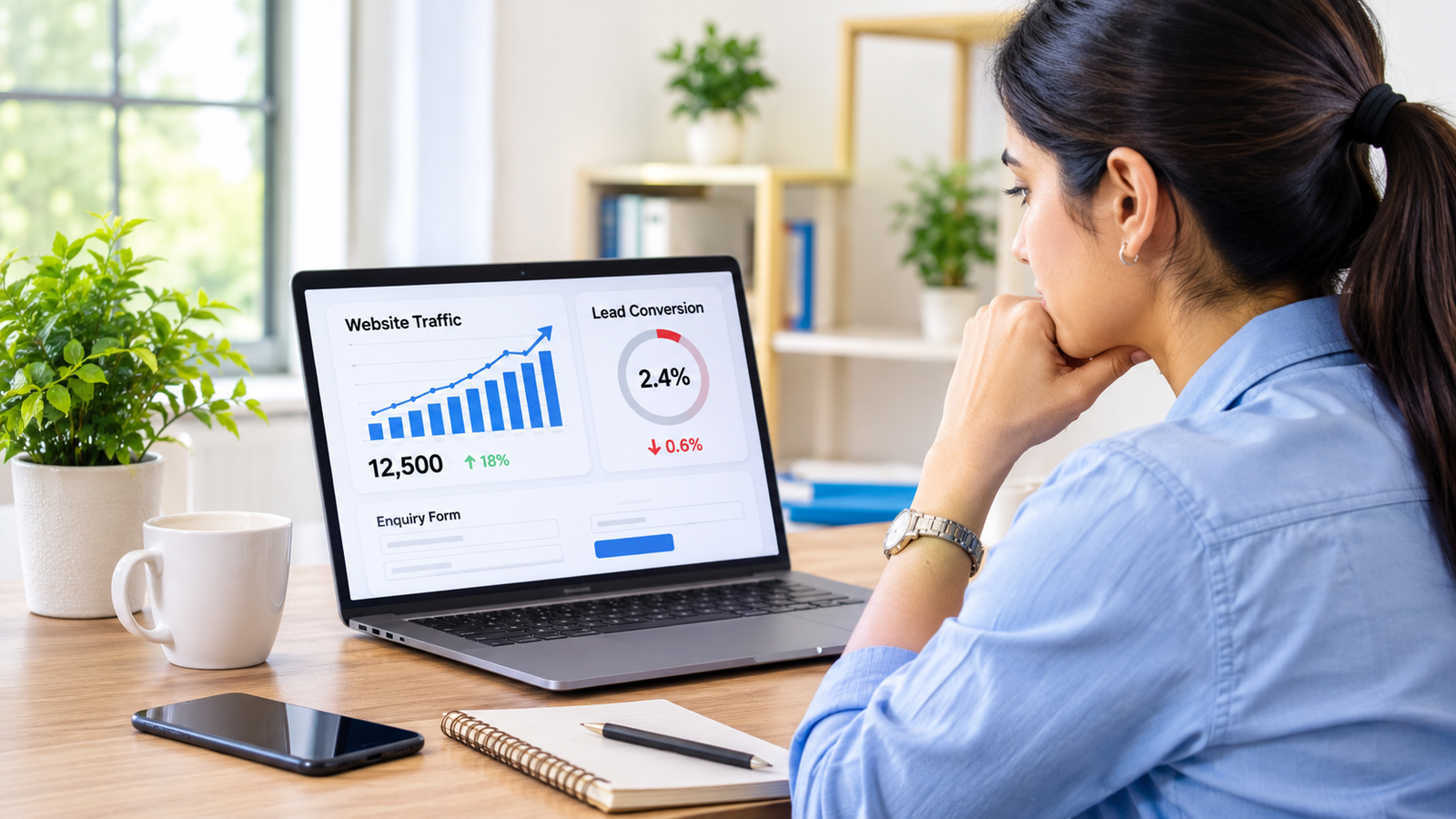
It’s not enough to attract visitors to your website; you need to retain them as well. Businesses spend a lot of money on SEO, Google Ads, social media marketing, and content creation to boost website traffic. They have visitors regularly, but are not successful at getting enquiries.
Sometimes it’s not the traffic. At times, the website can draw in those who are not looking to purchase. Other times, the information isn’t available, or people aren’t sure they have the ability to reach the business. Businesses spend a lot of money on SEO to increase website traffic.
Let’s understand why your website traffic is not converting into good leads and how to improve it.
1. You Are Attracting the Wrong Audience
Your web page may draw visitors who are interested in information, but not necessarily in a product or service. Your website traffic may include visitors who are interested in information but are not necessarily looking to purchase a product or service.
For instance, if a digital marketing agency is trying to optimize for the term “digital marketing jobs”, they could be getting traffic looking for a job rather than looking for digital marketing services.
Use keywords that are relevant to your services and customer needs to bring in the right traffic. Know what the potential customer is looking for before they make a purchase. Your SEO campaign and website content should be geared towards your audience: people who are actually interested in your products and services.
2. Your Website Content Does Not Answer Customer Questions
Visitors primarily want to know what you do, compare services, or find out how your business can help them with their issues. If they don’t get these answers, they may just walk out.
Writing “We provide the best SEO services” doesn’t give customers any idea what they’ll get. They could ask for keyword research services, technical SEO, or content optimisation.
Make sure your website provides a clear explanation of your services, your process, and your benefits. Provide relevant examples and respond to common customer questions in order to provide an informed decision to the visitors.
3. Your Website Does Not Have Clear Calls to Action
Your visitor might love your services but walk away because he/she is uncertain what to do next. This is frequently due to vague or poorly positioned calls to action (CTAs) on websites.
A CTA is a call to action that directs visitors to a specific action, like requesting a quotation or booking a consultation.
Try to use simple words and phrases, like:
- Get a Free Consultation
- Request a Quote
- Talk to Our Team
- Contact Us Today
Put these buttons behind service descriptions or customer reviews for visitors to easily take the next step.
4. Your Website Loading Speed Is Too Slow
One of the key aspects of user experience is website speed. If visitors find that the website takes too long to load, they might leave before they check out your services. This can be due to a large image, unnecessary plug-ins, bad hosting, or poorly written website code.
It is important to regularly monitor site speed for businesses. Optimize images, remove unnecessary plugins, host them safely, set up secure, trustworthy hosting, and make customizations to website features. Plus, test your website on your phone to ensure that it works smoothly.
5. Your Website Does Not Build Customer Trust
Before they provide contact details, visitors are looking for the reliability of a business. They could check out what customers had to say about you, your previous projects, and the history of the team. If there’s no evidence of your abilities, visitors may be hesitant to contact you.
You can establish trust by incorporating authentic customer reviews, case studies, project examples, team information, and clear contact details. All these can contribute to visitors grasping what your business does and why they can trust you to initiate a dialogue.

6. Your Website Is Not Mobile-Friendly
A lot of people find out about businesses via their mobile phones. If your website is not functioning well on mobile devices, then customers may not purchase from you. When you have to read a lot of small text, navigate the site is difficult, and there are complicated forms, it can be frustrating to navigate.
An internet website that is mobile-friendly should contain forms easily filled, simple menus, clear buttons and be easy to read. Test your pages across different screen sizes to make sure that visitors are able to access key information easily.
7. Your Landing Pages Do Not Match Your Advertisements
The idea behind clicking on an ad is to find information about the service that is advertised. If an ad encourages people to visit an SEO website but redirects them to a generic website, they might not be able to find what they’re looking for.
For those key services and advertising campaigns, make different landing pages. Include relevant headings, clearly explain the service, and provide an enquiry option. Ensure a landing page that is consistent with the ad for a better user experience.
8. Your Enquiry Forms Are Too Complicated
If too much information is required on the enquiry form, the visitor may be interested in your services but not fill in the form.
Most businesses don’t need a lot of information when a visitor makes their first enquiry and simply need to understand the visitor’s needs.
| Form field | Purpose |
| Name | Identify the potential customer |
| Phone number | Contact the visitor |
| Email address | Share service information |
| Service requirement | Understand customer needs |
You can also provide WhatsApp and direct calling options for people who prefer not to fill out forms.
9. You Are Not Tracking Website Performance Properly
Having a lot of visitors to your website doesn’t mean anything unless you know where they are coming from and what they are doing once they get there.
You can use Google Analytics 4 and Google Search Console to learn more about your website. Google Analytics 4 offers a range of data that includes insights on conversions and visitor actions, and Search Console monitors your site’s performance in Google Search.
Pay attention to:
- Which pages receive the most traffic.
- Which sources bring visitors to your website.
- How many visitors complete enquiry forms.
- Which marketing channels generate relevant leads.
Reviewing this information helps you identify problems and improve your marketing efforts using actual data. Getting website traffic is useful, but understanding what visitors do after reaching your website is equally important.
10. You Are Not Following Up With Potential Customers
Not all visitors click on a business’s website on their initial visit. Some people make a comparison between service providers or require extra information to make a decision.
If someone makes an enquiry and doesn’t hear back from the business, they can make enquiries to another business.
It’s important that businesses have a straightforward way of dealing with enquiries. Follow up on leads promptly, know what they need, and provide them with information. A CRM system will enable you to follow up on conversations and prompt your team to remind them of pending enquiries.
How to Turn Website Traffic Into Quality Leads
Improving lead generation does not always require major website changes. Identifying and fixing important problems can make the customer journey easier.
| Website problem | Possible solution |
| Irrelevant website visitors | Target keywords based on customer intent |
| Unclear website content | Explain services and their value |
| Low enquiry rate | Add clear calls to action |
| Slow loading pages | Optimise website performance |
| Lack of trust | Display genuine reviews and case studies |
| Poor mobile experience | Improve responsive design |
| Low landing page conversions | Match pages with advertising messages |
| Complicated enquiry forms | Reduce unnecessary form fields |
| No conversion tracking | Monitor leads through analytics tools |
| Missed enquiries | Follow up with potential customers |
Businesses should review these areas regularly to understand what needs improvement. SEO, website design, and conversion optimisation should work together to attract relevant visitors and encourage enquiries.
FAQs
Why is my website getting traffic but no leads?
Your website may be targeting the wrong people, giving them vague information or making it hard for them to reach you. Look through your keywords, content, and enquiry process to find the problem.
Explain how SEO can generate quality leads?
SEO can make your site visible for the relevant search queries. Using relevant keywords for your services and producing valuable content can help draw in visitors who may become potential customers.
Does website design affect lead generation?
Yes. The user experience can be impacted by poor navigation, slow loading, and confusing layouts. A well-organised website makes it simpler for visitors to browse services and connect with your enterprise.
How can I track website lead conversions?
Google Analytics 4 can be used to measure actions like form submissions, calls, and other key conversions.
Is website traffic or quality leads more important?
Both are important, but quality leads are more useful for business growth. Traffic leads your website, but quality leads are people who are truly interested in your products.
Final Thoughts
Getting website traffic is only one part of digital marketing. Businesses also need to focus on attracting visitors who are genuinely interested in their products or services. Building traffic to your website is just one component of digital marketing. It’s not about visitors; it’s about the right visitors who are taking action.
If visitors are coming to your website but not entering the quality lead generation process, consider the audience, content, customer visit, and the conversion process. SEO, paid search, and content marketing should complement each other to draw in visitors to your site and lead them toward your services.
The intent should be not just to drive more visitors to the site, but to create a site that will assist potential customers in looking for information, trusting your business, and taking the next step.

Vandana is a Content Writer and Digital Marketing Executive with 1+ years of experience in SEO content writing, website content, and digital marketing. She specialises in creating engaging, SEO-friendly content, keyword research, and content planning to help brands improve their online presence and audience reach.