Two strategies tend to be thrown into the ring when businesses are looking to boost their online visibility: SEO vs Google Ads. Both can be used to attract potential customers from the search engines, but in very different ways. In summary, SEO is long-term, and Google Ads is short-term.
The decision isn’t just a matter of which is “better,” and there’s no definitive answer. The better question is, what strategy will get you the desired results in your time, budget, and business?
The fact that there are differences between paid search and SEO helps you make better marketing decisions and boost your ROI.
Table of Contents
SEO vs. Google Ads: What’s the Difference?
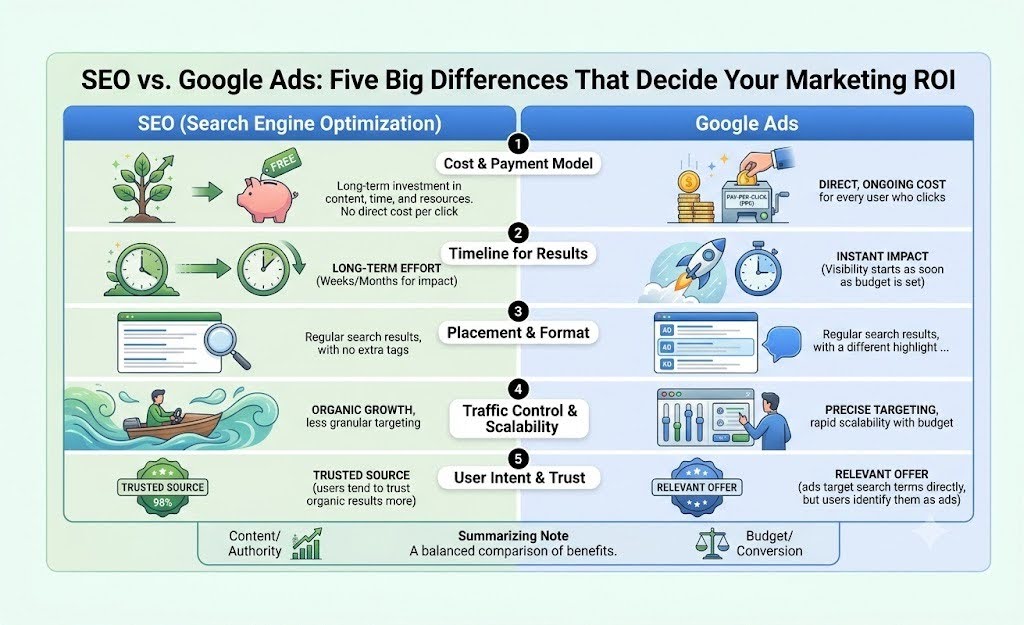
Here are the five main distinctions between SEO and Google Ads quickly.
| Factor | SEO | Google Ads |
| 1. Cost | Requires investing in content, optimization, technical SEO, and maintenance. The per-click advertising fee for organic clicks is not applicable. | Implements a paid advertising platform; often users are paid for interacting with ads (e.g., clicking on them). |
| 2. Speed | Usually takes a long time to gain rankings and organic traffic. It can take weeks or months to get results, depending on competition and website authority. | Once approved and in motion, it can create targeted visibility and traffic much quicker. |
| 3. Traffic & Visibility | Performs search engine optimization (SEO). Good rankings can help to drive traffic in the long term. | Offers paid visibility in the search results in eligible auctions during the advertising campaign. |
| 4. Control & Targeting | Provides more indirect ranking opportunities since organic listings are based on search engine algorithms and ranking factors. | Gives more control over budget, targeting, locations, keywords, schedules, ad copy, and landing pages |
| 5. Long-Term ROI | Can deliver high value in the long run, since an effective organic ranking can bring traffic without having to pay for each click. | Can offer tangible ROI in the short term, but regular paid visibility usually requires regular advertising budgets. |
There are several key differences between SEO and Google Ads.
1. Cost: Organic investment vs. pay-per-click (PPC)
One of the initial aspects businesses take into account while weighing SEO or Google Ads is cost. Usually, Google Ads will charge you for clicks or any interaction with the ads. This is influenced by various factors, including keyword competition, targeting, bidding strategy, ad quality, and campaign settings. The advertising expense determines the amount of paid traffic that can be generated; therefore, costs can escalate during the duration of the campaign.
The cost of SEO is different. You don’t have to pay Google for every organic click. Rather, your money is spent on things like website optimization, technical SEO, keyword research, content creation, and website improvement and authority building.
This does not mean that SEO is free. It takes time, expertise, and resources to do SEO professionally. Once a page reaches a high organic ranking, however, the extra traffic it receives is not an immediate cost to the advertiser for every click.
That disparity is significant, especially when assessing long-term ROI. Google Ads can offer hard facts on how much is being spent and how many conversions are being achieved in the campaign. In contrast, SEO can build an organic traffic asset that will continue to generate revenue after the hard work is done.
In summary, Google Ads needs to continue to be invested in to gain visibility through ads, whilst SEO needs to be invested in to achieve organic visibility.
2. Speed: Long-Term Growth vs. Immediate Results
The most obvious difference between Google Ads and SEO is how fast you can get traffic on each of these strategies.
With a good campaign set up and approved, Google Ads can begin to drive visibility right away. This is the reason paid search can prove to be useful for businesses that need immediate traffic, a new service they want to market, or a time-sensitive offer.
The general rule is that SEO takes time to work—the search engines take time to find, evaluate, and index pages. There are various factors that influence results like website authority, content quality, competition, technical health, and search intent. Industry comparisons are often made by noting that PPC is quicker to get off the ground, whereas SEO results are mostly gradual.
For instance, a company that is going to introduce a new service next month. Waiting for organic results could provide insufficient visibility before the launch. Meanwhile, while Google is developing its SEO strategy, Google Ads can help generate immediate exposure.
That being said, SEO can have greater value if the business wants a consistent amount of organic traffic for the next couple of years.
Takeaway: While Google Ads can bring immediate website traffic, SEO is more effective over the longer term to support your website’s organic growth.
3. Traffic and Visibility: Organic Rankings vs Paid Placement.
The other important consideration in the SEO vs ads debate is where and how your site will rank in search results. When the campaign is qualified to display for a relevant query, Google Ads will prominently display the ads on search engine results pages. The targeting, budget, ad message, and landing page are under the control of the business.
SEO works differently. The organic position of a page is determined by Google’s assessment of relevance, the quality of content, the user experience of a page, its authority, and so on.
Organic visibility can be an important marketing asset in the longer term. Once you’ve optimized a page to rank for clicks that are relevant to your business, it can continue to generate traffic you don’t have to pay for.
But SEO rankings do not come easily. Search algorithms, competitors, users’ behavior, and the layout of search results may vary. Organic visibility is not something that can be achieved in one go but needs continuous effort.
The other drawback of Google Ads is that they must be paid for to be viewed, and ad performance leads to visibility. If a campaign is turned off or the budget is exhausted, the paid traffic will stop.
So, if all you are looking for is visibility, then paid search is the way to provide it with ads, and SEO is the way to provide it with ranking.
4. Control and Targeting: Google Ads is flexible; SEO isn’t.
When businesses compare SEO and Google Ads, control is another important consideration.
Google Ads provides advertisers with extensive campaign controls. Depending on the campaign type and setup, businesses can target factors such as
- Keywords and search themes
- Geographic locations
- Audiences
- Devices
- Advertising schedules
- Budgets
- Ad messaging
- Landing pages
The level of control this offers makes paid search valuable for companies who want to achieve certain acquisition objectives. For example, a business might want to promote one of their services in one location for a certain length of time.
Unlike PPC, there is a degree of uncertainty with SEO as to the final ranking position. You can work your site and content for ranking higher on the page, but you can’t pick and choose where a page will rank on the page. On the contrary, SEO emphasizes enhancing the signals that indicate the usefulness and relevance of a page to a searcher.
This is a key factor in the choice of SEO vs PPC. PPC provides more control over campaign delivery, and relevance and quality are the key points of SEO.
Lesson learned: Google Ads offers more control at the campaign level, whilst SEO relies more on search engine algorithms and their internal ranking factors.
5. ROI in the Long Term: Growth on a Sustainable Scale vs. Continuous Ad Spendings
The SEO vs Google Ads debate really matters for ROI.
Google Ads can provide very measurable short-term performance. Impressions, clicks, conversions, cost per click, cost per conversion, and return on ad spend (ROAS) are all metrics businesses can track. That’s where paid ads come in handy when it comes to testing keywords, offers, landing pages, and customer acquisition strategies.
But there are a few general rules to note about paid traffic, and one is that it requires continued spending on advertising. When a campaign is ended, it’s unlikely to automatically continue with the same amount of paid visibility.
The ROI of SEO is different. While building organic visibility may take longer, once you have ranked successfully, it can still provide you with traffic that is relevant without you having to pay for each click. The value can thus build up over time, but it still needs to be maintained and invested in with SEO.
That’s why the question of Google Ads or SEO is heavily dependent upon your time perspective. While businesses that wish to gain immediate leads might prioritize Google Ads, a business with an SEO focus might be more concerned about the benefits of SEO over the long haul.
What is better at giving a higher return on investment: SEO or Google Ads?
The ROI of SEO vs Google Ads is not necessarily decided, as there is no one universal winner.
There are several factors to consider as to which is the better channel:
Business Goals
- If you’re seeking immediate leads, product launches, seasonal promotions, or rapid market testing, then Google Ads can be beneficial.
- If you’re seeking long-term visibility, organic growth, and enhanced organic authority, then SEO might be a better option.
Competition
- Competitive keywords could require more money to pay for through pay-per-click advertising and could be difficult to rank for organically.
Conversion Potential
- Measuring ROI by traffic is inaccurate. You can get a lot of visitors, but if they’re not relevant, they are not worth your time.
- Companies should look at conversions, customer acquisition cost, revenue, lead quality, and customer lifetime value rather than just clicks and rank.
How Google Ads and SEO Work Together to Improve Search Marketing
The number one mistake that businesses make is to use SEO and Google Ads as independent marketing actions rather than combined. In many instances, SEO and paid search work well together. While SEO works on the back burner, Google Ads can deliver traffic right away.
Another benefit of paid search data is that it can also show you which keywords and offers are successful in terms of engagement or conversion. Those insights can be used to guide SEO content and landing page strategies.
For example, if a Google Ads campaign is bringing in qualified leads through a consistent keyword that’s converting to commerce, it may be helpful to use it. That keyword might require a specific SEO landing page or content.
How to Choose Between SEO and Google Ads
Still unsure about SEO or Google Ads? Start with your primary objective.
Select Google Ads when
- You have to have traffic or leads in the shortest period of time.
- You have a new product or service to launch.
- You want to run tests on keywords and offers.
- You have a fixed amount of money to spend on advertising.
- Detailed campaign targeting is required.
Choose SEO when
- You want long-term natural inbound traffic.
- You’re creating brand credibility over time.
- You depend greatly on informational searches in your business.
- You want to minimize paid traffic in the future.
- Investing can be done regularly, and you can wait for the results to come in.
Consider both when
- You require immediate outcomes and long-term development.
- There is enough capacity to support both channels.
- You’d like to leverage PPC data to make SEO choices.
- Your strategy of getting customers to find your search is crucial.
Final Thoughts
It’s not a simple SEO vs. Google Ads situation where one channel is right for all businesses. SEO and Google Ads solve different marketing problems.
Google Ads can offer rapid, targeted, and measurable paid traffic. SEO can generate natural visibility, authority, and lasting search value. This will depend on your goals, competition, budget, customer journey, and ROI.
Google Ads might be a more direct option for companies that are looking for immediate outcomes. For businesses that focus on sustainable practices and long-term growth, SEO can provide more sustainable benefits. Many businesses will find that they can best do this by using both methods.
Finally, don’t compare SEO to ads on a traffic basis. Measure what’s important to your business: qualified leads, conversions, customer acquisition cost, revenue, and profit. With those numbers, SEO and Google Ads are not about picking a winner anymore but more about creating a marketing system that yields a measurable ROI.

Nizu Sachdeva is a Digital Marketing Specialist with around 6 years of experience in SEO, content marketing, social media strategy, graphic design, and video editing. She specializes in creating digital strategies and content-driven campaigns that help businesses strengthen their online presence.