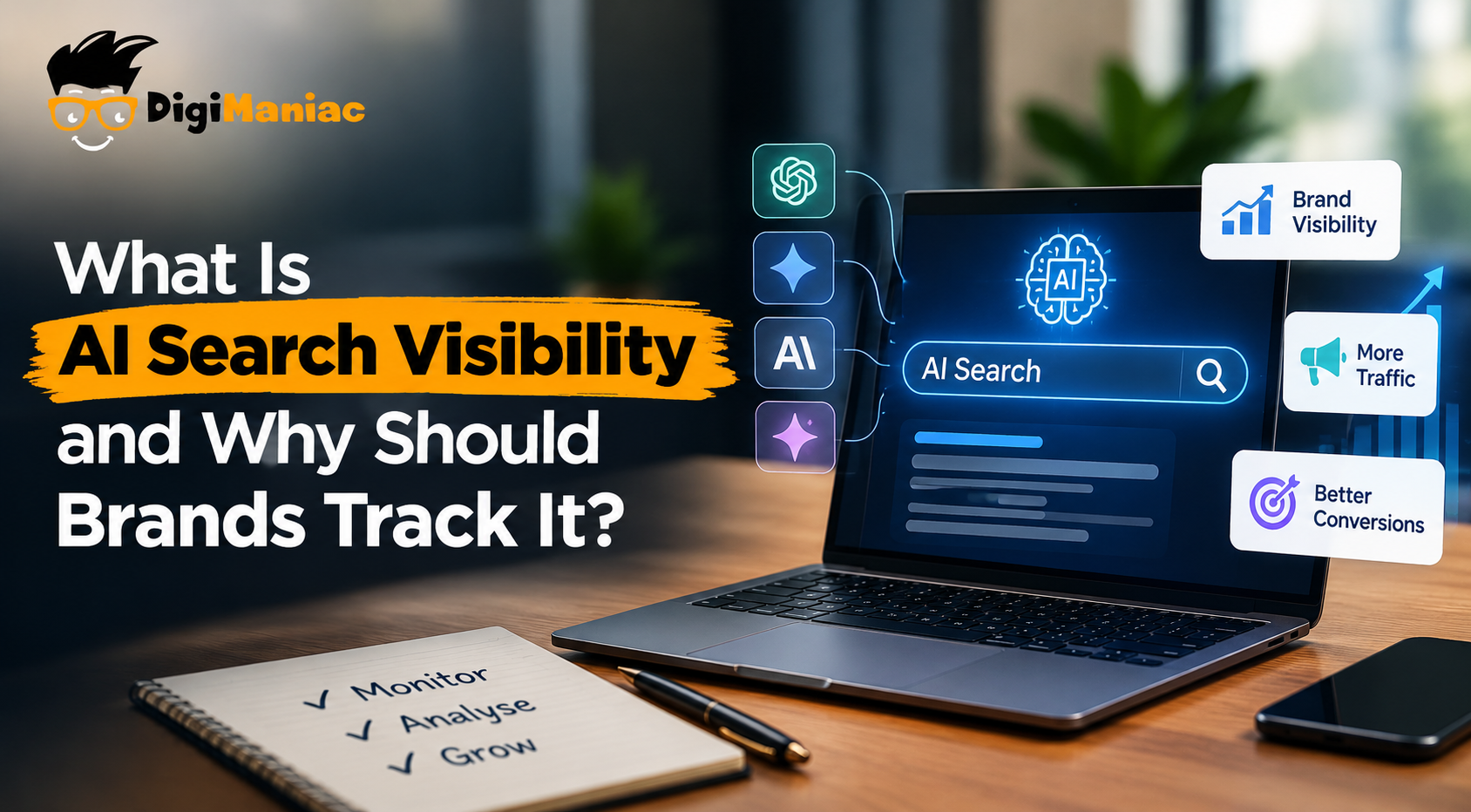
AI is changing how people search for information, compare products, and discover businesses online. Instead of visiting multiple websites, users can ask AI-powered platforms questions and receive summarised answers based on available information.
This change has created a new opportunity for businesses to reach potential customers. However, appearing in traditional Google search results does not guarantee that a brand will also appear in AI-generated answers.
This is why AI search visibility is becoming an important part of digital marketing. It helps businesses understand whether their brand is mentioned, recommended, or cited in AI-generated responses.
In this guide, you will learn what AI search visibility means, why brands should track it, which metrics matter, and how to improve your presence in AI search results.
Table of Contents
What Is AI Search Visibility?
AI search visibility refers to how often a brand, business, or website appears in answers generated by AI-powered search platforms. These answers may include brand mentions, website links, product comparisons, or recommendations.
For example, someone might ask an AI assistant, “What are the best ways for a small business to improve its online presence?” The response may explain SEO, content marketing, social media, and other strategies while referencing relevant businesses or websites.
If your business appears in that response, it has gained visibility for that particular question.
AI search visibility can take several forms:
- Brand mentions: Your business name appears in an AI-generated answer.
- Website citations: The response includes a link to your website.
- Recommendations: Your business or product is suggested as a potential solution.
- Competitor comparisons: Your brand appears alongside other businesses.
- Brand sentiment: The response describes your business positively, neutrally, or negatively.
A mention does not always mean that an AI platform recommends your business. Understanding the context of each appearance is essential when evaluating your visibility.
Why Should Brands Track AI Search Visibility?
Tracking AI search visibility helps businesses understand how they appear in AI-generated answers and identify opportunities to improve their online presence.
1. Understand How Customers Discover Your Business
People increasingly have different ways to research products and services, including traditional search engines, social media, online communities, and AI assistants.
Monitoring AI visibility helps you understand whether your business appears when potential customers ask questions related to your industry.
For example, someone researching website development may ask an AI assistant about website costs, essential features, or choosing a developer. If your website provides useful information on these topics, it may have an opportunity to be discovered.
2. Identify Opportunities Beyond Traditional SEO
Traditional SEO focuses on improving a website’s visibility in search engine results. AI search visibility focuses on appearances in AI-generated responses.
A website can rank well for a keyword but remain absent from an AI answer addressing a similar question. Therefore, monitoring both can reveal gaps that traditional ranking reports may not show.
3. Compare Your Visibility With Competitors
AI platforms may mention several businesses when answering a question. Tracking competitor appearances helps you understand which brands are being included in relevant conversations.
You can identify topics where competitors appear more frequently, questions where your business is missing, and content opportunities that deserve attention.
Use these findings to create more helpful and original content instead of copying competitor material.
4. Monitor How AI Describes Your Brand
AI-generated answers may reflect information gathered from your website and other online sources. Outdated or inconsistent information can lead to inaccurate descriptions of your business.
Regularly review how your brand is presented, including its services, expertise, products, and business details. Correct inaccurate information wherever you control the original source.
5. Discover New Content Opportunities
AI visibility tracking can reveal questions your audience asks and topics where your business has limited presence.
These insights can guide blog posts, FAQs, tutorials, comparison articles, and other useful resources that address genuine customer needs.
6. Connect Visibility With Business Results
Brand mentions can help measure exposure, but visibility alone does not guarantee sales. Businesses should also examine website visits, enquiries, conversions, and other available performance data.
Combining these measurements provides a better understanding of whether AI-driven discovery contributes to business goals.
AI Search Visibility vs Traditional SEO
AI search visibility and traditional SEO are related, but they measure different aspects of online discovery.
| Factor | Traditional SEO | AI Search Visibility |
| Main goal | Improve search result visibility | Appear in AI-generated answers |
| Typical results | Search listings and website links | Mentions, citations, and recommendations |
| Key metrics | Rankings, clicks, impressions | Mentions, citations, position, sentiment |
| Content focus | Relevant, useful, optimised pages | Clear answers and useful supporting information |
| Competitor analysis | Compare rankings and traffic | Compare appearances across AI responses |
Both approaches benefit from relevant content, accessible websites, clear information, and credible sources. AI search visibility should complement traditional SEO rather than replace it.
Important AI Search Visibility Metrics to Track
To measure your progress, focus on metrics that show how frequently your business appears and whether that presence is useful.
1. Brand Mentions
Brand mentions measure how often your business name appears in the AI responses you monitor.
For example, if your brand appears in 12 out of 50 responses, your mention rate is 24% for that particular set of prompts.
2. Citation Rate
Citation rate measures how often AI responses include links to your website.
A brand may be mentioned without a clickable link, so it is useful to track mentions and citations separately.
3. AI Share of Voice
AI share of voice measures your brand’s mentions relative to the total mentions of all tracked brands across a defined set of AI responses.
For example, if your business receives 20 mentions out of 100 total brand mentions, its AI share of voice is 20%.
4. Position in AI Answers
Record where your brand appears in a response. A mention near the beginning may receive more attention than one appearing later, although AI answers do not follow a universal ranking system.
5. Brand Sentiment
Sentiment indicates whether your brand is described positively, neutrally, or negatively. Review the actual response to understand the context rather than relying entirely on automated labels.
6. AI Referral Traffic
Referral traffic measures visits attributed to AI platforms. Track these visits alongside enquiries and conversions to understand whether AI-driven discovery leads to meaningful website activity.
How to Measure AI Search Visibility
You can begin tracking AI search visibility manually using a spreadsheet and a consistent process.
Step 1: Select Relevant AI Platforms
Identify the AI-powered search platforms your potential customers are likely to use. Customer feedback and website referral data can help you decide where to focus.
Step 2: Create a List of Relevant Prompts
Prepare questions that reflect your audience’s needs at different stages of their decision-making process.
Examples include:
- What is SEO, and how does it help businesses?
- How can a small business improve its online presence?
- What should I compare before choosing a service provider?
- Which digital marketing strategies are suitable for local businesses?
Include informational, comparison, and decision-making questions relevant to your industry.
Step 3: Record Your Results
Enter each prompt into your selected AI platforms. Record whether your brand appears, whether your website is cited, where your brand appears, and how the response describes it.
A spreadsheet can include the date, platform, prompt, brand mention, citation, position, and sentiment.
Step 4: Calculate Your Metrics
Use consistent formulas to measure your visibility.
Brand mention rate:
Mention rate = (Responses mentioning your brand ÷ Total responses checked) × 100
If your brand appears in 15 out of 60 responses, your mention rate is 25%.
Citation rate:
Citation rate = (Responses citing your website ÷ Total responses checked) × 100
If your website is cited in 9 out of 60 responses, your citation rate is 15%.
AI share of voice:
AI share of voice = (Your brand mentions ÷ Total mentions of tracked brands) × 100
If your brand receives 18 mentions out of 90 total mentions, your share of voice is 20%.
These figures apply only to the prompts, platforms, and counting rules used in your analysis.
Step 5: Monitor Changes Regularly
Repeat your checks weekly or monthly, depending on your requirements. Use the same core prompts and comparable testing conditions to identify changes.
AI responses can vary, so look for patterns across multiple observations rather than drawing conclusions from one answer.
How to Improve AI Search Visibility
There is no guaranteed method to make an AI platform mention a particular brand. However, businesses can take practical steps to improve the quality and discoverability of their online information.
1. Answer Real Customer Questions
Create content around questions customers ask before choosing a product or service. Use customer enquiries, search queries, FAQs, and relevant online discussions to identify useful topics.
2. Publish Original and Helpful Content
Include practical examples, expert explanations, genuine case studies, and original research wherever possible. Ensure that facts and statistics are accurate and supported by reliable evidence.
3. Structure Content Clearly
Use descriptive headings, short paragraphs, lists, and relevant tables. Begin each section with a direct explanation and provide supporting details afterwards.
Clear structure helps readers navigate content and can make relevant information easier for systems to identify.
4. Maintain Accurate Business Information
Keep your website, service pages, About page, and relevant business profiles accurate and consistent. Update outdated details and correct information wherever possible.
5. Build Credibility Across the Web
Earn genuine mentions through useful resources, expert contributions, industry publications, and authentic customer reviews. Avoid fake reviews or low-quality content created solely to increase mentions.
6. Maintain Technical SEO
Ensure important pages are accessible, indexable where appropriate, mobile-friendly, and easy to navigate. Review technical settings and follow the relevant requirements of the search platforms you want to reach.
7. Review Competitor Visibility
Identify relevant questions where competitors appear more often than your business. Use these findings to identify gaps and develop content that offers clearer explanations or additional value.
Common AI Search Visibility Mistakes to Avoid
Avoid these common mistakes when measuring and improving AI search visibility:
- Checking only one prompt: A single response cannot represent your overall visibility.
- Assuming Google rankings guarantee AI mentions: Track traditional SEO and AI visibility separately.
- Treating every mention as positive: Review the context and sentiment of each appearance.
- Ignoring website citations: Track mentions and citations as separate metrics.
- Changing prompts between reports: Keep a consistent core set for meaningful comparisons.
- Focusing only on visibility scores: Consider referral traffic, enquiries, and conversions where measurable.
- Expecting immediate results: Content and website improvements do not guarantee an immediate change in AI responses.
Conclusion
AI search visibility helps businesses understand whether their brand and website appear in AI-generated answers. Tracking mentions, citations, share of voice, position, sentiment, and referral traffic can reveal opportunities to improve online discovery.
The process can begin with a simple list of customer questions, manual checks across relevant AI platforms, and a spreadsheet to record results. Reviewing these findings regularly helps businesses identify content gaps, monitor competitors, and understand how their online presence changes over time.
The goal is not to appear in every AI answer. It is to provide accurate, useful, and relevant information that helps potential customers understand your expertise when your business is relevant to their needs.
Frequently Asked Questions (FAQs)
1. What is AI search visibility?
AI search visibility measures how often a brand, business, or website appears in AI-generated answers through mentions, citations, comparisons, or recommendations.
2. Why is AI search visibility important?
It helps businesses understand how they appear in AI-driven discovery, compare their presence with competitors, identify content gaps, and evaluate potential opportunities for website traffic and leads.
3. How is AI search visibility different from SEO?
SEO focuses on visibility in traditional search results, while AI search visibility focuses on appearances in AI-generated answers. Both approaches support online discoverability.
4. What metrics should brands track?
Important metrics include brand mentions, citation rate, AI share of voice, answer position, sentiment, prompt coverage, referral traffic, and conversions.
5. How often should AI search visibility be checked?
Weekly or monthly monitoring is a practical starting point. Use consistent prompts and testing conditions to compare results over time.
6. Does ranking on Google guarantee AI visibility?
No. AI platforms may use different retrieval methods and sources, so strong traditional rankings do not guarantee that a page or brand will appear in an AI-generated answer.

I’m Renu Singroha, an SEO & Content Marketing professional with 5+ years of experience in SEO strategy, content optimization, and digital marketing. I specialize in improving organic visibility, driving relevant traffic, and creating data-driven strategies that support business growth.